Kirjojen hintavertailu – 12 859 818 kirjaa ja 27 kauppaa

Kirjailija

Nir Kshetri

Kirjat ja teokset yhdessä paikassa: 24 kirjaa, julkaisuja vuosilta 2010–2026, suosituimpiin kuuluu Foundations of International Business. Vertaile teosten hintoja ja tarkista saatavuus suomalaisista kirjakaupoista.

24 kirjaa

Kirjojen julkaisuvuodet: 2010–2026.

Big Data’s Big Potential in Developing Economies
Big data involves the use of sophisticated analytics to make decisions based on large-scale data inputs. It is set to transform agriculture, environmental protection and healthcare in developing countries. This book critically evaluates the developing big data industry and market in these countries and gives an overview of the determinants, performance and impacts. It provides a detailed analysis of technology creation, technology infrastructures and human skills required to utilize big data while discussing novel applications and business models that make use of it to overcome healthcare barriers. The book also offers an analysis of big data's potential to improve environmental monitoring and protection where it is likely to have far-reaching and profound impacts on the agricultural sector. A key question addressed is how gains in agricultural productivity associated with big data will benefit smallholder farmers relative to global multinationals in that sector. The book also probes big data's roles in the creation of markets that can improve the welfare of smallholder farmers. Special consideration is given to big data-led transformation of the financial industry and discusses how the transformation can increase small-holder farmers' access to finance by changing the way lenders assess creditworthiness of potential borrowers. It also takes a look at data privacy and security issues facing smallholder farmers and reviews differences in such issues in industrialized and developing countries. The key ideas, concepts and theories presented are explored, illustrated and contrasted through in-depth case studies of developing world-based big data companies, and deployment and utilization of big data in agriculture, environmental protection and healthcare.

The Quest to Cyber Superiority

The Quest to Cyber Superiority

Nir Kshetri

Springer International Publishing AG
2016
sidottu
This book explains how major world economies are recognizing the need for a major push in cyber policy environments. It helps readers understand why these nations are committing substantial resources to cybersecurity, and to the development of standards, rules and guidelines in order to address cyber-threats and catch up with global trends and technological developments. A key focus is on specific countries’ engagement in cyberattacks and the development of cyber-warfare capabilities. Further, the book demonstrates how a nation’s technological advancement may not necessarily lead to cyber-superiority. It covers cybersecurity issues with regard to conflicts that shape relationships between major economies, and explains how attempts to secure the cyber domain have been hampered by the lack of an international consensus on key issues and concepts. The book also reveals how some economies are now facing a tricky trade-off between economically productive uses of emerging technologies and an enhanced cybersecurity profile. In the context of current paradigms related to the linkages between security and trade/investment, it also delves into new perspectives that are being brought to light by emerging cybersecurity issues.
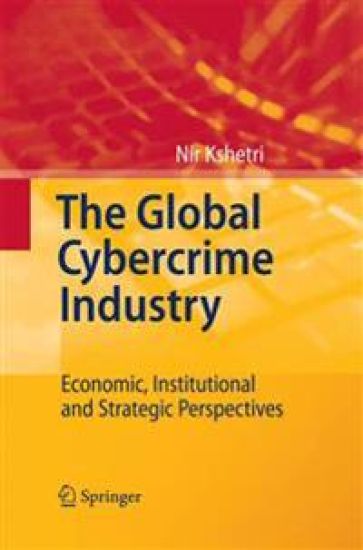
The Global Cybercrime Industry

The Global Cybercrime Industry

Nir Kshetri

Springer-Verlag Berlin and Heidelberg GmbH Co. K
2014
nidottu
The Internet’s rapid diffusion and digitization of economic activities have led to the emergence of a new breed of criminals. Economic, political, and social impacts impacts of these cyber-criminals’ activities have received considerable attention in recent years. Individuals, businesses, and governments rightfully worry about the security of their systems, networks, and IT infrastructures. Looking at the patterns of cybercrimes, it is apparent that many underlying assumptions about crimes are ?awed, unrealistic, and implausible to explain this new form of criminality. The empirical records regarding crime patterns and stra- gies to avoid and ?ght crimes run counter to the functioning of the cyberworld. The ?elds of hacking and cybercrime have also undergone political, social, and psychological metamorphosis. The cybercrime industry is a comparatively young area of inquiry. While there has been an agreement that the global cybercrime industry is tremendously huge, little is known about its exact size and structure. Very few published studies have examined economic and institutional factors that in?uence strategies and behaviors of various actors associated with the cybercrime industry. Theorists are also debating as to the best way to comprehend the actions of cyber criminals and hackers and the symbiotic relationships they have with various players.
The Global Cybercrime Industry

The Global Cybercrime Industry

Nir Kshetri

Springer-Verlag Berlin and Heidelberg GmbH Co. K
2010
sidottu
The Internet’s rapid diffusion and digitization of economic activities have led to the emergence of a new breed of criminals. Economic, political, and social impacts impacts of these cyber-criminals’ activities have received considerable attention in recent years. Individuals, businesses, and governments rightfully worry about the security of their systems, networks, and IT infrastructures. Looking at the patterns of cybercrimes, it is apparent that many underlying assumptions about crimes are ?awed, unrealistic, and implausible to explain this new form of criminality. The empirical records regarding crime patterns and stra- gies to avoid and ?ght crimes run counter to the functioning of the cyberworld. The ?elds of hacking and cybercrime have also undergone political, social, and psychological metamorphosis. The cybercrime industry is a comparatively young area of inquiry. While there has been an agreement that the global cybercrime industry is tremendously huge, little is known about its exact size and structure. Very few published studies have examined economic and institutional factors that in?uence strategies and behaviors of various actors associated with the cybercrime industry. Theorists are also debating as to the best way to comprehend the actions of cyber criminals and hackers and the symbiotic relationships they have with various players.