Kirjailija
Noam Chomsky
Kirjat ja teokset yhdessä paikassa: 246 kirjaa, julkaisuja vuosilta 1968–2026, suosituimpiin kuuluu On Cuba. Vertaile teosten hintoja ja tarkista saatavuus suomalaisista kirjakaupoista.
246 kirjaa
Kirjojen julkaisuvuodet: 1968–2026.
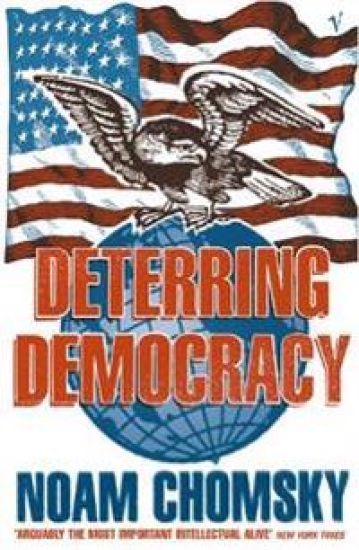
Chomsky takes on the international scene since 1945, devoting particular attention to events following the collapse of the Soviet Union. He develops a forceful critique of Western government, from imperialist foreign policies to the Clinton administration's empty promises to the poor.
Alex Carey documents the twentieth-century history of corporate propaganda as practiced by U. S. businesses, and its export to and adoption by Western democracies like the United Kingdom and Australia. The collection, drawn from Carey's voluminous unpublished writings, examines how and why the business elite successfully sold its values and perspectives to the rest of society.
No detailed description available for "Studies on Semantics in Generative Grammar".
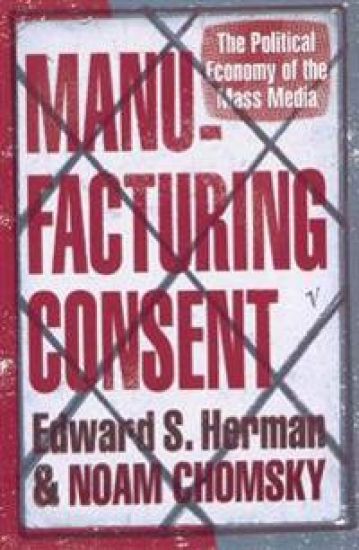
In his national bestselling 1988 CBC Massey Lectures, Noam Chomsky inquires into the nature of the media in a political system where the population cannot be disciplined by force and thus must be subjected to more subtle forms of ideological control. Specific cases are illustrated in detail, using the U. S. media primarily but also media in other societies. Chomsky considers how the media might be democratized (as part of the general problem of developing more democratic institutions) in order to offer citizens broader and more meaningful participation in social and political life.
Manufacturing Consent
Edward S Herman; Noam Chomsky
Vintage
1995
pokkari
Halvin toimitettuna 23,90 €
A detailed and compelling political study of how elite forces shape mass media. Edward S Herman and Noam Chomsky investigate how an underlying elite consensus structures mainstream media. Here they skilfully dissect the way in which the marketplace and the economics of publishing significantly shape the news. This book reveals how issues are framed and topics chosen, and the double standards underlying accounts of free elections, a free press, and governmental repression between Nicaragua and El Salvador; between the Russian invasion of Afghanistan and the American invasion of Vietnam; between the genocide in Cambodia under a pro-American government and genocide under Pol Pot. What emerges from this ground-breaking work is an account of just how propagandistic our mass media can be, and how we can learn to read them and see their function in a radically new way.
No detailed description available for "Lectures on Government and Binding".
From World War II until the 1980s, the United States reigned supreme as both the economic and the military leader of the world.
The Sound Pattern of English
Noam Chomsky; Morris Halle
MIT Press
1991
pokkari
Halvin toimitettuna 89,10 €
The theoretical issues raised in The Sound Pattern of English continue to be critical to current phonology, and in many instances the solutions proposed by Chomsky and Halle have yet to be improved upon. Since this classic work in phonology was published in 1968, there has been no other book that gives as broad a view of the subject, combining generally applicable theoretical contributions with analysis of the details of a single language. The theoretical issues raised in The Sound Pattern of English continue to be critical to current phonology, and in many instances the solutions proposed by Chomsky and Halle have yet to be improved upon.
'A towering intellect ... powerful, always provocative.' Guardian'A superb polemicist who combines fluency of language with a formidable intellect.' Observer'Must be read by everyone concerned with public affairs.' Edward SaidNecessary Illusions explodes the myth of an independent media, intent on uncovering the truth at any cost. Noam Chomsky demonstrates that, in practice, the media in the developed world serve the interests of state and corporate power - despite protestations to the contrary. While individual journalists strive to abide by high standards of professionalism and integrity in their work, their paymasters - the media corporations - ultimately decide what we view, hear and read. Rigorously documented, Necessary Illusions continues Chomsky's celebrated tradition of profoundly insightful indictments of US foreign and domestic institutions and tears away the veneer of propaganda that portrays the media as the servant of free speech and democracy.
No detailed description available for "Current Issues in Linguistic Theory".
The Chomsky Reader brings together for the first time the political thought of American's leading dissident intellectual--"arguably the most important intellectual alive" (The New York Times). At the center of practically every major debate over America's role in the world, one finds Noam Chomsky's ideas--sometimes attacked, sometimes studiously ignored, but always a powerful presence. Drawing from his published and unpublished work, The Chomsky Reader reveals the awesome range of this ever-critical mind--from global questions of war and peace to the most intricate questions of human intelligence, IQ, and creativity. It reveals the underlying radical coherency of his view of the world--from his enormously influential attacks on America's role in Vietnam to his perspective on Nicaragua and Central America today. Chomsky's challenge to accepted wisdom about Israel and the Palestinians has caused a furor in America, as have his trenchant essays on the real nature of terrorism in our age. No one has dissected more graphically the character of the Cold War consensus and the way it benefits the two superpowers, or argued more thoughtfully for a shared elitist ethos in liberalism and communism. No one has exposed more logically America's acclaimed freedoms as masking irresponsible power and unjustified privilege, or argued quite so insistently that the "free press" is part of a stultifying conformity that pervades all aspects of American intellectual life. In a lengthy interview with the editor, Chomsky discussed his thought in the context of his personal history.
Language and Problems of Knowledge is Noam Chomsky's most accessible statement on the nature, origins, and current concerns of the field of linguistics. He frames the lectures with four fundamental questions: What do we know when we are able to speak and understand a language? How is this knowledge acquired? How do we use this knowledge? What are the physical mechanisms involved in the representation, acquisition, and use of this knowledge? Starting from basic concepts, Chomsky sketches the present state of our answers to these questions and offers prospects for future research. Much of the discussion revolves around our understanding of basic human nature (that we are unique in being able to produce a rich, highly articulated, and complex language on the basis of quite rudimentary data), and it is here that Chomsky's ideas on language relate to his ideas on politics. The initial versions of these lectures were given at the Universidad Centroamericana in Managua, Nicaragua, in March 1986. A parallel set of lectures on contemporary political issues given at the same time has been published by South End Press under the title On Power and Ideology: The Managua Lectures. Language and Problems of Knowledge is sixteenth in the series Current Studies in Linguistics, edited by Jay Keyser.
This monograph explores several complex questions concerning the theories of government and bounding, including, in particular, the possibility of a unified approach to these topics. Starting with the intuitive idea that certain categories in certain configurations are barriers to government and movement, it considers whether the same categories are barriers in the two instances or whether one barrier suffices to block government (a stricter and "more local" relation) while more than one barrier inhibits movement, perhaps in a graded manner. Any proposal concerning the formulation of the concept of government has intricate consequences, and many of the empirical phenomena that appear to be relevant are still poorly understood. Similarly, judgments about the theory of movement also involve a number of different factors, including sensitivity to lexical choice. Therefore, Chomsky proceeds on the basis of speculations as to the proper idealization of complex phenomena - how they should be sorted into a variety of interacting systems (some of which remain quite obscure), which may tentatively be put aside to be explained by independent (sometimes unknown) factors, and which may be considered relevant to the subsystems under investigation. Barriers considers several possible paths through the maze of possibilities that arise. It sets the subtheory context (x-bar theory, theory of movement, and government) for determining what constitutes a barrier and explores two concepts of barrier - maximal projection and the minimality condition - and their manifestations in and implications for proper government, subjacency, island violations, vacuous movement, parasitic gaps, and A-chains. Barriers is Linguistic Inquiry Monograph 13.
Attempts to indentify the fundamental concepts of language, argues that the study of language reveals hidden facts about the mind, and looks at the impact of propaganda
Attempts to indentify the fundamental concepts of language, argues that the study of language reveals hidden facts about the mind, and looks at the impact of propaganda.
Some Concepts and Consequences of the Theory of Government and Binding
Noam Chomsky
MIT Press
1982
pokkari
Noam Chomsky, more than any other researcher, has radically restructured the study of human language over the past several decades. While the study of government and binding is an outgrowth of Chomsky's earlier work in transformational grammar, it represents a significant shift in focus and a new direction of investigation into the fundamentals of linguistic theory. This monograph consolidates and extends this new approach. It serves as a concise introduction to government-binding theory, applies it to several new domains of empirical data, and proposes some revisions to the principles of the theory that lead to greater unification, descriptive scope, and explanatory depth. Earlier work in the theory of grammar was concerned primarily with rule systems. The accent in government-binding theory, however, is on systems of principles of universal grammar. In the course of this book, Chomsky proposes and evaluates various general principles that limit and constrain the types of rules that are possible, and the ways they interact and function. In particular, he proposes that rule systems are in fact highly restricted in variety: only a finite number of grammars are attainable in principle, and these fall into a limited set of types. Another consequence of this shift in focus is the change of emphasis from derivations to representations. The major topic in the study of syntactic representations is the analysis of empty categories, which is a central theme of the book. After his introductory comments and a chapter on the variety of rule system, Chomsky takes up, in turn, the general properties of empty categories, the functional determination of empty categories, parasitic gaps, and binding theory and the typology of empty categories. The book is the sixth in the series Linguistic Inquiry Monographs, edited by Samuel Jay Keyser.

Examines United States foreign policy from the Vietnam era to the Reagan years, including discussions on policy decisions in Indochina, the Middle East, Central America, East Timor, and with the Soviet Union.
No detailed description available for "Topics in the Theory of Generative Grammar".
No detailed description available for "Syntactic Structures".