Kirjojen hintavertailu – 12 859 827 kirjaa ja 27 kauppaa

Kirjailija

Noam Chomsky

Kirjat ja teokset yhdessä paikassa: 246 kirjaa, julkaisuja vuosilta 1968–2026, suosituimpiin kuuluu On Cuba. Vertaile teosten hintoja ja tarkista saatavuus suomalaisista kirjakaupoista.

246 kirjaa

Kirjojen julkaisuvuodet: 1968–2026.

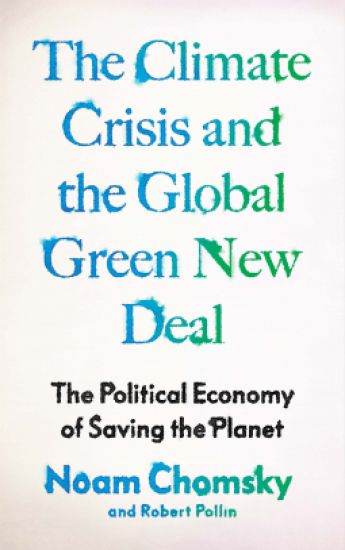
Climate Crisis and the Global Green New Deal

Climate Crisis and the Global Green New Deal

Noam Chomsky; Robert Pollin

Verso Books
2020
nidottu

Halvin toimitettuna 21,20 €

The environmental crisis under way is unique in human history. It is a true existential crisis. Those alive today will decide the fate of humanity. Meanwhile, the leaders of the most powerful state in human history are dedicating themselves with passion to destroying the prospects for organized human life. At the same time, there is a solution at hand, which is the Green New Deal. Putting meat on the bones of the Green New Deal starts with a single simple idea: we have to absolutely stop burning fossil fuels to produce energy within the next 30 years at most; and we have to do this in a way that also supports rising living standards and expanding opportunities for working people and the poor throughout the world. This version of a Green New Deal program is, in fact, entirely realistic in terms of its purely economic and technical features. The real question is whether it is politically feasible. Chomsky and Pollin examine how we can build the political force to make a global Green New Deal a reality.
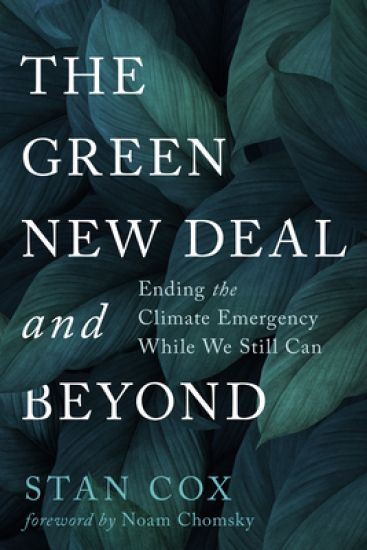
The Green New Deal and Beyond

The Green New Deal and Beyond

Stan Cox; Noam Chomsky

City Lights Books
2020
pokkari
A clear and urgent call for the national, social, and individual changes required to prevent catastrophic climate change.“An iconoclast of the best kind, Stan Cox has an all-too-rare commitment to following arguments wherever they lead, however politically dangerous that turns out to be.”—Naomi Klein, author of On Fire: The (Burning) Case for the New Green Deal"Moving to zero net carbon emissions, and fast, is the point of Stan Cox’s important new study, The Green New Deal and Beyond. Cox advocates on behalf of the GND as one step of several we need to take to stabilize the planet."—Noam Chomsky, from the book's forewordThe prospect of a Green New Deal is providing millions of people with a sense of hope, but scientists warn there is little time left to take the actions needed. We are at a critical point, and while the Green New Deal will be a step in the right direction, we need to do more—right now—to avoid catastrophe. In The Green New Deal and Beyond, author and plant scientist Stan Cox explains why we must abolish the use of fossil fuels as soon as possible, and how it can be done. He addresses a host of glaring issues not mentioned in the GND and guides us through visionary, achievable ideas for working toward a solution to the deepening crisis. It’s up to each of us, Cox writes, to play key roles in catalyzing the necessary transformation." A strictly science-based plan for effectively addressing the dire realities of climate change. . . . Convincing, painful, and a long shot—but better than the alternative."—Kirkus Reviews "His is a warning well worth heeding."—Raj Patel, co-author of A History of the World in Seven Cheap Things: A Guide to Capitalism, Nature, and the Future of the Planet"In The Green New Deal and Beyond, Stan Cox presents a smart, sane, and plausibly optimistic alternative to abandoning all hope."—David Owen, author of Volume Control: Hearing in a Deafening World "The teachings of Indigenous Peoples are still here, and it's up to the present generation to muster the courage and resources to follow those instructions. Stan Cox reminds us of this historic dialogue and development of the Green New Deal, and helps us find the path back to those instructions."—Winona LaDuke (Anishinaabe), author of All Our Relations: Native Struggles for Land and Life and LaDuke Chronicles"Stan Cox suggests remedies that should ignite lively discussion and intense debate, which is sorely needed. A must-read for those who care about our shared planetary future."—Mary Evelyn Tucker, Yale School of Forestry and Environmental Studies, co-author, Journey of the Universe"An invaluable contribution to what must become an unprecedented international revolution."—Will Potter, author of Green Is the New Red: An Insider’s Account of a Social Movement Under Siege"Cox argues that this is not idealism, but necessity. By 2030 or 2040, if our aims and policies turn out to have been insufficient, as he points out, it will have been too late."—Natalie Suzelis, Uneven Earth"In this important and readable book, Stan Cox moves the Overton window away from false hope and toward a more realistic path for avoiding climate catastrophe."—Dr. Peter Kalmus, NASA climate scientist and author of Being the Change

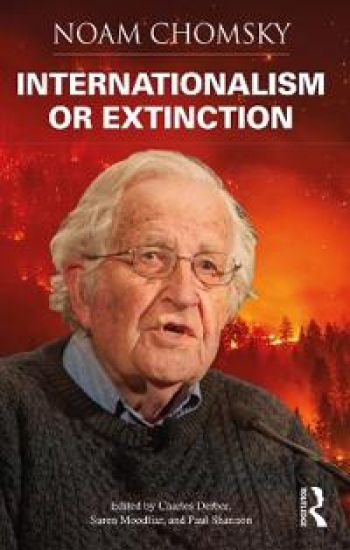
Internationalism or Extinction

Internationalism or Extinction

Noam Chomsky

Routledge
2019
nidottu
In his new book, Noam Chomsky writes cogently about the threats to planetary survival that are of growing alarm today. The prospect of human extinction emerged after World War II, the dawn of a new era scientists now term the Anthropocene. Chomsky uniquely traces the duality of existential threats from nuclear weapons and from climate change—including how the concerns emerged and evolved, and how the threats can interact with one another. The introduction and accompanying interviews place these dual threats in a framework of unprecedented corporate global power which has overtaken nation states’ ability to control the future and preserve the planet. Chomsky argues for the urgency of international climate and arms agreements, showing how global popular movements are mobilizing to force governments to meet this unprecedented challenge to civilization’s survival.
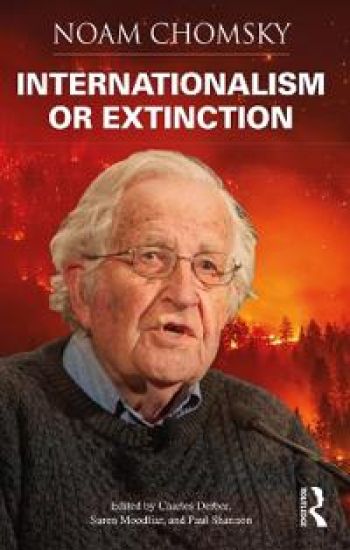
Internationalism or Extinction

Internationalism or Extinction

Noam Chomsky

Routledge
2019
sidottu
In his new book, Noam Chomsky writes cogently about the threats to planetary survival that are of growing alarm today. The prospect of human extinction emerged after World War II, the dawn of a new era scientists now term the Anthropocene. Chomsky uniquely traces the duality of existential threats from nuclear weapons and from climate change—including how the concerns emerged and evolved, and how the threats can interact with one another. The introduction and accompanying interviews place these dual threats in a framework of unprecedented corporate global power which has overtaken nation states’ ability to control the future and preserve the planet. Chomsky argues for the urgency of international climate and arms agreements, showing how global popular movements are mobilizing to force governments to meet this unprecedented challenge to civilization’s survival.
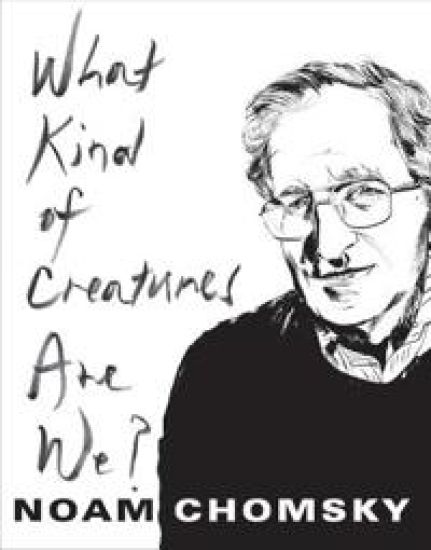
What Kind of Creatures Are We?

What Kind of Creatures Are We?

Noam Chomsky

Columbia University Press
2018
pokkari

Halvin toimitettuna 19,80 €

Noam Chomsky is widely known and deeply admired for being the founder of modern linguistics, one of the founders of the field of cognitive science, and perhaps the most avidly read political theorist and commentator of our time. In these lectures, he presents a lifetime of philosophical reflection on all three of these areas of research, to which he has contributed for over half a century. In clear, precise, and nontechnical language, Chomsky elaborates on fifty years of scientific development in the study of language, sketching how his own work has implications for the origins of language, the close relations that language bears to thought, and its eventual biological basis. He expounds and criticizes many alternative theories, such as those that emphasize the social, the communicative, and the referential aspects of language. Chomsky reviews how new discoveries about language overcome what seemed to be highly problematic assumptions in the past. He also investigates the apparent scope and limits of human cognitive capacities and what the human mind can seriously investigate, in the light of history of science and philosophical reflection and current understanding. Moving from language and mind to society and politics, he concludes with a searching exploration and philosophical defense of a position he describes as "libertarian socialism," tracing its links to anarchism and the ideas of John Dewey and even to the ideas of Marx and Mill, demonstrating its conceptual growth out of our historical past and urgent relation to matters of the present.
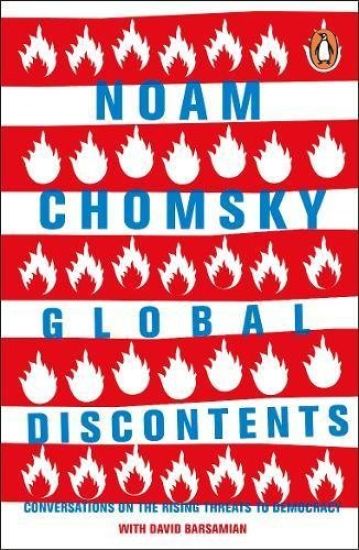
Global Discontents

Global Discontents

Noam Chomsky; David Barsamian

Penguin Books Ltd
2018
pokkari
'If I were a voter in Britain, I would vote for [Jeremy Corbyn]' - Noam Chomsky, 2017Global Discontents is an essential guide to geopolitics and how to fight back, from the world's leading public intellectualWhat kind of world are we leaving to our grandchildren? How are the discontents kindled today likely to blaze and explode tomorrow? From escalating climate change to the devastation in Syria, pandemic state surveillance to looming nuclear war, Noam Chomsky takes stock of the world today. Over the course of ten conversations with long-time collaborator David Barsamian, spanning 2013-2016, Chomsky argues in favour of radical changes to a system that cannot possibly cope with what awaits tomorrow. Interwoven with personal reflections spanning from childhood to his eighth decade of life, Global Discontents also marks out Chomsky's own intellectual journey, mapping his progress to revolutionary ideas and global prominence.
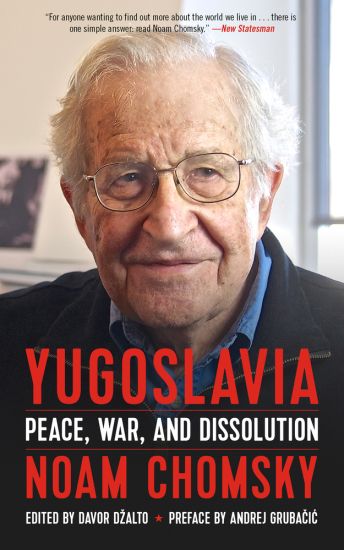
Yugoslavia

Yugoslavia

Noam Chomsky; Andrej Grubacic

PM Press
2018
nidottu

Halvin toimitettuna 27,50 €

The Balkans, in particular the turbulent ex-Yugoslav territory, have been among the most important world regions in Noam Chomsky's political reflections and activism over the past couple of decades. Through his articles, public talks, and correspondence, he has been addressing some of the crucial political and social issues (such as the relevancy of international law in today's politics, media manipulations, and economic crisis as a means of political control) that affect both the region and the international community. This volume provides a comprehensive survey of virtually all of Chomsky's texts and public talks that focus on the region of the former Yugoslavia, from the 1970s to the present. With numerous articles and interviews, this collection presents a wealth of materials appearing in book form for the first time along with reflections on events 25 years after the official end of communist Yugoslavia and the beginning of the war in Bosnia.
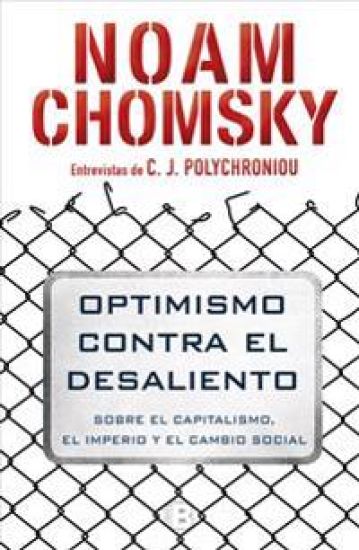
Optimismo Contra El Desaliento/ Optimism Over Despair: On Capitalism, Empire, and Social Change
Un repaso esencial de los problemas actuales del mundo y de c mo deber amos prepararnos para el ma ana, obra del l der de la opini n p blica internacional. Tenemos dos opciones. Podemos ser pesimistas, abandonar y contribuir a que ocurra lo peor sin vuelta atr s. O ser optimistas, atrapar las oportunidades que sin duda existen y contribuir, tal vez, a que el mundo sea un lugar mejor. No es una elecci n demasiado dif cil. Noam Chomsky, el incomparable pensador pol tico, nos ofrece una exploraci n del neoliberalismo creciente, de la crisis de los refugiados en Europa, del movimiento Black Lives Matter, de las disfunciones del sistema electoral estadounidense y de las perspectivas y los desaf os de organizar un movimiento para el cambio radical. Con cuatro entrevistas actualizadas sobre la campa a de las elecciones de 2016 en Estados Unidos y la resistencia global contra Trump, Optimismo contra el desaliento aporta una presentaci n concisa de las ideas de Chomsky y de su mirada sobre el estado actual del mundo. ENGLISH DESCRIPTION This volume offers readers a concise and accessible introduction to the ideas of Noam Chomsky, described by the New York Times as "arguably the most important intellectual alive." In these recent, wide-ranging interviews, conducted for Truthout by C. J. Polychroniou, Chomsky discusses his views on the "war on terror" and the rise of neoliberalism, the refugee crisis and cracks in the European Union, prospects for a just peace in Israel/Palestine, the rise of the Black Lives Matter movement, the dysfunctional US electoral system, the grave danger posed to humanity by the climate crisis, and the hopes, prospects, and challenges of building a movement for radical change. Noam Chomsky is Institute Professor (Emeritus) in the Department of Linguistics and Philosophy at MIT. His work is widely credited with having revolutionized the field of modern linguistics. He is the author of numerous best-selling political works, which have been translated into scores of languages worldwide. C. J. Polychroniou is a regular contributor to Truthout as well as a member of Truthout's Public Intellectual Project. He has published several books and his articles have appeared in a variety of journals, magazines, newspapers, and popular news websites."
Global Discontents

Global Discontents

Noam Chomsky; David Barsamian

Metropolitan Books (imprint of Henry Holt Company)
2017
nidottu
In wide-ranging interviews with David Barsamian, his longtime interlocutor, Noam Chomsky asks us to consider "the world we are leaving to our grandchildren": one imperiled by the escalation of climate change and the growing potential for nuclear war. If the current system is incapable of dealing with these threats, he argues, it's up to us to radically change it. These ten interviews, conducted from 2013 to 2016, examine the latest developments around the globe: the devastation of Syria, the reach of state surveillance, growing anger over economic inequality, the place of religion in American political culture, and the bitterly contested 2016 U. S. presidential election. In accompanying personal reflections on his Philadelphia childhood and his eighty- seventh birthday, Chomsky also describes his own intellectual journey and the development of his uncompromising stance as America's premier dissident intellectual.
Language in Our Brain

Language in Our Brain

Angela D. Friederici; Noam Chomsky

MIT Press
2017
sidottu
A comprehensive account of the neurobiological basis of language, arguing that species-specific brain differences may be at the root of the human capacity for language. Language makes us human. It is an intrinsic part of us, although we seldom think about it. Language is also an extremely complex entity with subcomponents responsible for its phonological, syntactic, and semantic aspects. In this landmark work, Angela Friederici offers a comprehensive account of these subcomponents and how they are integrated. Tracing the neurobiological basis of language across brain regions in humans and other primate species, she argues that species-specific brain differences may be at the root of the human capacity for language. Friederici shows which brain regions support the different language processes and, more important, how these brain regions are connected structurally and functionally to make language processes that take place in milliseconds possible. She finds that one particular brain structure (a white matter dorsal tract), connecting syntax-relevant brain regions, is present only in the mature human brain and only weakly present in other primate brains. Is this the "missing link" that explains humans' capacity for language? Friederici describes the basic language functions and their brain basis; the language networks connecting different language-related brain regions; the brain basis of language acquisition during early childhood and when learning a second language, proposing a neurocognitive model of the ontogeny of language; and the evolution of language and underlying neural constraints. She finds that it is the information exchange between the relevant brain regions, supported by the white matter tract, that is the crucial factor in both language development and evolution.
Voices for Peace

Voices for Peace

Noam Chomsky; John Pilger; Ilan Pappe; Cynthia McKinney; Bruce Gagnon; Kathy Kelly; Robin Ramsay; Brian Terrell

Clairview Books
2017
nidottu
The United States’ military doctrine, as proclaimed by its Department of Defense, is to attain `full-spectrum dominance… in the air, land, maritime and space domains and information environment… without effective opposition or prohibitive interference.’ This is an agenda for global conquest – for an ever-expanding US empire. As America prepares for conflict with Russia and China, wars continue in the Middle East and North Africa, tens of millions are exiled from their homes whilst many more face famine. But there is not only hope for change in the air, there is active resistance. People all over the world are challenging the status quo by taking nonviolent action. Voices for Peace features some of the world’s leading thinkers, journalists and activists, offering insight, inspiration and solutions to the world’s most critical problems: nuclear war, environmental destruction and refugee flows. In the wealth of material presented here, Kathy Kelly talks about the Afghan Peace Volunteers and Standing Rock protesters in the USA, calling for global unity. Bruce K. Gagnon’s piece on space weapons discusses South Korean activists’ opposition to American weapons in their country. Brian Terrell challenges the legality of drone warfare and outlines the grassroots links being forged between US and Russian citizens. Noam Chomsky discusses US policies towards Russia and Syria, as well as South America, trade, ISIS and Ukraine. John Pilger talks about the Trump-Obama naval build-up around China and exposes Britain’s `deep state’ connections to the Manchester terror attack. Former US Congresswoman Cynthia McKinney analyses the Charlie Hebdo attacks and the deep state in recent US history. Ilan Pappé offers an exclusive analysis of Israel’s actions to ethnically cleanse Israel of Palestinians. Finally, Robin Ramsay exposes the unconditional support given to the USA by successive UK governments. Seeking to inform and educate, this penetrating anthology is edited and introduced by author T. J. Coles, who gives a broader framework and context to the individual articles.
Optimism over Despair

Optimism over Despair

Noam Chomsky; C.J. Polychroniou

Haymarket Books
2017
pokkari
This volume offers readers a concise and accessible introduction to the ideas of Noam Chomsky, described by the New York Times as "arguably the most important intellectual alive." In these recent, wide-ranging interviews, conducted for Truthout by C. J. Polychroniou, Chomsky discusses his views on the "war on terror" and the rise of neoliberalism, the refugee crisis and cracks in the European Union, prospects for a just peace in Israel/Palestine, the rise of the Black Lives Matter movement, the dysfunctional US electoral system, the grave danger posed to humanity by the climate crisis, and the hopes, prospects, and challenges of building a movement for radical change. Noam Chomsky is Institute Professor (Emeritus) in the Department of Linguistics and Philosophy at MIT. His work is widely credited with having revolutionized the field of modern linguistics. He is the author of numerous best-selling political works, which have been translated into scores of languages worldwide. C. J. Polychroniou is a regular contributor to Truthout as well as a member of Truthout's Public Intellectual Project. He has published several books and his articles have appeared in a variety of journals, magazines, newspapers, and popular news websites.
Optimism Over Despair

Optimism Over Despair

Noam Chomsky; C J Polychroniou

Penguin Books Ltd.
2017
pokkari

Halvin toimitettuna 15,90 €

We have two choices. We can be pessimistic, give up, and help ensure that the worst will happen. Or we can be optimistic, grasp the opportunities that surely exist, and maybe help make the world a better place. Not much of a choice. From peerless political thinker Noam Chomsky comes an exploration of rising neoliberalism, the refugee crisis in Europe, the Black Lives Matter movement, the dysfunctional US electoral system, and the prospects and challenges of building a movement for radical change. Including four up-to-the-minute interviews on the 2016 American election campaign and global resistance to Trump, this Penguin Special is a concise introduction to Chomsky's ideas and his take on the state of the world today.
The Responsibility Of Intellectuals

The Responsibility Of Intellectuals

Noam Chomsky

The New Press
2017
sidottu
Originally published in the New York Review of Books, Chomsky s essay eviscerated the 'hypocritical moralism of the past' and exposed the shameful policies in Vietnam and the role of intellectuals in justifying it. Also included in this volume is the brilliant 'The Responsibility of Intellectuals Redux,' written on the tenth anniversary of 9/11, which makes the case for using privilege to challenge the state. As relevant now as it was in 1967, Chomsky reminds us that 'privilege yields opportunity and opportunity confers responsibilities.' All of us have choices, even in desperate times.
Why Only Us

Why Only Us

Robert C. Berwick; Noam Chomsky

MIT Press
2017
pokkari
Berwick and Chomsky draw on recent developments in linguistic theory to offer an evolutionary account of language and humans' remarkable, species-specific ability to acquire it." A loosely connected collection of four essays that will fascinate anyone interested in the extraordinary phenomenon of language."— New York Review of BooksWe are born crying, but those cries signal the first stirring of language. Within a year or so, infants master the sound system of their language; a few years after that, they are engaging in conversations. This remarkable, species-specific ability to acquire any human language—"the language faculty"—raises important biological questions about language, including how it has evolved. This book by two distinguished scholars—a computer scientist and a linguist—addresses the enduring question of the evolution of language. Robert Berwick and Noam Chomsky explain that until recently the evolutionary question could not be properly posed, because we did not have a clear idea of how to define "language" and therefore what it was that had evolved. But since the Minimalist Program, developed by Chomsky and others, we know the key ingredients of language and can put together an account of the evolution of human language and what distinguishes us from all other animals. Berwick and Chomsky discuss the biolinguistic perspective on language, which views language as a particular object of the biological world; the computational efficiency of language as a system of thought and understanding; the tension between Darwin's idea of gradual change and our contemporary understanding about evolutionary change and language; and evidence from nonhuman animals, in particular vocal learning in songbirds.
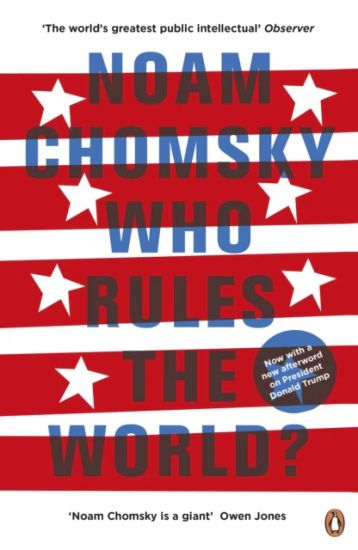
Who Rules the World?

Who Rules the World?

Noam Chomsky

Penguin Books Ltd.
2017
pokkari

Halvin toimitettuna 17,90 €

A new book on the state of the world today -- from one of the most respected and revered political commentators alive Noam Chomsky: philosopher, political writer, fearless activist. No one has done more to question the hidden actors who govern our lives, calling the powers that be to account. Here he presents Who Rules the World?, his definitive account of those powers, how they work, and why we should be questioning them. From the dark history of the US and Cuba to China's global rise, from torture memos to sanctions on Iran, this book investigates the defining issues of our times and exposes the hypocrisy at the heart of America's policies and actions. The world's political and financial elite are now operating almost totally unconstrained by the so-called democratic structure. With climate change and nuclear proliferation threatening our very survival, dissenting voices have never been more necessary. Fiercely outspoken and rigorously argued, Who Rules the World? is an indispensable guide to how things really are.