Kirjojen hintavertailu – 12 903 725 kirjaa ja 27 kauppaa
Kirjailija
Noël Challamel
Kirjat ja teokset yhdessä paikassa: 5 kirjaa, julkaisuja vuosilta 2012–2020, suosituimpiin kuuluu Hencky Bar-chain/net For Structural Analysis. Vertaile teosten hintoja ja tarkista saatavuus suomalaisista kirjakaupoista.
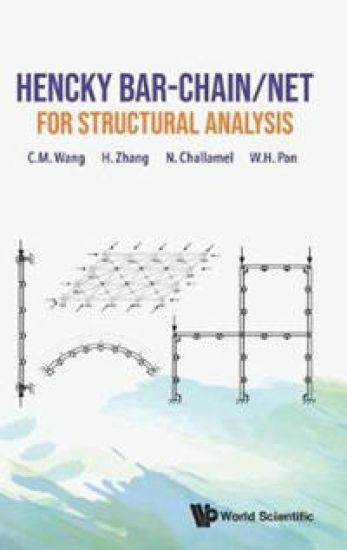
As an emerging discrete structural model, the Hencky bar-chain/net model (HBM) has shown its advantages over other numerical methods in some problems. Owing to the discrete properties of HBM, it is also a suitable model for nano-scale structures which are currently a very hot research topic in mechanics. This book introduces the concepts and previous research of the Hencky bar-chain/net model, before demonstrating how beams, columns, arches, rectangular plates and circular plates could be successfully modelled by HBM. HBM comprises rigid bars connected by frictionless hinges with elastic rotational springs (and a system of torsional springs in the cells for plates). In the treatment of the above-mentioned structures, HBM is found to be mathematically equivalent to the first order central finite difference method (FDM). So HBM may be regarded as the physical structural model behind the FDM. This book is a compilation of the authors' research on the development of the Hencky bar-chain/net model, and is organized according to the development and application of HBM for beams, columns, frames, arches and rings, and plates. Exercises are provided at the end of each chapter to aid comprehension and guide learning. It is a useful reference for students, researchers, academics and practitioners in the field of structural analysis.

Stability of Discrete Non-conservative Systems first exposes the general concepts and results concerning stability issues. It then presents an approach of stability that is different from Lyapunov which leads to the second order work criterion. Thanks to the new concept of Kinematic Structural Stability, a complete equivalence between two approaches of stability is obtained for a divergent type of stability. Extensions to flutter instability, to continuous systems, and to the dual questions concerning the measure of non-conservativeness provides a full, fresh look at these fundamental questions. A special chapter is devoted to applications for granular systems.
This book is focused on the theoretical and practical design of reinforced concrete beams, columns and frame structures. It is based on an analytical approach of designing normal reinforced concrete structural elements that are compatible with most international design rules, including for instance the European design rules – Eurocode 2 – for reinforced concrete structures. The book tries to distinguish between what belongs to the structural design philosophy of such structural elements (related to strength of materials arguments) and what belongs to the design rule aspects associated with specific characteristic data (for the material or loading parameters). Reinforced Concrete Beams, Columns and Frames – Mechanics and Design deals with the fundamental aspects of the mechanics and design of reinforced concrete in general, both related to the Serviceability Limit State (SLS) and the Ultimate Limit State (ULS). A second book, entitled Reinforced Concrete Beams, Columns and Frames – Section and Slender Member Analysis, deals with more advanced ULS aspects, along with instability and second-order analysis aspects. Some recent research results including the use of non-local mechanics are also presented. This book is aimed at Masters-level students, engineers, researchers and teachers in the field of reinforced concrete design. Most of the books in this area are very practical or code-oriented, whereas this book is more theoretically based, using rigorous mathematics and mechanics tools. Contents 1. Design at Serviceability Limit State (SLS). 2. Verification at Serviceability Limit State (SLS). 3. Concepts for the Design at Ultimate Limit State (ULS). 4. Bending-Curvature at Ultimate Limit State (ULS). Appendix 1. Cardano’s Method. Appendix 2. Steel Reinforcement Table. About the Authors Charles Casandjian was formerly Associate Professor at INSA (French National Institute of Applied Sciences), Rennes, France and the chairman of the course on reinforced concrete design. He has published work on the mechanics of concrete and is also involved in creating a web experience for teaching reinforced concrete design – BA-CORTEX. Noël Challamel is Professor in Civil Engineering at UBS, University of South Brittany in France and chairman of the EMI-ASCE Stability committee. His contributions mainly concern the dynamics, stability and inelastic behavior of structural components, with special emphasis on Continuum Damage Mechanics (more than 70 publications in International peer-reviewed journals). Christophe Lanos is Professor in Civil Engineering at the University of Rennes 1 in France. He has mainly published work on the mechanics of concrete, as well as other related subjects. He is also involved in creating a web experience for teaching reinforced concrete design – BA-CORTEX. Jostein Hellesland has been Professor of Structural Mechanics at the University of Oslo, Norway since January 1988. His contribution to the field of stability has been recognized and magnified by many high-quality papers in famous international journals such as Engineering Structures, Thin-Walled Structures, Journal of Constructional Steel Research and Journal of Structural Engineering.
This book is focused on the theoretical and practical design of reinforced concrete beams, columns and frame structures. It is based on an analytical approach of designing normal reinforced concrete structural elements that are compatible with most international design rules, including for instance the European design rules – Eurocode 2 – for reinforced concrete structures. The book tries to distinguish between what belongs to the structural design philosophy of such structural elements (related to strength of materials arguments) and what belongs to the design rule aspects associated with specific characteristic data (for the material or loading parameters). A previous book, entitled Reinforced Concrete Beams, Columns and Frames – Mechanics and Design, deals with the fundamental aspects of the mechanics and design of reinforced concrete in general, both related to the Serviceability Limit State (SLS) and the Ultimate Limit State (ULS), whereas the current book deals with more advanced ULS aspects, along with instability and second-order analysis aspects. Some recent research results including the use of non-local mechanics are also presented. This book is aimed at Masters-level students, engineers, researchers and teachers in the field of reinforced concrete design. Most of the books in this area are very practical or code-oriented, whereas this book is more theoretically based, using rigorous mathematics and mechanics tools. Contents 1. Advanced Design at Ultimate Limit State (ULS). 2. Slender Compression Members – Mechanics and Design. 3. Approximate Analysis Methods. Appendix 1. Cardano’s Method. Appendix 2. Steel Reinforcement Table. About the Authors Jostein Hellesland has been Professor of Structural Mechanics at the University of Oslo, Norway since January 1988. His contribution to the field of stability has been recognized and magnified by many high-quality papers in famous international journals such as Engineering Structures, Thin-Walled Structures, Journal of Constructional Steel Research and Journal of Structural Engineering. Noël Challamel is Professor in Civil Engineering at UBS, University of South Brittany in France and chairman of the EMI-ASCE Stability committee. His contributions mainly concern the dynamics, stability and inelastic behavior of structural components, with special emphasis on Continuum Damage Mechanics (more than 70 publications in International peer-reviewed journals). Charles Casandjian was formerly Associate Professor at INSA (French National Institute of Applied Sciences), Rennes, France and the chairman of the course on reinforced concrete design. He has published work on the mechanics of concrete and is also involved in creating a web experience for teaching reinforced concrete design – BA-CORTEX. Christophe Lanos is Professor in Civil Engineering at the University of Rennes 1 in France. He has mainly published work on the mechanics of concrete, as well as other related subjects. He is also involved in creating a web experience for teaching reinforced concrete design – BA-CORTEX.
Isaac Elishakoff; Kevin Dujat; Giuseppe Muscolino; Simon Bucas; Toshiaki Natsuki; Chien Ming Wang; Demetris Pentaras; Claudia Versaci; Joel Storch; Noël Challamel; Yingyan Zhang; Guillaume Ghyselinck
The main properties that make carbon nanotubes (CNTs) a promising technology for many future applications are: extremely high strength, low mass density, linear elastic behavior, almost perfect geometrical structure, and nanometer scale structure. Also, CNTs can conduct electricity better than copper and transmit heat better than diamonds. Therefore, they are bound to find a wide, and possibly revolutionary use in all fields of engineering. The interest in CNTs and their potential use in a wide range of commercial applications; such as nanoelectronics, quantum wire interconnects, field emission devices, composites, chemical sensors, biosensors, detectors, etc.; have rapidly increased in the last two decades. However, the performance of any CNT-based nanostructure is dependent on the mechanical properties of constituent CNTs. Therefore, it is crucial to know the mechanical behavior of individual CNTs such as their vibration frequencies, buckling loads, and deformations under different loadings. This title is dedicated to the vibration, buckling and impact behavior of CNTs, along with theory for carbon nanosensors, like the Bubnov-Galerkin and the Petrov-Galerkin methods, the Bresse-Timoshenko and the Donnell shell theory.