Kirjojen hintavertailu – 12 903 725 kirjaa ja 27 kauppaa

Kirjailija

Norman Friedman

Kirjat ja teokset yhdessä paikassa: 37 kirjaa, julkaisuja vuosilta 1980–2026, suosituimpiin kuuluu EIMI. Vertaile teosten hintoja ja tarkista saatavuus suomalaisista kirjakaupoista.

37 kirjaa

Kirjojen julkaisuvuodet: 1980–2026.

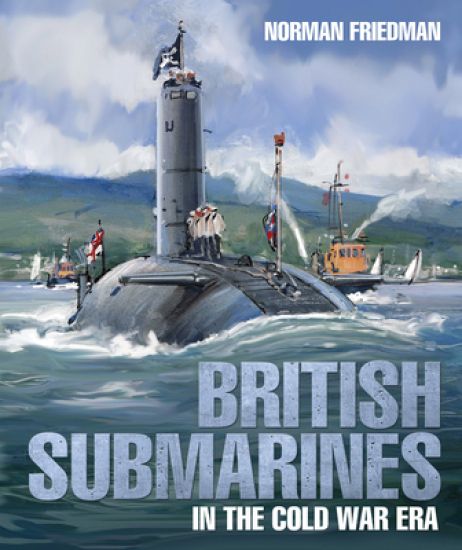
British Submarines

British Submarines

Norman Friedman

Seaforth Publishing
2021
sidottu
The Royal Navy's greatest contribution to the Allied success in World War II was undoubtedly the defeat of the U-boat menace in the North Atlantic, a victory on which all other European campaigns depended. The underwater threat was the most serious naval challenge of the war so it was not surprising that captured German submarine technology became the focus of attention for the British submarine service after 1945\. It was quick to test and adopt the schnorkel, streamlining, homing torpedoes and, less successfully, hydrogen-peroxide propulsion. Furthermore, in the course of the long Atlantic battle, the Royal Navy had become the world's most effective anti-submarine force and was able to utilise this expertise to improve the efficiency of its own submarines. However, in 1945 German submarine technology had also fallen into the hands of the Soviet Union and as the Cold War developed it became clear that a growing Russian submarine fleet would pose a new threat. Britain had to go to the US for its first nuclear propulsion technology, but the Royal Navy introduced the silencing technique which made British and US nuclear submarines viable anti-submarine assets, and it pioneered in the use of passive - silent - sonars in that role. Nuclear power also changed the role of some British submarines, which replaced bombers as the core element of British Cold War and post Cold War nuclear deterrence. As in other books in this series, this one shows how a combination of evolving strategic and tactical requirements and new technology produced successive types of submarines. It it is based largely on unpublished and previously classified official documentation, and to the extent allowed by security restrictions, also tells the operational story - HMS _Conqueror_ is still the only nuclear submarine to have sunk a warship in combat, but there are many less well known aspects of British submarine operations in the postwar era. Although some of the Cold War activities of British submarines have come to light in recent years, this book will be the first comprehensive technical history of the submarines themselves, their design rationale, and the service which operated them.
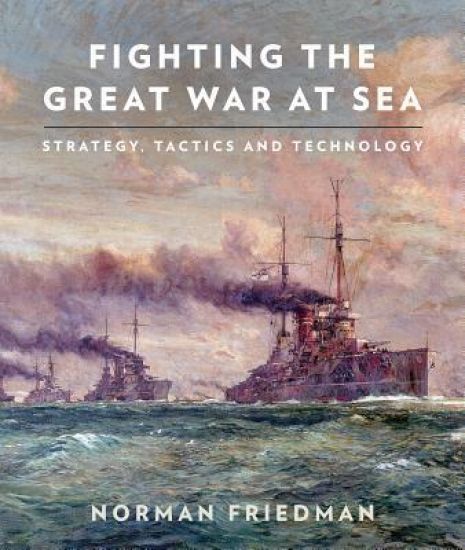
Fighting the Great War at Sea

Fighting the Great War at Sea

Norman Friedman

Seaforth Publishing
2019
nidottu
The overriding image of the First World War is the bloody stalemate of the Western Front, but although much of the action did occur on land, the overall shape of the war even the inevitability of British participation arose out of its maritime character. It was essentially a struggle about access to worldwide resources, most clearly seen in the desperate German attempts to deal with the American industrial threat, which ultimately levered the United States into the war, and thus a consequence of British sea control. This radical new book concentrates on the way in which each side tried to use or deny the sea to the other, and in so doing it describes rapid wartime changes not only in ship and weapon technology but also in the way naval warfare was envisaged and fought. Combat produced many surprises: some, like the impact of the mine and torpedo, are familiar, but this book also brings to light many previously unexplored subjects, like creative new tactical practices and improved command and control. The contrast between expectation and reality had enormous consequences not only for the course of the war but also for the way navies developed afterwards. This book melds strategic, technical, and tactical aspects to reveal the First World War from a fresh perspective, but also demonstrates how its perceived lessons dominated the way navies prepared for the Second.
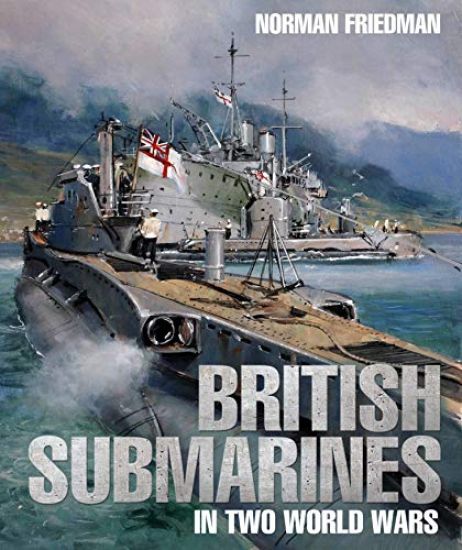
British Submarines in Two World Wars

British Submarines in Two World Wars

Norman Friedman

Seaforth Publishing
2019
sidottu
Although the Royal Navy did not invent the submarine, Norman Friedman's new book demonstrates how innovative the service was, to an extent which few will recognise. Its submarines performed well in combat in both world wars, and often in unheralded ways. Few will be aware that in 1914 Britain had the largest submarine fleet in the world, and that at the end of World War I it had some of the largest and most unusual of all submarines - whose origins and design are all detailed. During the First World War they virtually closed the Baltic to German iron ore traffic, and they helped block supplies to the Turkish army fighting at Gallipoli. British submarines were a major element in the North Sea battles, and they helped fight the U-boat menace. These roles led on to British submarine operations in World War II. Readers will be aware of the role of US submarines in strangling Japan, but perhaps not how British submarines in the Mediterranean fought a parallel costly but successful battle to strangle the German army in North Africa. Like their US counterparts, interwar British submariners were designed largely with the demands of a possible Pacific War, although that was not the war they fought. And the author shows how the demands of such a war, which would be fought over vast distances, collided with interwar British Government attempts to limit costs by holding down the size (and numbers) of submarines. It says much about the ingenuity of British submarine designers that they managed to meet their requirements despite enormous pressure on submarine size. As in other books in this series, the author demonstrates how a combination of evolving strategic and tactical requirements and evolving technology produced successive types of design. The Royal Navy was always painfully aware of the threat enemy submarines posed, and British submariners contributed heavily to the development of British anti-submarine tactics and technology, beginning with largely unknown efforts before the outbreak of World War I. Between the Wars British submariners exploited the new technology of sonar (Asdic), both to find and attack enemies and to avoid being attacked themselves. As a result, they pioneered submarine silencing, with important advantages to the US Navy as it observed the British. And it was a British submarine that pioneered the vital postwar use of submarines as anti-submarine weapons, sinking a U-boat while both were submerged. This feat was unique. Heavily illustrated with photos and original plans, this new volume from Norman Friedman, incorporating so much original analysis, will be eagerly awaited by naval historians and enthusiasts everywhere.
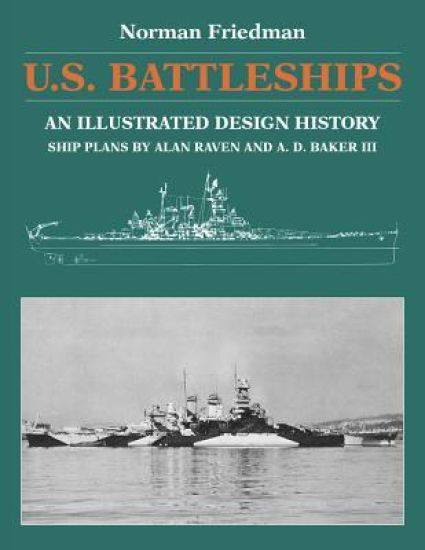
U.S. Battleships

U.S. Battleships

Norman Friedman; Alan Raven; A. D. Baker III

Naval Institute Press
2016
nidottu
Naval historians and enthusiasts alike will find U. S. Battleships to be the most comprehensive reference available on the entire development of U. S. battleships, from the Maine and Texas of 1886, through the Montana class of World War II, up to the recommissioned Iowas. Like the other books in Norman Friedman's design-history series, U. S. Battleships is based largely on formerly classified internal U. S. Navy records. Friedman, a leading authority of U. S. warships, explains the political and technical rationales for building battleships and recounts the evolution of each design. Alan Raven and A. D. Baker III have created detailed scale outboard and plan views of each battleship class and of major modifications to many classes. Numerous photographs complement the text.
The Hidden Domain

The Hidden Domain

Norman Friedman

Red Wheel/Weiser
2011
pokkari
The Hidden Domain explains that our familiar three-dimensional world is a reality arising from an invisible ocean of unmeasurable energy which surrounds and permeates us. This conception as remarkable as it seems arises in a natural way from the mathematical formalisms of modern quantum theory-a theory which is the most successful in scientific history. Physicists describe this nonphysical level of reality with the mathematical entity called the wave function. Since this level is not accessible to us through conventional scientific equipment presents a detailed study of the wave function using images metaphors and analogies which are grounded in solid science. This underlying basic source of our normal sensory reality is thoroughly investigated and illustrated without the use of ma thematics. An intriguing learning adventure is thus created for the layperson as well as the scientist.
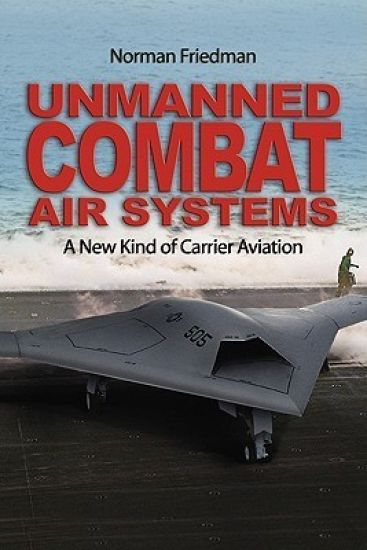
Unmanned Combat Air Systems

Unmanned Combat Air Systems

Norman Friedman

Naval Institute Press
2010
sidottu
The U. S. Navy’s Unmanned Combat Air System aircraft currently in development will transform naval aviation, extending its reach while dramatically reducing its cost, according to naval weapons expert Norman Friedman. In this his latest weapons book, he describes the new X-47B and shows how these new aircraft offer tactics that manned aircraft cannot duplicate. He calls the X-47B a natural extension of the evolving networked form of drone warfare that can be used for a variety of missions, including intelligence, surveillance and reconnaissance, and time sensitive targeting. Friedman makes the important point that an unmanned attack aircraft can also be seen as an extension of some current missiles that interact with remote human controllers. The book includes an extensive appendix describing the world’s military unmanned aircraft. About the Author Norman Friedman is an internationally respected defence analyst and historian and the author of more than thirty books, including Ships and Aircraft of the U. S. Fleet, 18th edition. A resident of New York City, he regularly testifies before Congress on Navy programs.
The Fifty-Year War

The Fifty-Year War

Norman Friedman

Naval Institute Press
2007
nidottu
Winner of the Royal United Services Institute Westminster Medal for Military Literature `To read a comprehensive history of the technical, military and political aspects of the Cold War, based on documents from the two super powers, written by a scholar who is free of bias, is something I never thought I would be able to do. But in The Fifty-Year War I can. . . For the men and women who are going to lead the world in the first generation of the twenty-first century, this account of how the Cold War was fought and won is indispensable. For those of us who lived through it . . . Friedman's account is enthralling. Having spent much of my life reading about, studying, worrying about, participating in the Cold War, I thought there was nothing new for me to learn about it. Boy was I wrong. Read The Fifty-Year War and see why. - Stephen Ambrose For fifty years the Cold War shaped our lives and divided our world. Other authors have portrayed the period as an uneasy peace, enforced by the possibility of mutual destruction through atomic and nuclear weapons. However, Norman Friedman has synthesized a vast array of information from a diverse spectrum of sources on both sides of the iron curtain to produce some extraordinary new conclusions. The renowned defence analyst has challenged conventional thinking on the subject. The Fifty-Year War is an essential book for those who wish to make sense of one of the most complex and fascinating epochs of world history. About the Author Norman Friedman is a defence analyst specializing in strategic and technical issues and a frequent television commentator. A resident of New York City, he is the author of many Naval Institute books and a columnist for Proceedings magazine.
The Naval Institute Guide to World Naval Weapons Systems
Long recognised as the most comprehensive work available on the subject, this guide remains the only complete reference to the weapons currently employed on US ships, submarines and naval aircraft around the world. It is the only book of its kind to explain the transformation of the US Navy into a network-centric force: a transformation that has had immense consequences for choices of tactics, weapons, services and the systems co-ordinating them. This guide also offers unparalleled coverage of the weapons, sensors and command systems of the world's navies, both those the US Navy works with and those it may have to fight. Written by one of the world's leading naval analysts, this edition has been completely revised and is newly illustrated. It provides a clear and precise account of how weapons technology has changed to meet the new tactical and strategic challenges facing international naval forces today. Cutting-edge information is found throughout, enhanced by many new and rarely seen photographs and drawings. The book benefits from the flood of material from Russia, whose weapons and systems are now owned and operated by numerous countries and are likely to be sold to many more. It also provides uniquely detailed coverage of weapons developed and deployed in the Far East, an area that promises to be the liveliest scene of naval action in the future. For the most complete and up-to-date information about weapons in every navy in the world, this is the essential resource. Norman Friedman is the author of numerous books, including Terrorism, Afghanistan, and America's New Way of War and Seapower as Strategy: Navies and National Interest. A resident of New York, he lectures around the world on naval and related military topics and contributes a monthly column analysing world naval developments for Proceedings magazine.
Terrorism, Afghanistan, and America's New Way of W

Terrorism, Afghanistan, and America's New Way of W

Norman Friedman

Naval Institute Press
2003
sidottu
Award-winning author Norman Friedman offers an in-depth analysis of the radically new tactics and strategy used by the United States in Afghanistan. He sets the Afghan war in the wider context of the war against terrorism, exploring the rationale for and consequences of the September 11 attacks. Friedman asserts that the terrorists’ attacks were intended to inspire a wider movement in the Muslim world that would lead to a pan-Muslim empire headed by Osama bin Laden. He argues that the attempt failed largely because of determined U. S. action and that the coalition’s success in Afghanistan has moved the war on terrorism towards the realm of police and intelligence operations. Although many books have examined September 11 and its aftermath, this work is the first to set the Afghan war in the context of an evolving U. S. tactical style that follows the new network-centric pattern and the first to use Afghanistan as a test of that pattern. The book also fully explores the contributions made by the U. S. Navy and Marine Corps while fighting in the land-locked country and the importance of the use of maritime power in the future. Nor does Friedman neglect to acknowledge the role played by politics, including the ethnic politics of Pakistan. Finally, the author’s examination of the new concepts of warfare as applied to the Afghan war provides valuable lessons to those concerned about future conflicts.