
Kirjailija
Octavio Paz
Kirjat ja teokset yhdessä paikassa: 56 kirjaa, julkaisuja vuosilta 1971–2025, suosituimpiin kuuluu Salamanteri. Vertaile teosten hintoja ja tarkista saatavuus suomalaisista kirjakaupoista.
56 kirjaa
Kirjojen julkaisuvuodet: 1971–2025.
Octavio Paz has written one of the most enduring and powerful works ever created on Mexico and its people, character, and culture. Compared to Ortega y Gasset's The Revolt of the Masses for its trenchant analysis, this collection contains Octavio Paz' most famous work, The Labyrinth of Solitude, a beautifully written and deeply felt discourse on Mexico's quest for identity that gives us an unequaled look at the country hidden behind the mask. Also included are Postscript, Return to the Labyrinth of Solitude, and Mexico and the United States, all of which develop the themes of the title essay and extend his penetrating commentary to the United States and Latin America.
Despite having written many acclaimed non-fiction books on the region, he has always considered those writings to be footnotes to the poems. From the long work "Mutra," written in 1952 and accompanied here by a new commentary by the author, to the celebrated poems of East Slope, and his recent adaptations from the classical Sanskrit, Paz scripts his India with a mixture of deft sensualism and hands-on politics.
A collection of essays examines the themes of love and sex in literature, from Plato to modern fiction
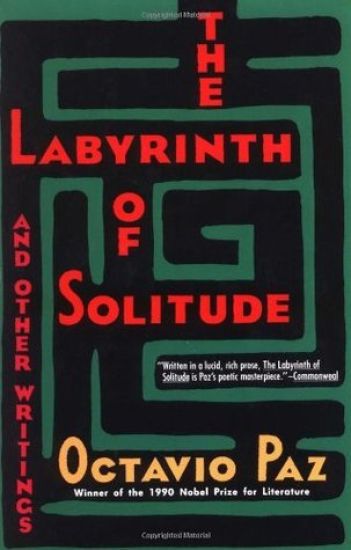
The Labyrinth of Solitude ; the Other Mexico ; Return to the Labyrinth of Solitude ; Mexico and the United States ; the Philanthropic Ogre
Octavio Paz
Avalon Travel Publishing
1994
nidottu
Examines Mexican character and culture, pre-Columbian societies, and relations between Mexico and the United States
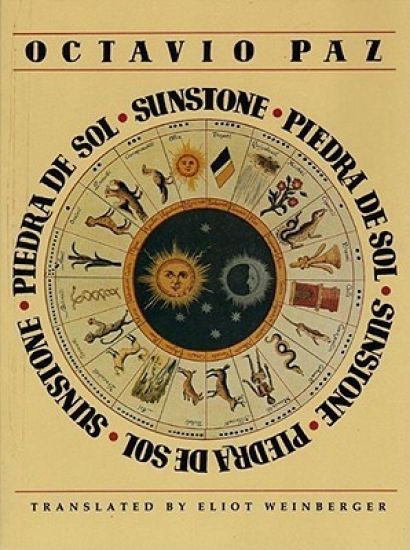
Piedra de Sol = Sunstone
Octavio Paz
NEW DIRECTIONS PUBLISHING CORPORATION
1991
nidottu
Halvin toimitettuna 20,40 €
Presented in Eliot Weinberger's excellent new translation with the Spanish texts en face, this is the 1957 poem "that definitively established Paz as a major international figure" (Sagetrieb). Written as a single cyclical sentence (at the end of the poem the first six lines are written again), Sunstone is a tour de force of momentum. It takes as its structural basis the circular Aztec calendar, which measured the synodic period of the planet Venus (584 days--the number of lines of Sunstone). But, as The New Republic noted, "this esoteric correlative design...does not circumscribe its subject. It is] a lyrically discursive exploration of time and memory, of erotic love, or art and writing."
The speech delivered by Paz in acceptance of the 1990 Nobel Prize for Literature, in which he discusses gratitude, separateness, and modernity. Published in a handsome bilingual edition. Translated by Anthony Stanton.
Octavio Paz launches a far-ranging excursion into the “incestuous and tempestuous” relations between modern poetry and the modern epoch. From the perspective of a Latin American poet, he explores the opposite meanings that the word “modern” has held for poets and philosophers, artists, and scientists. Tracing the beginnings of the modern poetry movement to the pre-Romantics, Paz outlines its course as a contradictory dialogue between the poetry of the Romance and Germanic languages. He discusses at length the unique character of Anglo-American “modernism” within the avant-garde movement, and especially vis-à-vis French and Spanish poetry. Finally he offers a critique of our era’s attitude toward the concept of time, affirming that we are at the “twilight of the idea of the future.” He proposes that we are living at the end of the avant-garde, the end of that vision of the world and of art born with the first Romantics.
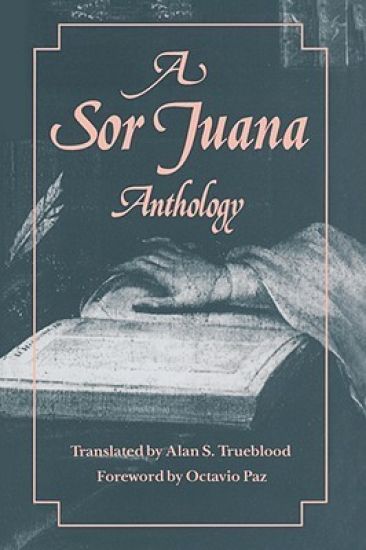
Here is a new voice—new to us—reaching across a gap of three hundred years. Sor (Sister) Juana Inés de la Cruz was acclaimed in her time as “Phoenix of Mexico, America’s Tenth Muse”; a generation later she was forgotten. In our century she was rediscovered, her works were reissued, and she is now considered one of the finest Hispanic poets of the seventeenth century. She deserves to be known to English-speaking readers for another reason as well: she speaks directly to our concern for the freedom of women to realize themselves artistically and intellectually. Her poetry is surprising in its scope and variety. She handled with ease the intricate verse forms of her day and wrote in a wide range of genres. Many of her lyrics reflect the worldliness and wit of the courtly society she moved in before becoming a nun; some, composed to be sung, offer charming glimpses of the native people, their festivities and colorful diversity. Alan Trueblood has chosen, in consultation with Octavio Paz, a generous selection of Sor Juana’s writings and has provided an introductory overview of her life and work. The short poems, and excerpts from her play The Divine Narcissus, are accompanied by the Spanish texts on facing pages. Her long philosophical poem, First Dream, is translated in its entirety, as is her famous autobiographical letter to the Bishop of Puebla, which is both a self-defense and a vindication of the right of women to cultivate their minds. The Anthology was conceived as a companion to the English-language edition of Octavio Paz’s magisterial study of Sor Juana. On its own, it will be welcomed as the first representative selection in English of her verse and prose.
One Earth, Four or Five Worlds: Reflections on Contemporary History
Octavio Paz
Ecco Press
1986
nidottu
Written with a poet's sensibility and a diplomat's sense of history, these essays view a contemporary world poised between the upheaval of the 1960s and the uncertainties of the 1980s. "Essays at once eloquent and slashing, urgent and erudite" (Publishers Weekly). Translated by Helen Lane.
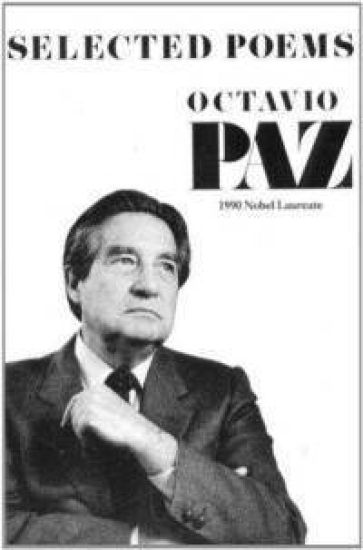
Poems deal with death, nature, the past, art, perception, love, travel, communication, and truth
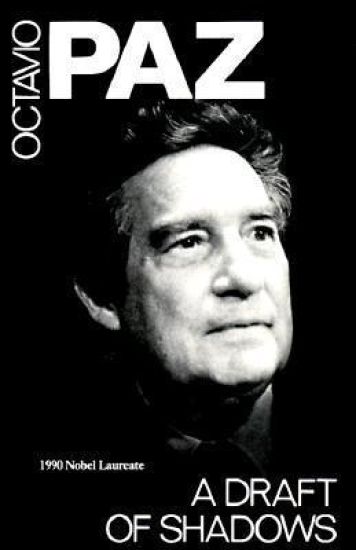
A Draft of Shadows and Other Poems is the most recent collection of the work of Mexico's leading poet and essayist, Octavio Paz. The first section of poems, from Ladera este (East Slope, 1969), reflects some of Paz's experiences as his country's ambassador to India (1962-68). Following stays in England, France, and the United States, he returned to Mexico in 1971, reacting to the urban sprawl and violence of Mexico City with the four long poems of disaster and rage that, together with shorter poems more familiar in tone, make up Vuelta ("Return," 1976). A long meditation on the poet's childhood and adolescence, Pasado en claro ("A Draft of Shadows," 1975) forms the third section of this volume and represents a further departure from the self-contained surreal images many associate with Paz. This bilingual selection concludes with a sampling of his most recent lyrics, and the promise of further experimentation. Paz, winner in 1981 of both the Neustadt Prize and the Cervantes Award, stated in a recent interview: "When I am writing a poem, it is to make something, an object or organism that will be whole and living, something that will have a life independent of me," and throughout this book the poet's abiding concern for language as a living force is revealed. For Paz, poetry is a way of reinventing the self, and appropriately, the reflective. "A Draft of Shadows" concludes: "I am the shadow my words cast."
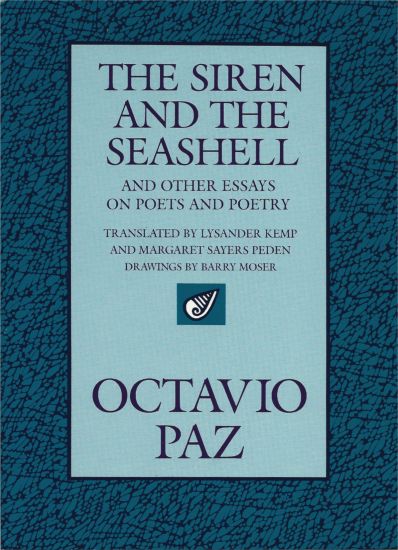
Octavio Paz has long been known for his brilliant essays as well as for his poetry. Through the essays, he has sought to confront the tensions inherent in the conflict between art and society and to achieve a unity of their polarities. The Siren and the Seashell is a collection of Paz’s essays, focusing on individual poets and on poetry in general. The first five poets he treats are Latin American: Sor Juana Inés de la Cruz, Rubén Darío, José Juan Tablada, Ramón López Velarde, and Alfonso Reyes. Then there are essays on Robert Frost, e. e. cummings, Saint-John Perse, Antonio Machado, and Jorge Guillén. Finally, there are Paz’s reflections on the poetry of solitude and communion and the literature of Latin America. Each essay is more than Paz’s impressions of one person or issue; each is the occasion for a wider discussion of cultural, historical, psychological, and philosophical themes. The essays were selected from Paz’s writing between 1942 and 1965 and provide an overview of the development of his thinking and an exploration of the ideas central in his works.
The first major book of short prose poetry in Spanish, Eagle or Sun? (Aguila o Sol?) exerted an enormous influence on modern Latin American writing. Written in 1949-50 by Nobel Laureate Octavio Paz, Eagle or Sun? has as its mythopoeic "place" Mexico--a country caught up in its pre-Columbian past, the world of modern imperialism, and an apocalyptic future foretold by the Aztec calendar. Indeed, three personae of the book--the goddess Itzapaplotl, the prophet clerk, the poet--are manifestations of the threefold aspects of the land. Paz himself explains: "Eagle or Sun? is an exploration of Mexico, yes, but at the same time, and above all, it is an exploration of the relations between language and the poet, reality and language, the poet and history."
In The Bow and the Lyre Octavio Paz, one of the most important poets writing in Spanish, presents his sustained reflections on the poetic phenomenon and on the place of poetry in history and in our personal lives. It is written in the same prose style that distinguishes The Labyrinth of Solitude. The Bow and the Lyre will serve as an important complement to Paz's poetry. Paz's discussions of the different aspects of the poetic phenomenon are not limited to Spanish and Spanish American literature. He is almost as apt to choose an example from Homer, Vergil, Blake, Whitman, Rimbaud as he is from Lope de Vega, Jiménez, Darío, Neruda. In writing these essays, he draws on his vast storehouse of knowledge, revealing a world outlook of ample proportions. In reading these essays, we share the observations of a searching, original, highly cultivated mind.
Bilingual text presents the most outstanding lyrical works of the Mexican poet, including Sun Stone and Blanco