Kirjojen hintavertailu – 12 903 725 kirjaa ja 27 kauppaa

Kirjailija

Oded Lipschits

Kirjat ja teokset yhdessä paikassa: 8 kirjaa, julkaisuja vuosilta 2011–2026, suosituimpiin kuuluu The Untold Story of the Kingdom of Judah. Vertaile teosten hintoja ja tarkista saatavuus suomalaisista kirjakaupoista.

8 kirjaa

Kirjojen julkaisuvuodet: 2011–2026.

The Untold Story of the Kingdom of Judah

The Untold Story of the Kingdom of Judah

Oded Lipschits

De Gruyter
2026
sidottu

Halvin toimitettuna 95,10 €

This book was written out of a great love for the biblical text and out of an even greater curiosity about the people who wrote it. The different chapters of the book are an invitation to a journey following those who composed the historical descriptions in the Hebrew Bible, in an attempt to find out who they were, when they wrote and where. The main questions in the book are not what the historical description is and how much it indeed reflects what really happened, but what the authors of the Biblical historiography knew about the ancient past of Israel and Judah, what they chose to include in their descriptions and what story they chose not to tell. The untold story is an important key to understanding the purpose of biblical historiography, the target audience for which it was intended and the message it carried. The main conclusion is that biblical historiography was not written to tell what history was, but to explain the present against the background of past events, and through this to teach a lesson about the right way to behave in the present, in order to ensure a good future. This is how Biblical historiography should be read and understood.
Judah in the Biblical Period

Judah in the Biblical Period

Oded Lipschits

De Gruyter
2024
sidottu
The collection of essays in this book represents more than twenty years of research on the history and archeology of Judah, as well as the study of the Biblical literature written in and about the period that might be called the “Age of Empires”. This 600-year-long period, when Judah was a vassal Assyrian, Egyptian and Babylonian kingdom and then a province under the consecutive rule of the Babylonian, Persian, Ptolemaic and Seleucid empires, was the longest and the most influential in Judean history and historiography. The administration that was shaped and developed during this period, the rural economy, the settlement pattern and the place of Jerusalem as a small temple, surrounded by a small settlement of (mainly) priests, Levites and other temple servants, characterize Judah during most of its history. This is the formative period when most of the Hebrew Bible was written and edited, when the main features of Judaism were shaped and when Judean cult and theology were created and developed. The 36 papers contained in this book present a broad picture of the Hebrew Bible against the background of the Biblical history and the archeology of Judah throughout the six centuries of the “Age of Empires”.
Age of Empires

Age of Empires

Oded Lipschits

Eisenbrauns
2021
sidottu
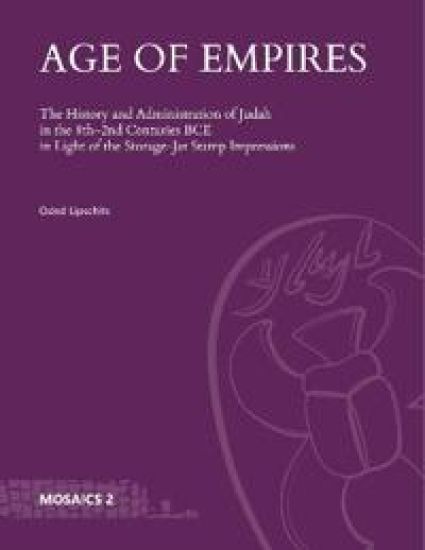
Storage jars of many shapes and sizes were in widespread use in the ancient world, transporting and storing agricultural products such as wine and oil, crucial to agriculture, economy, trade and subsistence. From the late 8th to the 2nd century BCE, the oval storage jars typical of Judah were often stamped or otherwise marked: in the late 8th and early 7th century BCE with lmlk stamp impressions, later in the 7th century with concentric circle incisions or rosette stamp impressions, in the 6th century, after the fall of Jerusalem, with lion stamp impressions, and in the Persian, Ptolemaic and Seleucid periods (late 6th–late 2nd centuries BCE) with yhwd stamp impressions. At the same time, several ad hoc systems of stamp impressions appeared: “private” stamp impressions were used on the eve of Sennacherib’s campaign, mw?h stamp impressions after the destruction of Jerusalem, and yršlm impressions after the establishment of the Hasmonean state. While administrative systems that stamped storage jars are known elsewhere in the ancient Near East, the phenomenon in Judah is unparalleled in its scale, variety and continuity, spanning a period of some 600 years without interruption. This is the first attempt to consider the phenomenon as a whole and to develop a unified theory that would explain the function of these stamp impressions and shed new light on the history of Judah during six centuries of subjugation to the empires that ruled the region—as a vassal kingdom in the age of the Assyrian, Egyptian, and Babylonian empires and as a province under successive Babylonian, Persian, Ptolemaic, and Seleucid rule.
Ramat Ra?el VI

Ramat Ra?el VI

Oded Lipschits; Liora Freud; Manfred Oeming; Yuval Gadot

Eisenbrauns
2021
sidottu
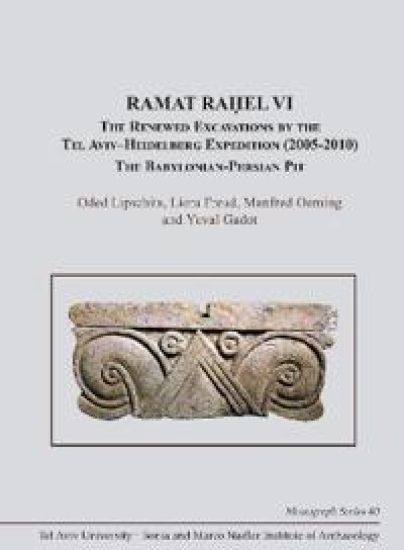
This is part of a three-volume final report of the renewed excavations at Ramat Ra?el by the Tel Aviv–Heidelberg Expedition (2005-2010). It presents the finds from the Babylonian-Persian pit, one of the most dramatic find-spots at Ramat Ra?el. The pit yielded a rich assemblage of pottery vessels and yhwd, lion, and sixth-century “private” stamp impressions, including, for the first time, complete restored stamped jars, jars bearing two handles stamped with different yhwd impressions, and jars bearing both lion and “private” stamp impressions on their bodies. Residue analysis was conducted on many of the vessels excavated from the pit to analyze their contents, yielding surprising results. The finds contribute to our understanding of the pottery of the Babylonian and early Persian periods (6th-5th centuries BCE) and to the study of the development of the stamped-jar administration in the province of Yehud under Babylonian and Persian rule. Also available from Eisenbrauns: Ramat Ra?el III: Final Publication of Aharoni'’s Excavations at Ramat Ra?el (1954, 1959–1962) by Oded Lipschits, Yuval Gadot, and Liora Freud; and Ramat Ra?el IV: The Renewed Excavations by the Tel Aviv–Heidelberg Expedition (2005–2010): Stratigraphy and Architecture, by Oded Lipschits, Mandred Oeming, and Yuval Gadot.
Ramat Ra?el IV

Ramat Ra?el IV

Oded Lipschits; Manfred Oeming; Yuval Godot

Eisenbrauns
2020
sidottu
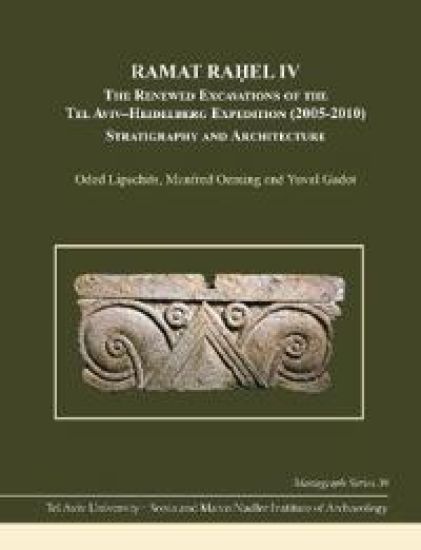
This is the first of a three-volume final report on the Tel Aviv–Heidelberg Renewed Excavations at Ramat Ra?el, 2005–2010. It presents the stratigraphy and architecture of the excavation areas, including portions of the palatial compound, the subterranean columbarium complex, and the Late Roman cemetery; site formation of the tell; twentieth-century fortifications at the site; and the ancient garden and its water installations.
Ramat Ra?el III

Ramat Ra?el III

Oded Lipschits; Yuval Gadot; Liora Freud

Eisenbrauns
2016
sidottu
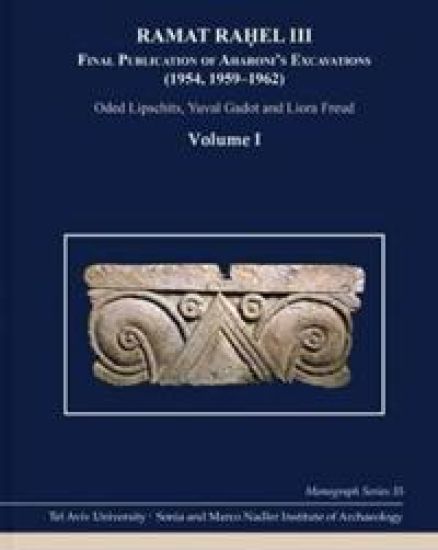
This book brings to complete and final publication two past excavations conducted at the site of Ramat Ra?el. A major part of the report is devoted to publishing the results of Yohanan Aharoni’s long-term excavation project at the site during the years 1954, 1956, 1959–1962. The renewal of excavations at the site in 2004 triggered the need to reevaluate the site’s architecture and stratigraphy, and from that the idea to publish this report was born.
The Fall and Rise of Jerusalem

The Fall and Rise of Jerusalem

Oded Lipschits

Eisenbrauns
2013
pokkari
The period of the demise of the kingdom of Judah at the end of the 6th century B. C. E., the fall of Jerusalem to the Babylonians, the exile of the elite to Babylon, and the reshaping of the territory of the new province of Judah, culminating at the end of the century with the first return of exiles—all have been subjects of intense scrutiny during the last decade. Lipschits takes into account the biblical textual evidence, the results of archaeological research, and the reports of Babylonian and Egyptian sources and provides a comprehensive survey and analysis of the evidence for the history of this 100-year-long era. He provides a lucid historical survey that will, no doubt, become the baseline for all future studies of this era.
The Yehud Stamp Impressions

The Yehud Stamp Impressions

Oded Lipschits; David S. Vanderhooft

Eisenbrauns
2011
sidottu
The study of the yehud stamp impressions, which appear on the handles or bodies of store jars, has persisted for over a century, beginning with the discovery of the first of these impressions at Gezer in 1904. Nevertheless, until the pioneering work of Stern in 1973, who cataloged, classified, and discussed the stamp impressions known up to 1970, discovery and publication of new stamp impressions were scattered, and analysis was cursory at best. Furthermore, a gap in research has persisted since then. Now, Oded Lipschits and David Vanderhooft are pleased to present a comprehensive catalog (through the winter of 2008–9) of published and unpublished yehud stamp impressions, with digital photographs and complete archaeological and publication data for each impression. This long-overdue resource provides a secure foundation for general reflection on the whole corpus and illuminates more-narrow fields such as stratigraphy, paleography, administration, historical geography, and Persian-period economic developments within Yehud. The catalog clarifies what is nebulous apart from a complete corpus, matters such as distribution, petrographic analysis of the clay, new readings of the seal legends, use of the toponym yehud, and significance of the title phwa. The scope of this catalog renders it a worthwhile tool for all future study of these invaluable artifacts and the period of history that produced them.