Kirjojen hintavertailu – 12 859 828 kirjaa ja 27 kauppaa

Kirjailija

Office Of Justice Programs

Kirjat ja teokset yhdessä paikassa: 61 kirjaa, julkaisuja vuosilta 2012–2017, suosituimpiin kuuluu The Role of Local Government in Community Safety. Vertaile teosten hintoja ja tarkista saatavuus suomalaisista kirjakaupoista.

61 kirjaa

Kirjojen julkaisuvuodet: 2012–2017.

Background Checks for Firearm Transfers

Background Checks for Firearm Transfers

Office of Justice Programs; Bureau of Justice Statistics

Createspace Independent Publishing Platform
2017
nidottu
More than 180 million applications for firearm transfers or permits were subject to background checks since the effective date of the Brady Handgun Violence Prevention Act on February 28, 1994, through December 31, 2014. During this period, about 2.8 million applications (1.6%) were denied. In 2014, nearly 15 million applications were subject to background checks, and 193,000 (1.3%) were denied, including about 91,000 denied by the FBI and about 102,000 denied by state and local agencies. Data in this report were obtained from the Bureau of Justice Statistics' (BJS) Firearm Inquiry Statistics (FIST) program. The FIST program collects information on firearm applications and denials and combines this information with the FBI's National Instant Criminal Background Check System (NICS) transaction data to produce an estimated number of background checks for firearm transfers or permits since the effective date of the Brady Act. These statistical tables describe trends in background check activities that occurred in 2014 and include partial data for 2013. Data include the number of firearm transaction applications processed by the FBI and by state and local agencies, the number of applications denied, reasons for denial, and estimates of applications by jurisdiction and by each type of approval system.
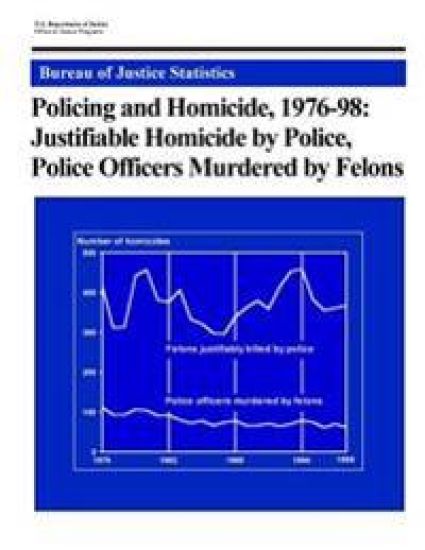
Policing and Homicide, 1976-98: Justifiable Homicide by Police, Police Officers Murdered by Felons

Policing and Homicide, 1976-98: Justifiable Homicide by Police, Police Officers Murdered by Felons

Office of Justice Programs; Bureau of Justice Statistics

Createspace Independent Publishing Platform
2016
nidottu
This report brings together in a single publication national statistics on two distinct types of homicide: the justifiable homicide of felons by police, and the murder of police officers by felons. Although the two are fundamentally different - the use of deadly force against a police officer is almost never justified, while the use of deadly force by police often is - certain connectionscan be made between them beyond the fact that both always involve the police. Sometimes one directly results in the other: 1 in 6 murders of a police officer result in the justifiable killing of themurderer. (Still, of all the justifiable homicides by police only about 3% occur in connection with the murder of a police officer.) The two also sharedemographic similarities. For example, almost all the felons justifiably killed by police (98%) and almost all of the felons who murdered a police officer (97%) are males; in both types of homicidejust over half of the felons are ages 18 to 30; and in both types just over half of the felons are white. The first section of the report deals with the justifiable homicide of felons by police; the second, with the murder of police officers by felons. Together, the two types account for around 2% of all intentional killings in the United States. The types of homicide not covered in this report are: negligent homicides; justifiable homicides by private citizens; and murders in which the victim issomeone other than an officer slain in the line of duty.
Juvenile Intensive Supervision: Planning Guide

Juvenile Intensive Supervision: Planning Guide

Office of Justice Programs; Office of Juvenile Justice and Delinquen; U. S. Department of Justice

Createspace Independent Publishing Platform
2016
nidottu
OJJDP considers the intensive supervision program (ISP) a promising intermediate sanction for first-time serious or violent juvenile offenders who are inappropriate for or fail to respond successfully to immediate intervention. Many serious and violent offenders at this stage may be appropriate for placement in an intensive supervision program that serves as an alternative to secure incarceration. The Intensive Supervision of Probationers Program Model is a highly structured, continuously monitored, individualized plan that consists of five phases with decreasing levels of restrictiveness:1. Short-term placement in community confinement.2. Day treatment.3. Outreach and tracking.4. Routine supervision.5. Discharge and followup. Program models such as these have been found to be effective for many serious, violent, and chronic juvenile offenders, obviating the need for secure incarceration. OJJDP views the intensive supervision program as a positive response to the need to address the overcrowding of juvenile detention centers. The Planning Guide offers practitioners the tools they need to implement confidently an ISP as an alternative to long-term institutional confinement for designated juvenile offenders. OJJDP believes the intensive supervision program offers the juvenile justice system a needed alternative to incarceration for the right juvenile offender.