Kirjojen hintavertailu – 12 859 818 kirjaa ja 27 kauppaa

Kirjailija

Olaf Rieper

Kirjat ja teokset yhdessä paikassa: 5 kirjaa, julkaisuja vuosilta 1996–2023, suosituimpiin kuuluu Politics and Practices of Intergovernmental Evaluation. Vertaile teosten hintoja ja tarkista saatavuus suomalaisista kirjakaupoista.

5 kirjaa

Kirjojen julkaisuvuodet: 1996–2023.

Forskning om og med mennesker

Forskning om og med mennesker

Laila Launsø; Olaf Rieper; Leif Olsen

Gyldendal
2023
nidottu
Denne 8. udgave giver en indføring i forskningsprocessens forskellige faser fra emneafgrænsning over problemformulering og indsamlings- og analysemetoder til formidling. Bogen er en velskrevet og lettilgængelig grundbog på mange uddannelser. Den er båret af en grundholdning om, at forskning ikke kan bedømmes ud fra én gylden standard for den korrekte metode, men at man på mangfoldige måder må undersøge sit emne for at skabe brugbar viden om og til mennesker i samfundslivet. Heraf følger, at kriterier for, hvad der er god kvalitet i forskningen, og hvad der udgør evidens, ikke kan besvares med henvisning til en enkel procedure, som definerer den rette metode. Det gør forskning mere kompliceret, men også mere spændende og udfordrende. I denne 8. udgave har forfatterne opdateret litteraturhenvisningerne samt revideret dele af teksten og tilføjet nye eksempler. Forskning om og med mennesker kan anvendes til såvel selvstudium som grundstamme i metodekurser på forskellige niveauer og som forfriskende læsning – også for den garvede forsker.
Politics and Practices of Intergovernmental Evaluation

Politics and Practices of Intergovernmental Evaluation

Olaf Rieper; Jacques Toulemonde

Routledge
2018
nidottu
Great intellectual effort has gone into the development of sophisticated designs and methodologies to study individual policies, programs, and projects. Costly efforts to find the smallest evidence of a policy or program impact have been undertaken in the presumption that such data are central to policy decision making. Meanwhile, the intergovernmental nature of political and policy governance has been ignored. Whether it is Canada, the United States, England, Denmark, Sweden, Germany, Japan, or any other industrial country, the governmental structure is essentially a web of interrelated policies, programs, and projects. To understand local responsibilities and requirements, one must also understand the role that regional and national governmental agencies and administrations play. Politics and Practice of Intergovernmental Evaluation is a landmark work in the area of the evaluation of intergovernmental policies, programs, and projects. Comparative and cross-national in its perspective, the material presented here not only provides a systematic theoretical and empirical treatment of intergovernmental evaluation, but does so with case material from seven nations and the European Union. No other such comparative work exists on this topic. Contributors include: Jan Eric Furubo; Mary Henkel; Linda G. Morra; Robert V. Segsworth and Dale H. Poel; and Willi Zimmermann and Peter Knoepfel. The Politics and Practice of Intergovernmental Evaluation will be of interest to political theorists, policymakers, and scholars and students of government and the evaluation community.
The Evidence Book

The Evidence Book

Olaf Rieper; Frans L. Leeuw; Tom Ling

AldineTransaction
2011
nidottu
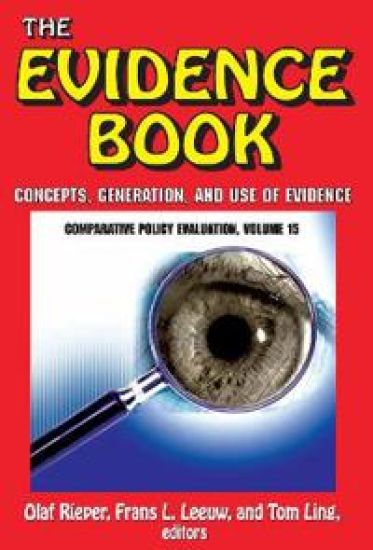
Knowledge grows as ideas are tested against each other. Agreement is not resolved simply by naming concepts but in the dialectical process of thesis, antithesis, and synthesis. There are many echoes of these debates in The Evidence Book. The contributors make claims for both practitioner wisdom and the voice of experience. Against this is posed the authority of experimental science and the randomized controlled trial. The contributors are concerned, in their own ways, with collecting, ranking, and analyzing evidence and using this to deliver evaluations. As an expert group, they are aware that the concept of evidence has been increasingly important in the last decade. As with other concepts, it too often escapes precise definition. Despite this, the growing importance of evidence has been advocated with enthusiasm by supporters who see it as a way of increasing the effectiveness and quality of decisions and of professional life. The willingness to engage in evidence-based policy and the means to do so is heavily constrained by economic, political, and cultural climates. This book is a marvelously comprehensive and utterly unique treatise on evidence-based policy. It is a wide-ranging contribution to the field of evaluation.
The Evidence Book

The Evidence Book

Olaf Rieper; Frans L. Leeuw; Tom Ling

AldineTransaction
2009
sidottu
Knowledge grows as ideas are tested against each other. Agreement is not resolved simply by naming concepts but in the dialectical process of thesis, antithesis, and synthesis. There are many echoes of these debates in The Evidence Book. The contributors make claims for both practitioner wisdom and the voice of experience. Against this is posed the authority of experimental science and the randomized controlled trial. The contributors are concerned, in their own ways, with collecting, ranking, and analyzing evidence and using this to deliver evaluations. As an expert group, they are aware that the concept of evidence has been increasingly important in the last decade. As with other concepts, it too often escapes precise definition. Despite this, the growing importance of evidence has been advocated with enthusiasm by supporters who see it as a way of increasing the effectiveness and quality of decisions and of professional life. The willingness to engage in evidence-based policy and the means to do so is heavily constrained by economic, political, and cultural climates. This book is a marvelously comprehensive and utterly unique treatise on evidence-based policy. It is a wide-ranging contribution to the field of evaluation.
Politics and Practices of Intergovernmental Evaluation

Politics and Practices of Intergovernmental Evaluation

Olaf Rieper; Jacques Toulemonde

Transaction Publishers
1996
sidottu
Great intellectual effort has gone into the development of sophisticated designs and methodologies to study individual policies, programs, and projects. Costly efforts to find the smallest evidence of a policy or program impact have been undertaken in the presumption that such data are central to policy decision making. Meanwhile, the intergovernmental nature of political and policy governance has been ignored. Whether it is Canada, the United States, England, Denmark, Sweden, Germany, Japan, or any other industrial country, the governmental structure is essentially a web of interrelated policies, programs, and projects. To understand local responsibilities and requirements, one must also understand the role that regional and national governmental agencies and administrations play. Politics and Practice of Intergovernmental Evaluation is a landmark work in the area of the evaluation of intergovernmental policies, programs, and projects. Comparative and cross-national in its perspective, the material presented here not only provides a systematic theoretical and empirical treatment of intergovernmental evaluation, but does so with case material from seven nations and the European Union. No other such comparative work exists on this topic. Contributors include: Jan Eric Furubo; Mary Henkel; Linda G. Morra; Robert V. Segsworth and Dale H. Poel; and Willi Zimmermann and Peter Knoepfel. The Politics and Practice of Intergovernmental Evaluation will be of interest to political theorists, policymakers, and scholars and students of government and the evaluation community.