Kirjojen hintavertailu – 12 903 724 kirjaa ja 27 kauppaa

Kirjailija

Ole Peter Grell

Kirjat ja teokset yhdessä paikassa: 11 kirjaa, julkaisuja vuosilta 1996–2024, suosituimpiin kuuluu Brethren in Christ. Vertaile teosten hintoja ja tarkista saatavuus suomalaisista kirjakaupoista.

11 kirjaa

Kirjojen julkaisuvuodet: 1996–2024.

The World of Worm: Physician, Professor, Antiquarian, and Collector, 1588-1654

The World of Worm: Physician, Professor, Antiquarian, and Collector, 1588-1654

Ole Peter Grell

TAYLOR FRANCIS LTD
2024
nidottu

Halvin toimitettuna 74,10 €

This monograph offers the first comprehensive treatment of the multi-faceted scholarly interests of Ole Worm, professor of medicine at the University of Copenhagen. Scholarship about Worm has focused mainly on Worm’s collecting and the creation of his cabinet of curiosity, the Museum Wormianum, resulting in Worm’s rationale for his research being largely overlooked. Worm shared his many interests with a number of other physicians of the age, but in terms of breadth, few matched the variety of his concerns. For a man who considered himself first and foremost a physician and anatomist, his interests in Paracelsianism and collecting can at times be baffling, while his interests in antiquarianism, runes, and chronology strike the modern reader as at odds with his medical and natural philosophical interests. It is important to comprehend that Worm’s multi-faceted interests in the created world were underpinned by his Lutheran, Melanchthonian natural philosophy, and this served to unify all Worm’s scholarly undertakings, inquiries, and experiments in the single aim of reaching a better understanding of God’s creation, the Book of Nature.
The World of Worm: Physician, Professor, Antiquarian, and Collector, 1588-1654
This monograph offers the first comprehensive treatment of the multi-faceted scholarly interests of Ole Worm, professor of medicine at the University of Copenhagen. Scholarship about Worm has focused mainly on Worm’s collecting and the creation of his cabinet of curiosity, the Museum Wormianum, resulting in Worm’s rationale for his research being largely overlooked. Worm shared his many interests with a number of other physicians of the age, but in terms of breadth, few matched the variety of his concerns. For a man who considered himself first and foremost a physician and anatomist, his interests in Paracelsianism and collecting can at times be baffling, while his interests in antiquarianism, runes, and chronology strike the modern reader as at odds with his medical and natural philosophical interests. It is important to comprehend that Worm’s multi-faceted interests in the created world were underpinned by his Lutheran, Melanchthonian natural philosophy, and this served to unify all Worm’s scholarly undertakings, inquiries, and experiments in the single aim of reaching a better understanding of God’s creation, the Book of Nature.
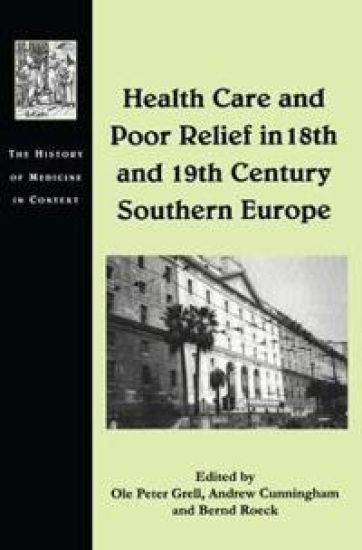
Health Care and Poor Relief in 18th and 19th Century Southern Europe
The poor and the sick-poor have always presented a problem to the governments and churches of Europe. Whose responsibility are they? Are they a wilful burden on the honest working population, or are they a necessary presence for the true Christian to live the true Christian life? In the 18th and 19th centuries what happened to the poor and the sick-poor in the north and south of Europe was different. In the north there occurred first the Reformation in the 16th century, which changed attitudes to the poor, and then the advent of industrialisation, with its far-reaching effects of pauperisation of people both in town and countryside. In the Catholic south, where industrialisation did not appear so soon, the Catholic Church introduced a programme of reform at all levels but along traditional lines. This included the founding of new orders dedicated to the care of the poor and sick, of new institutions within which to house and care for them. At all times it was taken for granted that it was a necessary aspect of being a Christian that one should give for the care of the needy, and that this was not the duty of the state or of secular institutions. The secularising movement did however reach the southern countries by way both of the Enlightenment and - more drastically - in the form of the Napoleonic invasions. But after the defeat of Napoleon, the Church reasserted its right to administer and control the support of the poor and sick, and this situation continued until 1900 in most areas. Moreover the effects of industrialisation and the concomitant increase in population did make itself felt in the south in the course of the 19th century, which put great stress on the institutions for poor relief and health care for the poor. All this is still relevant today, since the situations that governments and the Catholic Church found themselves confronted with, and the stark choices they had to make, are being replayed to some extent today. Who is responsible for the poor, who is to blame for their being poor? How should their poverty be relieved, how should the health care of the many be funded? These are still live issues today. While complete in itself the present volume also forms the fourth and last of a four-volume survey of health care and poor relief in Europe between 1500 and 1900, edited by Ole Peter Grell and Andrew Cunningham
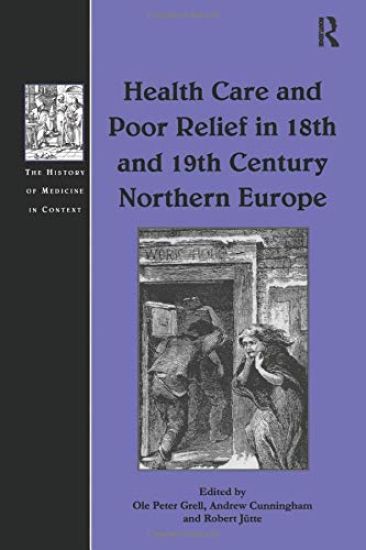
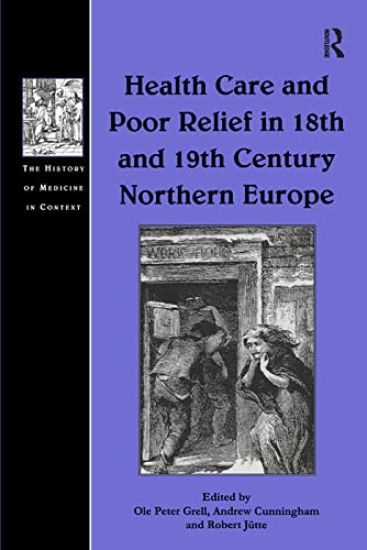
Health Care and Poor Relief in 18th and 19th Century Northern Europe
Throughout history governments have had to confront the problem of how to deal with the poorer parts of their population. During the medieval and early modern period this responsibility was largely borne by religious institutions, civic institutions and individual charity. By the eighteenth century, however, the rapid social and economic changes brought about by industrialisation put these systems under intolerable strain, forcing radical new solutions to be sought to address both old and new problems of health care and poor relief. This volume looks at how northern European governments of the eighteenth and nineteenth centuries coped with the needs of the poor, whilst balancing any new measures against the perceived negative effects of relief upon the moral wellbeing of the poor and issues of social stability. Taken together, the essays in this volume chart the varying responses of states, social classes and political theorists towards the great social and economic issue of the age, industrialisation. Its demands and effects undermined the capacity of the old poor relief arrangements to look after those people that the fits and starts of the industrialisation cycle itself turned into paupers. The result was a response that replaced the traditional principle of 'outdoor' relief, with a generally repressive system of 'indoor' relief that lasted until the rise of organised labour forced a more benign approach to the problems of poverty. Although complete in itself, this volume also forms the third of a four-volume survey of health care and poor relief provision between 1500 and 1900, edited by Ole Peter Grell and Andrew Cunningham.
Brethren in Christ

Brethren in Christ

Ole Peter Grell

Cambridge University Press
2016
pokkari
This groundbreaking book explores the migration of Calvinist refugees in Europe during the Reformation, across a century of persecution, exile and minority existence. Ole Peter Grell follows the fortunes of some of the earliest Reformed merchant families, forced to flee from the Tuscan city of Lucca during the 1560s, through their journey to France during the Wars of Religion to the St Bartholomew Day Massacre and their search for refuge in Sedan. He traces the lives of these interconnected families over three generations as they settled in European cities from Geneva to London, marrying into the diaspora of Reformed merchants. Based on a potent combination of religion, commerce and family networks, these often wealthy merchants and highly skilled craftsmen were amongst the most successful of early modern capitalists. Brethren in Christ shows how this interconnected network, reinforced through marriage and enterprise, forged the backbone of international Calvinism in Reformation Europe.
Brethren in Christ

Brethren in Christ

Ole Peter Grell

Cambridge University Press
2011
sidottu
This groundbreaking book explores the migration of Calvinist refugees in Europe during the Reformation, across a century of persecution, exile and minority existence. Ole Peter Grell follows the fortunes of some of the earliest Reformed merchant families, forced to flee from the Tuscan city of Lucca during the 1560s, through their journey to France during the Wars of Religion to the St Bartholomew Day Massacre and their search for refuge in Sedan. He traces the lives of these interconnected families over three generations as they settled in European cities from Geneva to London, marrying into the diaspora of Reformed merchants. Based on a potent combination of religion, commerce and family networks, these often wealthy merchants and highly skilled craftsmen were amongst the most successful of early modern capitalists. Brethren in Christ shows how this interconnected network, reinforced through marriage and enterprise, forged the backbone of international Calvinism in Reformation Europe.
The Impact of the European Reformation

The Impact of the European Reformation

Ole Peter Grell

Ashgate Publishing Limited
2008
sidottu
Recent decades have witnessed the fragmentation of Reformation studies, with high-level research confined within specific geographical, confessional or chronological boundaries. By bringing together scholars working on a wide variety of topics, this volume counteracts this centrifugal trend and provides a broad perspective on the impact of the European reformation. The essays present new research from historians of politics, of the church and of belief. Their geographical scope ranges from Scotland and England via France and Germany to Transylvania and their chronological span from the 1520s to the 1690s Considering the impact of the Reformation on political culture and examining the relationship between rulers and ruled; the book also examines the church and its personnel, another sphere of life that was entirely transformed by the Reformation. Important aspects of knowledge and belief are discussed in terms of scientific knowledge and technological progress, juxtaposed with analyses of elite and popular belief, which demonstrates the limitations of Weber's notion of the disenchantment of the world. Together they indicate the diverse directions in which Reformation scholarship is now moving, while reminding us of the need to understand particular developments within a broader European context; demonstrating that movements for religious reform left no sphere of European life untouched.
Health Care and Poor Relief in 18th and 19th Century Southern Europe
The poor and the sick-poor have always presented a problem to the governments and churches of Europe. Whose responsibility are they? Are they a wilful burden on the honest working population, or are they a necessary presence for the true Christian to live the true Christian life? In the 18th and 19th centuries what happened to the poor and the sick-poor in the north and south of Europe was different. In the north there occurred first the Reformation in the 16th century, which changed attitudes to the poor, and then the advent of industrialisation, with its far-reaching effects of pauperisation of people both in town and countryside. In the Catholic south, where industrialisation did not appear so soon, the Catholic Church introduced a programme of reform at all levels but along traditional lines. This included the founding of new orders dedicated to the care of the poor and sick, of new institutions within which to house and care for them. At all times it was taken for granted that it was a necessary aspect of being a Christian that one should give for the care of the needy, and that this was not the duty of the state or of secular institutions. The secularising movement did however reach the southern countries by way both of the Enlightenment and - more drastically - in the form of the Napoleonic invasions. But after the defeat of Napoleon, the Church reasserted its right to administer and control the support of the poor and sick, and this situation continued until 1900 in most areas. Moreover the effects of industrialisation and the concomitant increase in population did make itself felt in the south in the course of the 19th century, which put great stress on the institutions for poor relief and health care for the poor. All this is still relevant today, since the situations that governments and the Catholic Church found themselves confronted with, and the stark choices they had to make, are being replayed to some extent today. Who is responsible for the poor, who is to blame for their being poor? How should their poverty be relieved, how should the health care of the many be funded? These are still live issues today. While complete in itself the present volume also forms the fourth and last of a four-volume survey of health care and poor relief in Europe between 1500 and 1900, edited by Ole Peter Grell and Andrew Cunningham
Health Care and Poor Relief in 18th and 19th Century Northern Europe

Health Care and Poor Relief in 18th and 19th Century Northern Europe

Ole Peter Grell; Andrew Cunningham

Ashgate Publishing Limited
2002
sidottu
Throughout history governments have had to confront the problem of how to deal with the poorer parts of their population. During the medieval and early modern period this responsibility was largely borne by religious institutions, civic institutions and individual charity. By the eighteenth century, however, the rapid social and economic changes brought about by industrialisation put these systems under intolerable strain, forcing radical new solutions to be sought to address both old and new problems of health care and poor relief. This volume looks at how northern European governments of the eighteenth and nineteenth centuries coped with the needs of the poor, whilst balancing any new measures against the perceived negative effects of relief upon the moral wellbeing of the poor and issues of social stability. Taken together, the essays in this volume chart the varying responses of states, social classes and political theorists towards the great social and economic issue of the age, industrialisation. Its demands and effects undermined the capacity of the old poor relief arrangements to look after those people that the fits and starts of the industrialisation cycle itself turned into paupers. The result was a response that replaced the traditional principle of 'outdoor' relief, with a generally repressive system of 'indoor' relief that lasted until the rise of organised labour forced a more benign approach to the problems of poverty. Although complete in itself, this volume also forms the third of a four-volume survey of health care and poor relief provision between 1500 and 1900, edited by Ole Peter Grell and Andrew Cunningham.
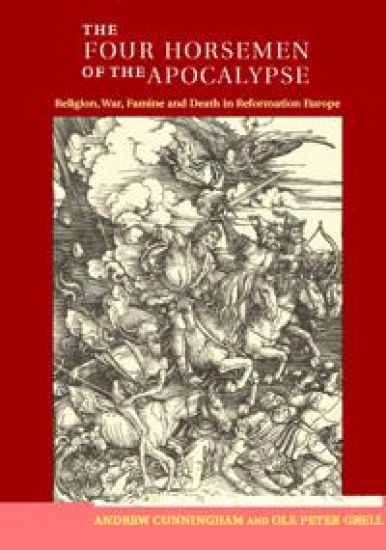
The Four Horsemen of the Apocalypse

The Four Horsemen of the Apocalypse

Andrew Cunningham; Ole Peter Grell

Cambridge University Press
2001
pokkari
This book offers a new and exciting interpretation of early modern European history (1490–1648). Cunningham and Grell’s point of departure, and a prism through which events of the period are interpreted, is Dürer’s famous woodcut of The Four Horsemen of the Apocalypse. This image came to characterise the outlook and expectations of most early modern Europeans, who experienced a dramatic rise in population, leading to repeated episodes of war, epidemics and famine. These were seen as indicating the imminent end of the world. The book is lavishly illustrated with fascinating contemporary images which, like many texts of the period, are preoccupied with Apocalypticism and eschatological expectations. Lucidly written and carefully organised, it brings together religious, social, military and medical history in one survey, giving a unique insight into why the early modern world linked all the crises of the age to the Day of Judgement.
Calvinist Exiles in Tudor and Stuart England
This volume is a synthesis of the research articles of one of Europe’s leading scholars of 16th-century exile communities. It will be invaluable to the growing number of historians interested in the religious, intellectual, social and economic impact of stranger communities on the rapidly changing nation that was Elizabethan and early Stuart England. Southern England in general, and London in particular, played a unique part in offering refuge to Calvinist exiles for more than a century. For the English government, the attraction of exiles was not so much their Reformed religion and discipline as their economic potential - the exiles were in the main skilled craftsmen and well-connected merchants who could benefit the English economy.