Kirjojen hintavertailu – 12 859 828 kirjaa ja 27 kauppaa

Kirjailija

Onésimo Hernández-Lerma

Kirjat ja teokset yhdessä paikassa: 16 kirjaa, julkaisuja vuosilta 1989–2024, suosituimpiin kuuluu Discrete–Time Stochastic Control and Dynamic Potential Games. Vertaile teosten hintoja ja tarkista saatavuus suomalaisista kirjakaupoista.

Nimi esiintyy myös muodoissa: Onesimo Hernandez-Lerma

16 kirjaa

Kirjojen julkaisuvuodet: 1989–2024.

Evolutionary Games and the Replicator Dynamics

Evolutionary Games and the Replicator Dynamics

Saul Mendoza-Palacios; Onésimo Hernández-Lerma

Cambridge University Press
2024
pokkari
This Element introduces the replicator dynamics for symmetric and asymmetric games where the strategy sets are metric spaces. Under this hypothesis the replicator dynamics evolves in a Banach space of finite signed measures. The authors provide a general framework to study the stability of the replicator dynamics for evolutionary games in this Banach space. This allows them to establish a relation between Nash equilibria and the stability of the replicator for normal a form games applicable to oligopoly models, theory of international trade, public good models, the tragedy of commons, and War of attrition game among others. They also provide conditions to approximate the replicator dynamics on a space of measures by means of a finite-dimensional dynamical system and a sequence of measure-valued Markov processes.
Evolutionary Games and the Replicator Dynamics

Evolutionary Games and the Replicator Dynamics

Saul Mendoza-Palacios; Onésimo Hernández-Lerma

Cambridge University Press
2024
sidottu
This Element introduces the replicator dynamics for symmetric and asymmetric games where the strategy sets are metric spaces. Under this hypothesis the replicator dynamics evolves in a Banach space of finite signed measures. The authors provide a general framework to study the stability of the replicator dynamics for evolutionary games in this Banach space. This allows them to establish a relation between Nash equilibria and the stability of the replicator for normal a form games applicable to oligopoly models, theory of international trade, public good models, the tragedy of commons, and War of attrition game among others. They also provide conditions to approximate the replicator dynamics on a space of measures by means of a finite-dimensional dynamical system and a sequence of measure-valued Markov processes.
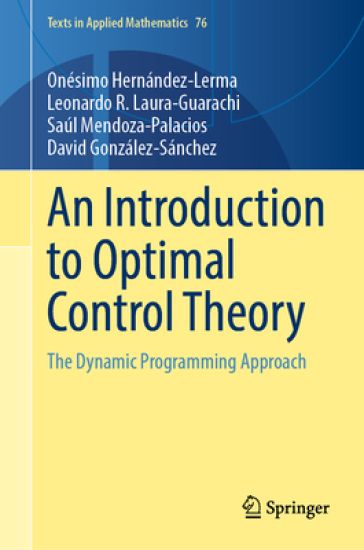
An Introduction to Optimal Control Theory

An Introduction to Optimal Control Theory

Onésimo Hernández-Lerma; Leonardo R. Laura-Guarachi; Saul Mendoza-Palacios; David González-Sánchez

Springer International Publishing AG
2024
nidottu
This book introduces optimal control problems for large families of deterministic and stochastic systems with discrete or continuous time parameter. These families include most of the systems studied in many disciplines, including Economics, Engineering, Operations Research, and Management Science, among many others. The main objective is to give a concise, systematic, and reasonably self contained presentation of some key topics in optimal control theory. To this end, most of the analyses are based on the dynamic programming (DP) technique. This technique is applicable to almost all control problems that appear in theory and applications. They include, for instance, finite and infinite horizon control problems in which the underlying dynamic system follows either a deterministic or stochastic difference or differential equation. In the infinite horizon case, it also uses DP to study undiscounted problems, such as the ergodic or long-run average cost. After a general introduction to control problems, the book covers the topic dividing into four parts with different dynamical systems: control of discrete-time deterministic systems, discrete-time stochastic systems, ordinary differential equations, and finally a general continuous-time MCP with applications for stochastic differential equations. The first and second part should be accessible to undergraduate students with some knowledge of elementary calculus, linear algebra, and some concepts from probability theory (random variables, expectations, and so forth). Whereas the third and fourth part would be appropriate for advanced undergraduates or graduate students who have a working knowledge of mathematical analysis (derivatives, integrals, ...) and stochastic processes.
An Introduction to Optimal Control Theory

An Introduction to Optimal Control Theory

Onésimo Hernández-Lerma; Leonardo R. Laura-Guarachi; Saul Mendoza-Palacios; David González-Sánchez

Springer International Publishing AG
2023
sidottu
This book introduces optimal control problems for large families of deterministic and stochastic systems with discrete or continuous time parameter. These families include most of the systems studied in many disciplines, including Economics, Engineering, Operations Research, and Management Science, among many others. The main objective is to give a concise, systematic, and reasonably self contained presentation of some key topics in optimal control theory. To this end, most of the analyses are based on the dynamic programming (DP) technique. This technique is applicable to almost all control problems that appear in theory and applications. They include, for instance, finite and infinite horizon control problems in which the underlying dynamic system follows either a deterministic or stochastic difference or differential equation. In the infinite horizon case, it also uses DP to study undiscounted problems, such as the ergodic or long-run average cost. After a general introduction to control problems, the book covers the topic dividing into four parts with different dynamical systems: control of discrete-time deterministic systems, discrete-time stochastic systems, ordinary differential equations, and finally a general continuous-time MCP with applications for stochastic differential equations. The first and second part should be accessible to undergraduate students with some knowledge of elementary calculus, linear algebra, and some concepts from probability theory (random variables, expectations, and so forth). Whereas the third and fourth part would be appropriate for advanced undergraduates or graduate students who have a working knowledge of mathematical analysis (derivatives, integrals, ...) and stochastic processes.
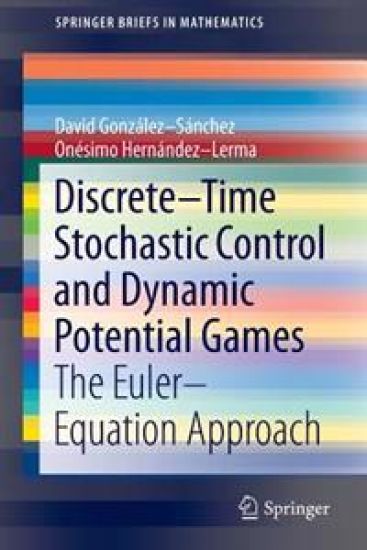
Discrete–Time Stochastic Control and Dynamic Potential Games

Discrete–Time Stochastic Control and Dynamic Potential Games

David González-Sánchez; Onésimo Hernández-Lerma

Springer International Publishing AG
2013
nidottu
? There are several techniques to study noncooperative dynamic games, such as dynamic programming and the maximum principle (also called the Lagrange method). It turns out, however, that one way to characterize dynamic potential games requires to analyze inverse optimal control problems, and it is here where the Euler equation approach comes in because it is particularly well–suited to solve inverse problems. Despite the importance of dynamic potential games, there is no systematic study about them. This monograph is the first attempt to provide a systematic, self–contained presentation of stochastic dynamic potential games.
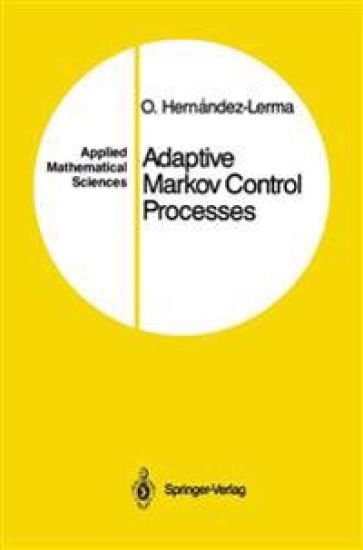
Adaptive Markov Control Processes

Adaptive Markov Control Processes

Onesimo Hernandez-Lerma

Springer-Verlag New York Inc.
2012
nidottu
This book is concerned with a class of discrete-time stochastic control processes known as controlled Markov processes (CMP's), also known as Markov decision processes or Markov dynamic programs. Starting in the mid-1950swith Richard Bellman, many contributions to CMP's have been made, and applications to engineering, statistics and operations research, among other areas, have also been developed. The purpose of this book is to present some recent developments on the theory of adaptive CMP's, i. e. , CMP's that depend on unknown parameters. Thus at each decision time, the controller or decision-maker must estimate the true parameter values, and then adapt the control actions to the estimated values. We do not intend to describe all aspects of stochastic adaptive control; rather, the selection of material reflects our own research interests. The prerequisite for this book is a knowledgeof real analysis and prob­ ability theory at the level of, say, Ash (1972) or Royden (1968), but no previous knowledge of control or decision processes is required. The pre­ sentation, on the other hand, is meant to beself-contained,in the sensethat whenever a result from analysisor probability is used, it is usually stated in full and references are supplied for further discussion, if necessary. Several appendices are provided for this purpose. The material is divided into six chapters. Chapter 1 contains the basic definitions about the stochastic control problems we are interested in; a brief description of some applications is also provided.
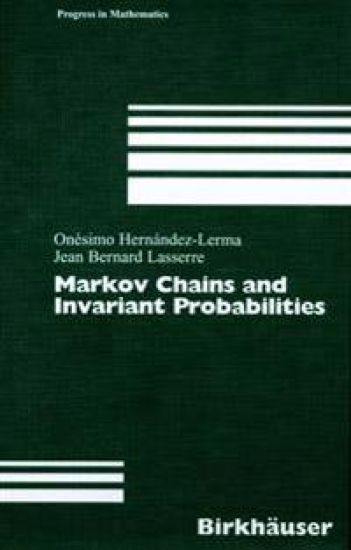
Markov Chains and Invariant Probabilities

Markov Chains and Invariant Probabilities

Onésimo Hernández-Lerma; Jean B. Lasserre

Springer Basel
2012
nidottu
This book is about discrete-time, time-homogeneous, Markov chains (Mes) and their ergodic behavior. To this end, most of the material is in fact about stable Mes, by which we mean Mes that admit an invariant probability measure. To state this more precisely and give an overview of the questions we shall be dealing with, we will first introduce some notation and terminology. Let (X,B) be a measurable space, and consider a X-valued Markov chain ~. = {~k' k = 0, 1, ... } with transition probability function (t.pJ.) P(x, B), i.e., P(x, B) := Prob (~k+1 E B I ~k = x) for each x E X, B E B, and k = 0,1, .... The Me ~. is said to be stable if there exists a probability measure (p.m.) /.l on B such that (*) VB EB. /.l(B) = Ix /.l(dx) P(x, B) If (*) holds then /.l is called an invariant p.m. for the Me ~. (or the t.p.f. P).
Further Topics on Discrete-Time Markov Control Processes

Further Topics on Discrete-Time Markov Control Processes

Onesimo Hernandez-Lerma; Jean B. Lasserre

Springer-Verlag New York Inc.
2012
nidottu
This book presents the second part of a two-volume series devoted to a sys­ tematic exposition of some recent developments in the theory of discrete­ time Markov control processes (MCPs). As in the first part, hereafter re­ ferred to as "Volume I" (see Hernandez-Lerma and Lasserre [1]), interest is mainly confined to MCPs with Borel state and control spaces, and possibly unbounded costs. However, an important feature of the present volume is that it is essentially self-contained and can be read independently of Volume I. The reason for this independence is that even though both volumes deal with similar classes of MCPs, the assumptions on the control models are usually different. For instance, Volume I deals only with nonnegative cost­ per-stage functions, whereas in the present volume we allow cost functions to take positive or negative values, as needed in some applications. Thus, many results in Volume Ion, say, discounted or average cost problems are not applicable to the models considered here. On the other hand, we now consider control models that typically re­ quire more restrictive classes of control-constraint sets and/or transition laws. This loss of generality is, of course, deliberate because it allows us to obtain more "precise" results. For example, in a very general context, in §4.
Discrete-Time Markov Control Processes

Discrete-Time Markov Control Processes

Onesimo Hernandez-Lerma; Jean B. Lasserre

Springer-Verlag New York Inc.
2012
nidottu
This book presents the first part of a planned two-volume series devoted to a systematic exposition of some recent developments in the theory of discrete-time Markov control processes (MCPs). Interest is mainly confined to MCPs with Borel state and control (or action) spaces, and possibly unbounded costs and noncompact control constraint sets. MCPs are a class of stochastic control problems, also known as Markov decision processes, controlled Markov processes, or stochastic dynamic pro­ grams; sometimes, particularly when the state space is a countable set, they are also called Markov decision (or controlled Markov) chains. Regardless of the name used, MCPs appear in many fields, for example, engineering, economics, operations research, statistics, renewable and nonrenewable re­ source management, (control of) epidemics, etc. However, most of the lit­ erature (say, at least 90%) is concentrated on MCPs for which (a) the state space is a countable set, and/or (b) the costs-per-stage are bounded, and/or (c) the control constraint sets are compact. But curiously enough, the most widely used control model in engineering and economics--namely the LQ (Linear system/Quadratic cost) model-satisfies none of these conditions. Moreover, when dealing with "partially observable" systems) a standard approach is to transform them into equivalent "completely observable" sys­ tems in a larger state space (in fact, a space of probability measures), which is uncountable even if the original state process is finite-valued.
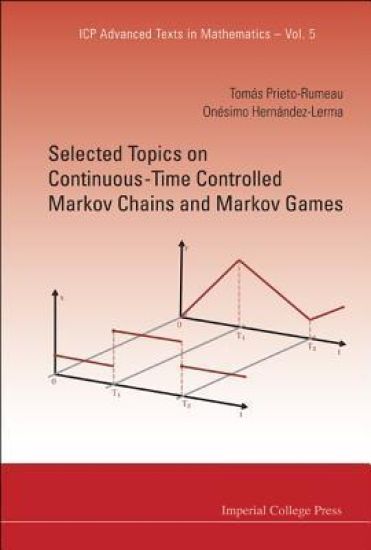
Selected Topics On Continuous-time Controlled Markov Chains And Markov Games

Selected Topics On Continuous-time Controlled Markov Chains And Markov Games

Tomas Prieto-rumeau; Onesimo Hernandez-lerma

Imperial College Press
2012
sidottu
This book concerns continuous-time controlled Markov chains, also known as continuous-time Markov decision processes. They form a class of stochastic control problems in which a single decision-maker wishes to optimize a given objective function. This book is also concerned with Markov games, where two decision-makers (or players) try to optimize their own objective function. Both decision-making processes appear in a large number of applications in economics, operations research, engineering, and computer science, among other areas. An extensive, self-contained, up-to-date analysis of basic optimality criteria (such as discounted and average reward), and advanced optimality criteria (e.g., bias, overtaking, sensitive discount, and Blackwell optimality) is presented. A particular emphasis is made on the application of the results herein: algorithmic and computational issues are discussed, and applications to population models and epidemic processes are shown. This book is addressed to students and researchers in the fields of stochastic control and stochastic games. Moreover, it could be of interest also to undergraduate and beginning graduate students because the reader is not supposed to have a high mathematical background: a working knowledge of calculus, linear algebra, probability, and continuous-time Markov chains should suffice to understand the contents of the book.
Continuous-Time Markov Decision Processes

Continuous-Time Markov Decision Processes

Xianping Guo; Onésimo Hernández-Lerma

Springer-Verlag Berlin and Heidelberg GmbH Co. K
2012
nidottu
Continuous-time Markov decision processes (MDPs), also known as controlled Markov chains, are used for modeling decision-making problems that arise in operations research (for instance, inventory, manufacturing, and queueing systems), computer science, communications engineering, control of populations (such as fisheries and epidemics), and management science, among many other fields. This volume provides a unified, systematic, self-contained presentation of recent developments on the theory and applications of continuous-time MDPs. The MDPs in this volume include most of the cases that arise in applications, because they allow unbounded transition and reward/cost rates. Much of the material appears for the first time in book form.
Continuous-Time Markov Decision Processes

Continuous-Time Markov Decision Processes

Xianping Guo; Onésimo Hernández-Lerma

Springer-Verlag Berlin and Heidelberg GmbH Co. K
2009
sidottu
Continuous-time Markov decision processes (MDPs), also known as controlled Markov chains, are used for modeling decision-making problems that arise in operations research (for instance, inventory, manufacturing, and queueing systems), computer science, communications engineering, control of populations (such as fisheries and epidemics), and management science, among many other fields. This volume provides a unified, systematic, self-contained presentation of recent developments on the theory and applications of continuous-time MDPs. The MDPs in this volume include most of the cases that arise in applications, because they allow unbounded transition and reward/cost rates. Much of the material appears for the first time in book form.
Markov Chains and Invariant Probabilities

Markov Chains and Invariant Probabilities

Onésimo Hernández-Lerma; Jean B. Lasserre

Birkhauser Verlag AG
2003
sidottu
This book is about discrete-time, time-homogeneous, Markov chains (Mes) and their ergodic behavior. To this end, most of the material is in fact about stable Mes, by which we mean Mes that admit an invariant probability measure. To state this more precisely and give an overview of the questions we shall be dealing with, we will first introduce some notation and terminology. Let (X,B) be a measurable space, and consider a X-valued Markov chain ~. = {~k' k = 0, 1, ... } with transition probability function (t.pJ.) P(x, B), i.e., P(x, B) := Prob (~k+1 E B I ~k = x) for each x E X, B E B, and k = 0,1, .... The Me ~. is said to be stable if there exists a probability measure (p.m.) /.l on B such that (*) VB EB. /.l(B) = Ix /.l(dx) P(x, B) If (*) holds then /.l is called an invariant p.m. for the Me ~. (or the t.p.f. P).
Further Topics on Discrete-Time Markov Control Processes

Further Topics on Discrete-Time Markov Control Processes

Onesimo Hernandez-Lerma; Jean B. Lasserre

Springer-Verlag New York Inc.
1999
sidottu
This book presents the second part of a two-volume series devoted to a sys­ tematic exposition of some recent developments in the theory of discrete­ time Markov control processes (MCPs). As in the first part, hereafter re­ ferred to as "Volume I" (see Hernandez-Lerma and Lasserre [1]), interest is mainly confined to MCPs with Borel state and control spaces, and possibly unbounded costs. However, an important feature of the present volume is that it is essentially self-contained and can be read independently of Volume I. The reason for this independence is that even though both volumes deal with similar classes of MCPs, the assumptions on the control models are usually different. For instance, Volume I deals only with nonnegative cost­ per-stage functions, whereas in the present volume we allow cost functions to take positive or negative values, as needed in some applications. Thus, many results in Volume Ion, say, discounted or average cost problems are not applicable to the models considered here. On the other hand, we now consider control models that typically re­ quire more restrictive classes of control-constraint sets and/or transition laws. This loss of generality is, of course, deliberate because it allows us to obtain more "precise" results. For example, in a very general context, in §4.
Discrete-Time Markov Control Processes

Discrete-Time Markov Control Processes

Onesimo Hernandez-Lerma; Jean B. Lasserre

Springer-Verlag New York Inc.
1995
sidottu
This book presents the first part of a planned two-volume series devoted to a systematic exposition of some recent developments in the theory of discrete-time Markov control processes (MCPs). Interest is mainly confined to MCPs with Borel state and control (or action) spaces, and possibly unbounded costs and noncompact control constraint sets. MCPs are a class of stochastic control problems, also known as Markov decision processes, controlled Markov processes, or stochastic dynamic pro­ grams; sometimes, particularly when the state space is a countable set, they are also called Markov decision (or controlled Markov) chains. Regardless of the name used, MCPs appear in many fields, for example, engineering, economics, operations research, statistics, renewable and nonrenewable re­ source management, (control of) epidemics, etc. However, most of the lit­ erature (say, at least 90%) is concentrated on MCPs for which (a) the state space is a countable set, and/or (b) the costs-per-stage are bounded, and/or (c) the control constraint sets are compact. But curiously enough, the most widely used control model in engineering and economics--namely the LQ (Linear system/Quadratic cost) model-satisfies none of these conditions. Moreover, when dealing with "partially observable" systems) a standard approach is to transform them into equivalent "completely observable" sys­ tems in a larger state space (in fact, a space of probability measures), which is uncountable even if the original state process is finite-valued.
Adaptive Markov Control Processes

Adaptive Markov Control Processes

Onesimo Hernandez-Lerma

Springer-Verlag New York Inc.
1989
sidottu
This book is concerned with a class of discrete-time stochastic control processes known as controlled Markov processes (CMP's), also known as Markov decision processes or Markov dynamic programs. Starting in the mid-1950swith Richard Bellman, many contributions to CMP's have been made, and applications to engineering, statistics and operations research, among other areas, have also been developed. The purpose of this book is to present some recent developments on the theory of adaptive CMP's, i. e. , CMP's that depend on unknown parameters. Thus at each decision time, the controller or decision-maker must estimate the true parameter values, and then adapt the control actions to the estimated values. We do not intend to describe all aspects of stochastic adaptive control; rather, the selection of material reflects our own research interests. The prerequisite for this book is a knowledgeof real analysis and prob­ ability theory at the level of, say, Ash (1972) or Royden (1968), but no previous knowledge of control or decision processes is required. The pre­ sentation, on the other hand, is meant to beself-contained,in the sensethat whenever a result from analysisor probability is used, it is usually stated in full and references are supplied for further discussion, if necessary. Several appendices are provided for this purpose. The material is divided into six chapters. Chapter 1 contains the basic definitions about the stochastic control problems we are interested in; a brief description of some applications is also provided.