Kirjojen hintavertailu – 12 859 824 kirjaa ja 27 kauppaa

Kirjailija

Oscar Wilde

Kirjat ja teokset yhdessä paikassa: 2 744 kirjaa, julkaisuja vuosilta 1890–2026, suosituimpiin kuuluu Aforismeja. Vertaile teosten hintoja ja tarkista saatavuus suomalaisista kirjakaupoista.

2 744 kirjaa

Kirjojen julkaisuvuodet: 1890–2026.

Salomé, Drame En Un Acte

Salomé, Drame En Un Acte

Oscar Wilde

Hachette Livre - BNF
2018
pokkari
Salome, drame en un acte / Oscar WildeDate de l'edition originale: 1907Ce livre est la reproduction fidele d une uvre publiee avant 1920 et fait partie d une collection de livres reimprimes a la demande editee par Hachette Livre, dans le cadre d un partenariat avec la Bibliotheque nationale de France, offrant l opportunite d acceder a des ouvrages anciens et souvent rares issus des fonds patrimoniaux de la BnF. Les uvres faisant partie de cette collection ont ete numerisees par la BnF et sont presentes sur Gallica, sa bibliotheque numerique. En entreprenant de redonner vie a ces ouvrages au travers d une collection de livres reimprimes a la demande, nous leur donnons la possibilite de rencontrer un public elargi et participons a la transmission de connaissances et de savoirs parfois difficilement accessibles. Nous avons cherche a concilier la reproduction fidele d un livre ancien a partir de sa version numerisee avec le souci d un confort de lecture optimal. Nous esperons que les ouvrages de cette nouvelle collection vous apporteront entiere satisfaction. Pour plus d informations, rendez-vous sur www.hachettebnf.fr
A Woman of No Importance

A Woman of No Importance

Oscar Wilde

Createspace Independent Publishing Platform
2018
nidottu
SCENE Lawn in front of the terrace at Hunstanton. Sir John and Lady Caroline Pontefract, Miss Worsley, on chairs under large yew tree.] Lady Caroline. I believe this is the first English country house you have stayed at, Miss Worsley? Hester. Yes, Lady Caroline. Lady Caroline. You have no country houses, I am told, in America? Hester. We have not many. Lady Caroline. Have you any country? What we should call country? Hester. Smiling.] We have the largest country in the world, Lady Caroline. They used to tell us at school that some of our states are as big as France and England put together. Lady Caroline. Ah you must find it very draughty, I should fancy. To Sir John.] John, you should have your muffler. What is the use of my always knitting mufflers for you if you won't wear them? Sir John. I am quite warm, Caroline, I assure you. Lady Caroline. I think not, John. Well, you couldn't come to a more charming place than this, Miss Worsley, though the house is excessively damp, quite unpardonably damp, and dear Lady Hunstanton is sometimes a little lax about the people she asks down here. To Sir John.] Jane mixes too much. Lord Illingworth, of course, is a man of high distinction. It is a privilege to meet him. And that member of Parliament, Mr. Kettle- Sir John. Kelvil, my love, Kelvil.
Lady Windermere's Fan

Lady Windermere's Fan

Oscar Wilde

Createspace Independent Publishing Platform
2018
nidottu
Morning-room of Lord Windermere's house in Carlton House Terrace. Doors C. and R. Bureau with books and papers R. Sofa with small tea-table L. Window opening on to terrace L. Table R. Lady Windermere is at table R., arranging roses in a blue bowl.] Enter Parker.] Parker. Is your ladyship at home this afternoon? Lady Windermere. Yes-who has called? Parker. Lord Darlington, my lady. Lady Windermere. Hesitates for a moment.] Show him up-and I'm at home to any one who calls. Parker. Yes, my lady. Exit C.] Lady Windermere. It's best for me to see him before to-night. I'm glad he's come. Enter Parker C.] Parker. Lord Darlington, Enter Lord Darlington C.] Exit Parker.] Lord Darlington. How do you do, Lady Windermere? Lady Windermere. How do you do, Lord Darlington? No, I can't shake hands with you. My hands are all wet with these roses. Aren't they lovely? They came up from Selby this morning. Lord Darlington. They are quite perfect. Sees a fan lying on the table.] And what a wonderful fan May I look at it?
The Happy Prince: And Other Tales

The Happy Prince: And Other Tales

Oscar Wilde

Createspace Independent Publishing Platform
2018
nidottu
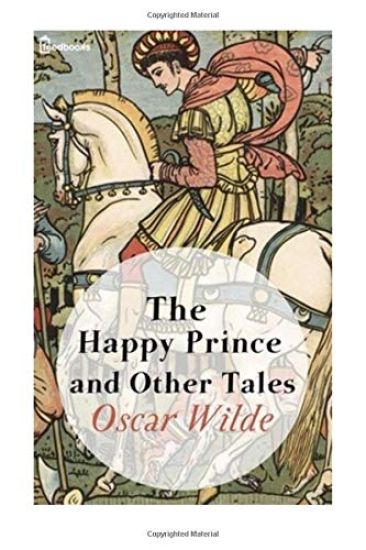
The Happy Prince and Other Tales by Oscar Wilde. A Collection of Stories for Children. The Happy Prince and Other Tales (sometimes called The Happy Prince and Other Stories) is a collection of stories for children by Oscar Wilde first published in May 1888. It contains five stories: "The Happy Prince", "The Nightingale and the Rose", "The Selfish Giant", "The Devoted Friend", and "The Remarkable Rocket". The Happy Prince: In a town where a lot of poor people suffer and where there are a lot of miseries, a swallow who was left behind after his flock flew off to Egypt for the winter, meets the statue of the late "Happy Prince," who in reality has never experienced true sorrow, for he lived in a palace where sorrow was not allowed to enter. Viewing various scenes of people suffering in poverty from his tall monument, the Happy Prince asks the swallow to take the ruby from his hilt, the sapphires from his eyes, and the golden leaf covering his body to give to the poor.
Salome

Salome

Oscar Wilde

Createspace Independent Publishing Platform
2018
nidottu
OSCAR WILDE Salome - bersetzt von Hedwig Lachmann - Erstdruck: Verlag: Bln.-Paris, F rstner 1905 - Neugesetzte Ausgabe, 1. Aulage 2018 Narraboth: "Wie sch n ist die Prinzessin Salome heute abend " Page (unruhig): "Du siehst sie immer an. ... Es ist gef hrlich, Menschen auf diese Art anzusehn. Schreckliches kann geschehn." LIWI Literatur- und Wissenschaftsverlag G ttingen
Lord Arthur Savile's Crime and other Stories

Lord Arthur Savile's Crime and other Stories

Oscar Wilde

Createspace Independent Publishing Platform
2018
nidottu
Lord Arthur Savile's Crime and Other Stories is a collection of short semi-comic mystery stories. This collection exemplifies Wilde's sharp wit and dark humour. Stories in this collection include Lord Arthur Savile's Crime, The Canterville Ghost, The Sphinx Without a Secret, The Model Millionaire, and The Portrait Of Mr W H.
The Canterville Ghost

The Canterville Ghost

Oscar Wilde

Createspace Independent Publishing Platform
2018
nidottu
A sophisticated American family, the Otis, buys the old English castle of the Canterville. The old owner then tells them that in the mansion he inhabits since time immemorial the wrathful ghost of Lord Simon Canterville, who killed his wife and whose body mysteriously disappeared afterwards. Far from being intimidated, the tenants buy the castle with the ghost included, and end up subjecting the poor anachronistic spectrum, which ends up being a toy and victim of the two terrible children of the family. The ghost is depressed and asks for help from a girl to help him die.
The Importance of Being Earnest

The Importance of Being Earnest

Oscar Wilde

Createspace Independent Publishing Platform
2018
nidottu
The Importance of Being Earnest is a play by Oscar Wilde. First performed on 14 February 1895 at the St James's Theatre in London, it is a farcical comedy in which the protagonists maintain fictitious person to escape burdensome social obligations. Working within the social conventions of late Victorian London, the play's major themes are the triviality with which it treats institutions as serious as marriage, and the resulting satire of Victorian ways. Some contemporary reviews praised the play's humour and the culmination of Wilde's artistic career, while others were cautious about its lack of social messages. Its high farce and witty dialogue have helped make The Importance of Being Earnest Wilde's most enduringly popular play. The successful opening night marked the climax of Wilde's career but also heralded his downfall. The Marquess of Queensberry, whose son Lord Alfred Douglas was Wilde's lover, planned to present the writer with a bouquet of rotten vegetables and disrupt the show. Wilde was tipped off and Queensberry was refused admission. Their feud came to a climax in court, where Wilde's homosexuality was revealed to the Victorian public and he was sentenced to imprisonment. Despite the play's early success, Wilde's notoriety caused the play to be closed after 86 performances. After his release from prison, he published the play from exile in Paris, but he wrote no further comic or dramatic work. The Importance of Being Earnest has been revived many times since its premiere. It has been adapted for the cinema on three occasions. In The Importance of Being Earnest (1952), Dame Edith Evans reprised her celebrated interpretation of Lady Bracknell; The Importance of Being Earnest (1992) by Kurt Baker used an all-black cast; and Oliver Parker's The Importance of Being Earnest (2002) incorporated some of Wilde's original material cut during the preparation of the original stage production.
The Importance of Being Earnest

The Importance of Being Earnest

Oscar Wilde

Createspace Independent Publishing Platform
2018
nidottu
The Importance of Being Earnest is a play by Oscar Wilde. First performed on February 14th 1895 at the St James's Theatre in London, it is a farcical comedy in which the protagonists maintain fictitious person to escape burdensome social obligations. Working within the social conventions of late Victorian London, the play's major themes are the triviality with which it treats institutions as serious as marriage, and the resulting satire of Victorian ways. Some contemporary reviews praised the play's humour and the culmination of Wilde's artistic career, while others were cautious about its lack of social messages. Its high farce and witty dialogue have helped make The Importance of Being Earnest Wilde's most enduringly popular play. The successful opening night marked the climax of Wilde's career but also heralded his downfall. The Marquess of Queensberry, whose son Lord Alfred Douglas was Wilde's lover, planned to present the writer with a bouquet of rotten vegetables and disrupt the show. Wilde was tipped off and Queensberry was refused admission. Their feud came to a climax in court, where Wilde's homosexuality was revealed to the Victorian public and he was sentenced to imprisonment. Despite the play's early success, Wilde's notoriety caused the play to be closed after 86 performances. After his release from prison, he published the play from exile in Paris, but he wrote no further comic or dramatic work.
The Picture of Dorian Gray

The Picture of Dorian Gray

Oscar Wilde

Createspace Independent Publishing Platform
2018
nidottu
The plot of the novel varies between each of the published versions. The summary below deals with the longest version, the 1891 novel. However, certain episodes described-in particular Dorian's encounter with, and murder of, James Vane-do not appear in the version originally submitted by Wilde to Lippincott's. The Picture of Dorian Gray begins on a beautiful summer day in Victorian era England, where Lord Henry Wotton, an opinionated man, is observing the sensitive artist Basil Hallward painting the portrait of Dorian Gray, a handsome young man who is Basil's ultimate muse. While sitting for the painting, Dorian listens to Lord Henry espousing his hedonistic world view, and begins to think that beauty is the only aspect of life worth pursuing. This prompts Dorian to wish that the painted image of himself would age instead of himself.
Salome: A Tragedy in One Act

Salome: A Tragedy in One Act

Oscar Wilde

Createspace Independent Publishing Platform
2018
nidottu

Halvin toimitettuna 16,40 €

Translated from the French of Oscar Wilde with illustrations by Aubrey Beardsley 1894]. Salome is a tragedy by Oscar Wilde. The original 1891 version of the play was in French. Three years later an English translation was published. The play tells in one act the Biblical story of Salome, stepdaughter of the tetrarch Herod Antipas, who, to her stepfather's dismay but to the delight of her mother Herodias, requests the head of Jokanaan (John the Baptist) on a silver platter as a reward for dancing the dance of the seven veils. Wilde's play Salom is the distortion of the Biblical story through the creation of Salom as a victim and victimiser. She is the incarnation of seductive lust and manipulative power. Salom is the object of lust and perverted desire leading to her twisted obsession in the beheading of John the Baptist. Keijser believes that Wilde was influenced by the Bible's word choice and style, adapting Bible verses and diction generously. Biblical images, symbols, and diction are referenced from the Gospels, Isaiah, Song of Solomon and the Book of Revelation. Wilde even gives John the Baptist a more derived biblical Hebrew name with Iokannan.
The Importance of Being Earnest: A Trivial Comedy for Serious People

The Importance of Being Earnest: A Trivial Comedy for Serious People

Oscar Wilde

Createspace Independent Publishing Platform
2018
nidottu
The Importance of Being Earnest, A Trivial Comedy for Serious People is a play by Oscar Wilde. First performed on 14 February 1895 at the St James's Theatre in London, it is a farcical comedy in which the protagonists maintain fictitious person to escape burdensome social obligations. The play opens with Algernon Moncrieff, an idle young gentleman, receiving his best friend, Jack Worthing ('Ernest'). Ernest has come from the country to propose to Algernon's cousin, Gwendolen Fairfax. Algernon refuses to consent until Ernest explains why his cigarette case bears the inscription, "From little Cecily, with her fondest love to her dear Uncle Jack." 'Ernest' is forced to admit to living a double life. In the country, he assumes a serious attitude for the benefit of his young ward, the heiress Cecily Cardew, and goes by the name of John (or Jack), while pretending that he must worry about a wastrel younger brother named Ernest in London. In the city, meanwhile, he assumes the identity of the libertine Ernest. Algernon confesses a similar deception: he pretends to have an invalid friend named Bunbury in the country, whom he can "visit" whenever he wishes to avoid an unwelcome social obligation. Jack refuses to tell Algernon the location of his country estate.