Kirjojen hintavertailu – 12 903 725 kirjaa ja 27 kauppaa
Kirjailija
P. D. Ouspensky
Kirjat ja teokset yhdessä paikassa: 87 kirjaa, julkaisuja vuosilta 1973–2026, suosituimpiin kuuluu Strange Life of Ivan Osokin. Vertaile teosten hintoja ja tarkista saatavuus suomalaisista kirjakaupoista.
Nimi esiintyy myös muodoissa: P D Ouspensky, P.D. Ouspensky
"I have called this system of higher logic Tertium Organum because for us it is the third canon-third instrument-of thought after those of Aristotle and Bacon. The first was Organon, the second, Novum Organum. But the third existed earlier than the first." TERTIUM ORGANUM
Die Psychologie, die Ouspensky in diesen Einführungs-Vorträgen erläutert, existiert in der einen oder anderen Form bereits seit Tausenden von Jahren. Im Gegensatz zur moderneren Psychologie betrachtet sie den Menschen von dem Gesichtspunkt aus, was er werden kann. Sobald ein Mensch einmal erkennt, wie wenig Kontrolle er über seine Reaktionen auf äußere Umstände und innere Reize besitzt, mag der Wunsch in ihm erwachen, einen Weg zu finden, sich von dieser mechanischen Lebensweise zu befreien. Ouspensky beschreibt, wie ein Mensch gleichzeitig an seinem Wissen und Sein arbeiten muß, um innere Einheit zu erlangen, und warum es sehr schwierig ist, sie ohne die Hilfe einer ? Schule? zu erreichen, auch wenn die Entwicklung von den eigenen Anstrengungen abhängt. Dies ist ein Quellenwerk ersten Ranges, ein Einführung zum ? Vierten Weg? aus erster Hand.
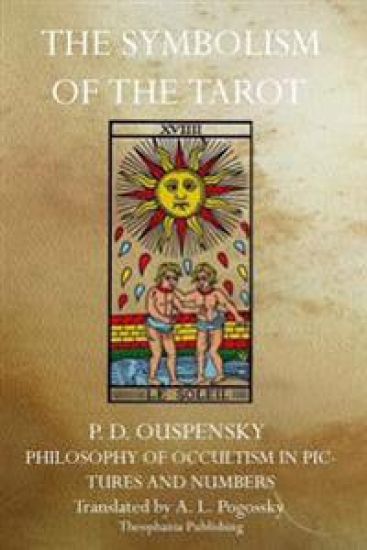
Symbolism of the Tarot is a book written by P. D. Ouspensky that delves into the mystical and symbolic meanings behind the Tarot cards. The book explores the origins of the Tarot and its connections to ancient mystery traditions, as well as the symbolism and significance of each individual card. Ouspensky examines the Tarot as a tool for divination and self-discovery, and provides insights into the deeper spiritual meanings behind the cards. The book is a comprehensive guide to the Tarot, providing readers with a thorough understanding of its symbolism and significance. It is a must-read for anyone interested in esoteric traditions, symbolism, and the Tarot. This Is A New Release Of The Original 1913 Edition. This scarce antiquarian book is a facsimile reprint of the old original and may contain some imperfections such as library marks and notations. Because we believe this work is culturally important, we have made it available as part of our commitment for protecting, preserving, and promoting the world's literature in affordable, high quality, modern editions, that are true to their original work.
Tertium Organum is a philosophical book written by P. D. Ouspensky, first published in 1912. The title refers to Aristotle's Organon, which was a treatise on logic and syllogism. Ouspensky's book is an attempt to present a new system of thought that goes beyond the limitations of traditional logic and reason. It explores the nature of reality and consciousness, and proposes a new way of understanding the world based on higher dimensions of existence. The book is divided into three parts, each of which builds on the previous one. The first part introduces the concept of higher dimensions and their relationship to human consciousness. The second part explores the implications of these ideas for science, philosophy, and religion. The third part presents a practical guide to applying these ideas in daily life. Throughout the book, Ouspensky draws on a wide range of sources, including Eastern mysticism, modern physics, and the works of philosophers such as Kant and Hegel. Tertium Organum is a challenging and thought-provoking work that has influenced many thinkers in the fields of philosophy, psychology, and spirituality. This Is A New Release Of The Original 1920 Edition. This scarce antiquarian book is a facsimile reprint of the old original and may contain some imperfections such as library marks and notations. Because we believe this work is culturally important, we have made it available as part of our commitment for protecting, preserving, and promoting the world's literature in affordable, high quality, modern editions, that are true to their original work.
The Strange Life of Ivan Osokin is a philosophical novel written by P. D. Ouspensky. The story follows the life of Ivan Osokin, a young man who is given a second chance at life after a failed suicide attempt. Ivan is transported back in time to relive his life, hoping to make different choices and change his fate. However, he soon realizes that he is doomed to repeat the same mistakes and encounter the same people, leading him to question the nature of free will and the possibility of escaping one's destiny. The novel explores themes of time, fate, and the human condition, and offers a thought-provoking perspective on the nature of existence. This is a new release of the original 1947 edition. This scarce antiquarian book is a facsimile reprint of the old original and may contain some imperfections such as library marks and notations. Because we believe this work is culturally important, we have made it available as part of our commitment for protecting, preserving, and promoting the world's literature in affordable, high quality, modern editions, that are true to their original work.
Thank you for checking out this book by Theophania Publishing. We appreciate your business and look forward to serving you soon. We have thousands of titles available, and we invite you to search for us by name, contact us via our website, or download our most recent catalogues. No study of occult philosophy is possible without an acquaintance with symbolism, for if the words occultism and symbolism are correctly used, they mean almost one and the same thing. Symbolism cannot be learned as one learns to build bridges or speak a foreign language, and for the interpretation of symbols a special cast of mind is necessary; in addition to knowledge, special faculties, the power of creative thought and a developed imagination are required. One who understands the use of symbolism in the arts, knows, in a general way, what is meant by occult symbolism. But even then a special training of the mind is necessary, in order to comprehend the "language of the Initiates", and to express in this language the intuitions as they arise.
When Tertium Organum burst onto the New York literary scene its author, P. D. Ouspensky, was unaware of it. Piotr Demianovich Ouspensky, the most famous pupil of Greco-Armenian spiritual teacher George Ivanovitch Gurdjieff, had written Kluck Kzaradkam (the original title) in his native Russian and it had been published in St. Petersburg in 1912. At the time of its New York debut his whereabouts were unknown. A Russian by the name of Nicholas Bessarabof had emigrated to America before the 1917 Russian Revolution and had taken the book with him. He gave a copy to architect Claude Bragdon who could read Russian and was interested in forth-dimensional consciousness. After reading the book a friend echoed Bragdons' sentiments saying; He has recently discovered a young Russian who "seems to us remarkable in many ways." The man has introduced him to Ouspensky and his book on the fourth dimension called Tertium Organum. Bragdon believes this book to be the "long sought New Testament of the Sixth Race which will justify the meekness of the saint, the vision of the mystic, and create a new heaven and a new earth." He is currently collaborating with Bessarabof on an English translation. A" In 1920 without Ouspensky's knowledge, Bragdon and Bessarabof published the book in English through Manas Press in New York. Meanwhile Ouspensky, a journalist and destitute author, had arrived in Constantinople with hardly a penny to his name. Later that year he was gratified to receive a substantial royalty check, and the news that Tertium Organum was a publishing success in English, and that his fame in literary circles was assured. In 1921 he wrote, "This translation, made without my knowledge and participation, at a time when I was cut off by war and revolution from the civilized world, transmits my thought so exactly that after a very attentive review of the book I could find only one word to correct. Such a result could be achieved only because Mr. Bessarabof and Mr. Bragdon were not translating words merely, but were grasping directly my thoughts at the back of them." In May 1921 Ouspensky received the sum of GBP100 from Lady Rothermere who was in Rochester, New York; it was wired with the message: 'Deeply impressed by your book Tertium Organum - wish to meet you in New York or London - will pay all expenses.'This invitation gave Ouspensky the opportunity to move to England where he secured Gurdjieff's permission to write a book on his philosophy. Ouspensky spent the next twenty years in England lecturing and teaching Gurdjieff's ideas and developing his own philosophy. His lectures in London were attended by such literary figures as Aldous Huxley, T. S. Eliot, and other writers, journalists and doctors. His influence on the literary scene of the 1920's and 1930's as well as on the Russian avant-garde was huge but today he is not widely known.
Time is motion. Prepare for a mind bending ride through the world of human perception, consciousness, and thought. A new look at the concept of space and time. Is there a fourth dimension hiding in what we perceive to be time? Can some adjustment of consciousness allow us to see it? A huge evolutionary leap and a book that will challenge the way you think about what you thought you knew.
This is one of the Great Books on the Great Mystery..... do you have a mind balanced and broad enough to grasp it? Time is really motion in extra dimensional space... this profound thought can point us towards the actual physical location of the "Fourth Dimension". Our perception confuses this Dimension with Time, but with an evolution of consciousness, it can be percieved. This is the next huge Evolutionary Leap, both for the individual and for Mankind, in understanding the true nature of the Universe and Reality. Peter D. Ouspesky was a widely traveled Russian born philosopher, who made his way to London after the Bolshevik Revolution. He was associated with Gurdjieff for many years, but ultimately seperated both from the man and the philosophy. Ouspensky's work stands apart and above, as writing of rare lucidity and clarity.