Kirjojen hintavertailu – 12 903 725 kirjaa ja 27 kauppaa

Kirjailija

P.G. Sankaran

Kirjat ja teokset yhdessä paikassa: 3 kirjaa, julkaisuja vuosilta 2013–2018, suosituimpiin kuuluu Quantile-Based Reliability Analysis. Vertaile teosten hintoja ja tarkista saatavuus suomalaisista kirjakaupoista.

3 kirjaa

Kirjojen julkaisuvuodet: 2013–2018.

Reliability Modelling and Analysis in Discrete Time

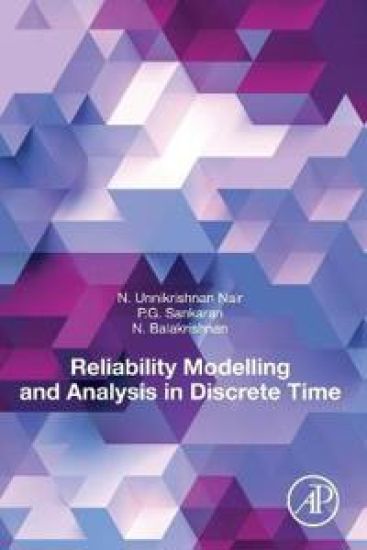
Reliability Modelling and Analysis in Discrete Time

Unnikrishnan Nair; P.G. Sankaran; N. Balakrishnan

Academic Press Inc
2018
nidottu
Reliability Modelling and Analysis in Discrete Time provides an overview of the probabilistic and statistical aspects connected with discrete reliability systems. This engaging book discusses their distributional properties and dependence structures before exploring various orderings associated between different reliability structures. Though clear explanations, multiple examples, and exhaustive coverage of the basic and advanced topics of research in this area, the work gives the reader a thorough understanding of the theory and concepts associated with discrete models and reliability structures. A comprehensive bibliography assists readers who are interested in further research and understanding. Requiring only an introductory understanding of statistics, this book offers valuable insight and coverage for students and researchers in Probability and Statistics, Electrical Engineering, and Reliability/Quality Engineering. The book also includes a comprehensive bibliography to assist readers seeking to delve deeper.
Quantile-Based Reliability Analysis

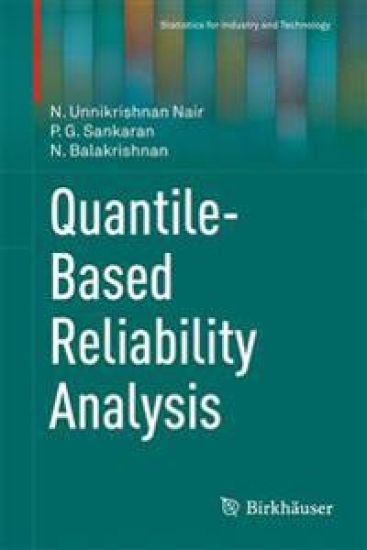
Quantile-Based Reliability Analysis

N. Unnikrishnan Nair; P.G. Sankaran; N. Balakrishnan

Birkhauser Boston Inc
2016
nidottu
Quantile-Based Reliability Analysis presents a novel approach to reliability theory using quantile functions in contrast to the traditional approach based on distribution functions. Quantile functions and distribution functions are mathematically equivalent ways to define a probability distribution. However, quantile functions have several advantages over distribution functions. First, many data sets with non-elementary distribution functions can be modeled by quantile functions with simple forms. Second, most quantile functions approximate many of the standard models in reliability analysis quite well. Consequently, if physical conditions do not suggest a plausible model, an arbitrary quantile function will be a good first approximation. Finally, the inference procedures for quantile models need less information and are more robust to outliers. Quantile-Based Reliability Analysis’s innovative methodology is laid out in a well-organized sequence of topics, including: · Definitions and properties of reliability concepts in terms of quantile functions;· Ageing concepts and their interrelationships;· Total time on test transforms;· L-moments of residual life;· Score and tail exponent functions and relevant applications;· Modeling problems and stochastic orders connecting quantile-based reliability functions. An ideal text for advanced undergraduate and graduate courses in reliability and statistics, Quantile-Based Reliability Analysis also contains many unique topics for study and research in survival analysis, engineering, economics, and the medical sciences. In addition, its illuminating discussion of the general theory of quantile functions is germane to many contexts involving statistical analysis.
Quantile-Based Reliability Analysis

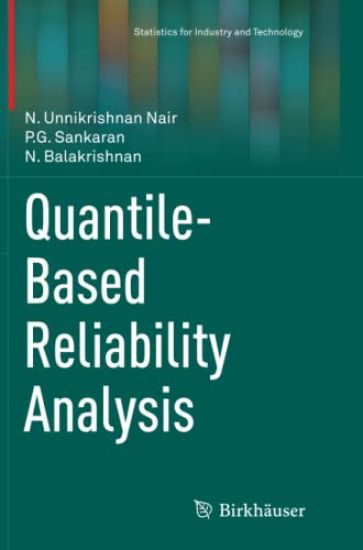
Quantile-Based Reliability Analysis

N. Unnikrishnan Nair; P.G. Sankaran; N. Balakrishnan

Birkhauser Boston Inc
2013
sidottu
Quantile-Based Reliability Analysis presents a novel approach to reliability theory using quantile functions in contrast to the traditional approach based on distribution functions. Quantile functions and distribution functions are mathematically equivalent ways to define a probability distribution. However, quantile functions have several advantages over distribution functions. First, many data sets with non-elementary distribution functions can be modeled by quantile functions with simple forms. Second, most quantile functions approximate many of the standard models in reliability analysis quite well. Consequently, if physical conditions do not suggest a plausible model, an arbitrary quantile function will be a good first approximation. Finally, the inference procedures for quantile models need less information and are more robust to outliers. Quantile-Based Reliability Analysis’s innovative methodology is laid out in a well-organized sequence of topics, including: · Definitions and properties of reliability concepts in terms of quantile functions;· Ageing concepts and their interrelationships;· Total time on test transforms;· L-moments of residual life;· Score and tail exponent functions and relevant applications;· Modeling problems and stochastic orders connecting quantile-based reliability functions. An ideal text for advanced undergraduate and graduate courses in reliability and statistics, Quantile-Based Reliability Analysis also contains many unique topics for study and research in survival analysis, engineering, economics, and the medical sciences. In addition, its illuminating discussion of the general theory of quantile functions is germane to many contexts involving statistical analysis.