Kirjojen hintavertailu – 12 903 725 kirjaa ja 27 kauppaa

Kirjailija

P. H. Liotta

Kirjat ja teokset yhdessä paikassa: 4 kirjaa, julkaisuja vuosilta 2001–2012, suosituimpiin kuuluu Dismembering the State. Vertaile teosten hintoja ja tarkista saatavuus suomalaisista kirjakaupoista.

4 kirjaa

Kirjojen julkaisuvuodet: 2001–2012.

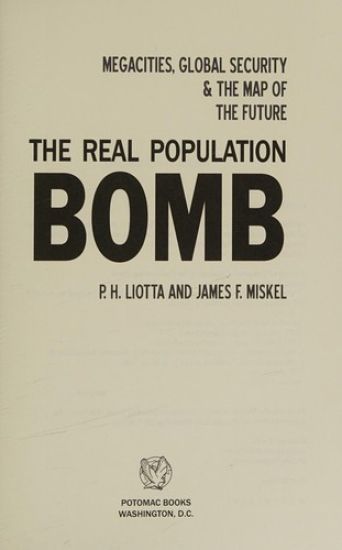
The Real Population Bomb

The Real Population Bomb

P. H. Liotta; James F. Miskel

Potomac Books Inc
2012
sidottu
Shocking in description and crammed with detail, this book is about where and how geopolitics plays out in the twenty-first century. Drawing on the authors’ three decades of international field work and seasoned policy analysis, The Real Population Bomb hits like a pile driver. Its essential truths can no longer be ignored: we have never been here before in human history. The choices we make in this next decade will determine the fate of human societies. By 2025, twenty-seven cities will have populations greater than ten million and over six hundred cities will have populations greater than one million. Specific megacities, intimately connected to globalization, are posing huge security challenges—now. Liotta and Miskel focus intensely on effects these massive, underserved, and undergoverned cities have on international stability, human security, and environmental degradation, and offer strategies and solutions for mitigating those effects. Their stark, often stunning, portraits of major urban centers in Africa, Asia, the Middle East, and South America illuminate how megacity Leviathans are redrawing the map of the future—in ways that affect us all. You may not agree with this book’s message. But it will prove difficult to forget.
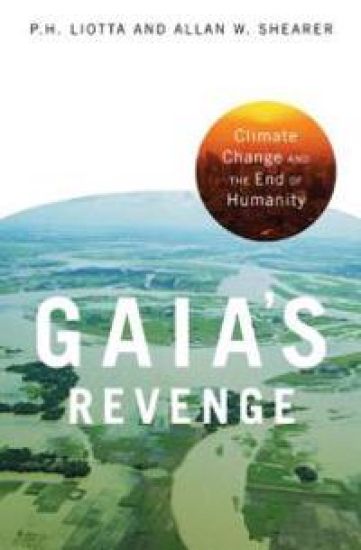
Gaia's Revenge

Gaia's Revenge

Allan W. Shearer; P. H. Liotta

Praeger Publishers Inc
2006
sidottu
Highlighting the connections between climate change and human security, this book elucidates what might happen when a mere 10-degree drop in average temperature results in a sudden inability to produce enough food, when rapidly advancing desertification produces water scarcities where none existed before, and when newly frozen landscapes lead to more power plants for energy, resulting in increased air pollution. The destabilizing effects of these possibilities create many potential challenges for U. S. national security in a globalized world in which we may have to intervene militarily to safeguard our interests around the globe. In February 2004, a Pentagon report on climate change and its implication for national security received extraordinary attention and publicity. Public attention, however, focused almost exclusively on portents of inevitable doom and disaster—most particularly on a scenario outlining a possible future similar to a climate event of 8,200 years ago and its impact on the availability of food, energy, and water. This book offers a broad examination of the meaning of climate change and global warming while maintaining a strategic perspective on the implications of environmental effects on all forms of security—national, international, and human (transcending borders and having more to do with basic resources). Given the uncertainty surrounding climate change as a specific event, the authors argue for recognizing the profound social, political, and human impact that could take place in the coming years. While recognizing the inherent dangers of prediction, Liotta and Shearer effectively present the case that the time to not only recognize—but deal with—potentially profound outcomes is now.
The Fight for Legitimacy

The Fight for Legitimacy

Cindy R. Jebb; P. H. Liotta; Thomas Sherlock; Ruth Margolies Beitler

Praeger Publishers Inc
2006
sidottu
Terrorism cannot be treated as a monolithic threat. Moreover, as much as we may wish to focus on the terror tactics and terrorist means, we cannot overlook the ends. In fact, good policy can only be crafted with an understanding of the terrorist strategy; that is, how terrorists integrate their means to secure their goals, given their perception of the security environment. The groups covered in this book change and evolve. While their governments must take aggressive actions to secure their populations against attacks, those governments that recognize the real grievances can simultaneously take action that addresses those grievances. This two-pronged approach simultaneously bolsters state legitimacy across the ethnic and majority populations, while demonstrating state effectiveness regarding insecurity. The authors argue that the best way for states to win legitimacy vis-a-vis terrorists is by adhering to liberal democratic values, cooperating with other states, and applying prudent counterterrorist tactics. Inter-state cooperation, which affects domestic and foreign policies, requires some convergence of political cultures among those cooperating states. This book begins by analyzing five hotspot situations and their regional effects: the Basques in Spain, the ethnic Albanians in Macedonia, the Kurds in Turkey, the Chechens and Russia; and the Palestinians, Israel, and a future Palestinian state. These cases shed some light on how we should understand, characterize, and categorize terrorism, and they provide insights into the concepts of political legitimacy, liberal democracy, political culture, and political community. As the United States assesses its homeland defense posture, it must resist any temptation to weaken its liberal democratic values, and, as a superpower, it must encourage other states to adhere to liberal democratic values as well. Liberal democracy is a security imperative in today's global security environment.
Dismembering the State

Dismembering the State

P. H. Liotta

Lexington Books
2001
sidottu
P. H. Liotta's previous book, The Wreckage Reconsidered, was acclaimed as a tour de force of scholarship. In Dismembering the State, Liotta continues to challenge numerous assumptions about the disintegration of Yugoslavia. His research uses an "ecological," or holistic, perspective to address interwoven questions such as the role of military intervention as coercive diplomacy, the use of chaos as a strategy against America's and NATO's technological military predominance, and the influence of post-Cold War European democratic and economic reforms. This book considers how a host of factors, from 1991 to 1999, combined to contribute significantly to both the disintegration of the nation-state and to the continued instability of the present states of the former Yugoslavia. Of interest to both scholars and sophisticated lay readers, Liotta has fashioned a scholarly assessment of this timely and complex topic that promises to be as innovative as it is erudite.