Kirjojen hintavertailu – 12 903 724 kirjaa ja 27 kauppaa

Kirjailija

P. K. Jain

Kirjat ja teokset yhdessä paikassa: 24 kirjaa, julkaisuja vuosilta 2013–2026, suosituimpiin kuuluu जिन राहों से गुजरा मैं. Vertaile teosten hintoja ja tarkista saatavuus suomalaisista kirjakaupoista.

Nimi esiintyy myös muodoissa: P.K. Jain, P K Jain

24 kirjaa

Kirjojen julkaisuvuodet: 2013–2026.

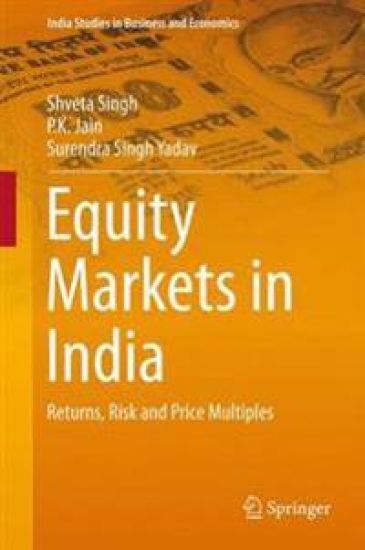
Equity Markets in India

Equity Markets in India

Shveta Singh; P.K. Jain; Surendra Singh Yadav

Springer Verlag, Singapore
2016
sidottu
The book presents a comprehensive view of the Indian equity markets over the past two decades (1994-2014). Equity markets constitute the most important segment of stock exchanges; in fact, the status of equity returns is, by and large, considered as a barometer of the state of a country’s economy. Returns earned by the equity investors on their funds invested in equity markets have become a decisive factor in the growth of such markets. In this context, the book discusses all the major aspects of equity returns and also conducts a dis-aggregative analysis based on underlying factors like age, size, ownership structure, industry affiliation/sector, among others, to explain the factors affecting returns and risk. While on the one hand the study ascertains the market rates of return (earned) on equities from the investors’ perspective (by including both the capital gains and the dividend income), it also shows how to compute the rates of returns on equities from the corporate perspective(that is, rate of return earned on equity funds). It further assesses the required/expected rate of return and examines the volatility in stock returns, with a focus on its behaviour during the period of the study. It deepens investors’ understanding of equity investment, helping them to make more-informed investments. While of interest to the investor community, this book also contributes significantly to the existing literature on market returns and is a valuable reference resource for academics, researchers and market participants, financial institutions and other intermediaries, regulators and policy makers.

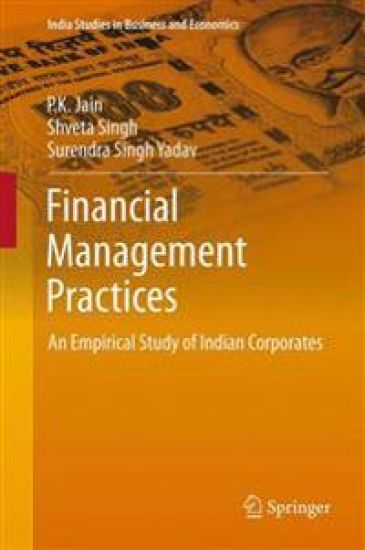
Financial Management Practices

Financial Management Practices

P.K. Jain; Shveta Singh; Surendra Singh Yadav

Springer, India, Private Ltd
2015
nidottu
Financial management practices are likely to have a marked effect on the financial performance of a corporate enterprise. Therefore, sound financial decisions/practices can contribute towards meeting the desired objective of having profitable operations. This subject assumes paramount significance in view of the present dynamic and turbulent business environment, which has produced more intense competition and smaller profit margins across the world. In this context, the financial management practices of the corporates in India, a country with a vast potential for economic growth, can offer valuable insights. The present study explores whether there has been a major change in the financial performance (measured in terms of profitability) and financial policies/decisions of the sample companies over a fixed period (2000-2001 to 2010-2011), with a special focus on pre and post-recession analysis. It delves deeper into current research areas such as zero working capital, real options in capital budgeting, pecking order in capital structures, and clause 49 as reflected in the financial management decisions of sample companies, and provides a broader perspective by identifying trends (if any) in certain aspects of financial decision-making over the past two decades. A comprehensive study, covering all the major aspects of financial management practices, also contains an inter-sectoral study (among the sample companies) and develops an index of professionalism in financial management based on the practices of the sample companies. The book is primarily targeted at teachers/students of finance, management, commerce, accounting and related professional disciplines/fields. Practitioners/professionals will find it an invaluable text that helps guide them to better decision-making.
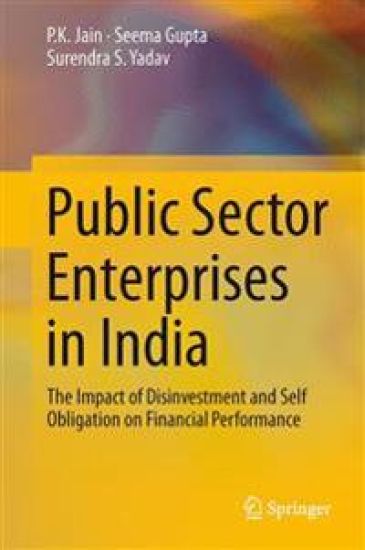
Public Sector Enterprises in India

Public Sector Enterprises in India

P.K. Jain; Seema Gupta; Surendra S. Yadav

Springer, India, Private Ltd
2014
sidottu
The book examines the various aspects of non-financial central public sector enterprises (PSEs) in India, for a period from 1986-87 to 2010-11. The analysis is based on all the key financial ratios; namely, profitability, efficiency, liquidity, leverage and productivity. Liberalization and globalization have caused competition in India and have lowered the profit margins. At the same time, Indian government has reduced subsidies and budgetary support for PSEs to curtail their own fiscal deficit. Strategic and economic reforms were also introduced in PSEs to make their operations commercially profitable so that they are not dependent on the government to meet their financial requirements on the one hand, and have their own earnings to finance their expansion/modernization requirements as well as their social obligations, on the other. To what extent, the PSEs have succeeded in this objective constitutes one major aspect of the present research work. The other equally important aspect examined is financial performance of the PSEs which have opted for disinvestment and have signed memorandum of understanding (MoU)/ self obligations. The Indian Government has desired the central PSEs to be profitable in their operations in post-liberation era of 1990s. For this purpose, two major instruments, namely, disinvestment and MoUs, were introduced. This book examines, in detail, financial performance of PSEs which had opted for disinvestment and have signed MoU. Based on analysis/ findings and literature on the subject, the book contains some concrete suggestions that would prove extremely helpful to Indian Government to further improve their financial performance. ?
Financial Management Practices

Financial Management Practices

P.K. Jain; Shveta Singh; Surendra Singh Yadav

Springer, India, Private Ltd
2013
sidottu
Financial management practices are likely to have a marked effect on the financial performance of a corporate enterprise. Therefore, sound financial decisions/practices can contribute towards meeting the desired objective of having profitable operations. This subject assumes paramount significance in view of the present dynamic and turbulent business environment, which has produced more intense competition and smaller profit margins across the world. In this context, the financial management practices of the corporates in India, a country with a vast potential for economic growth, can offer valuable insights. The present study explores whether there has been a major change in the financial performance (measured in terms of profitability) and financial policies/decisions of the sample companies over a fixed period (2000-2001 to 2010-2011), with a special focus on pre and post-recession analysis. It delves deeper into current research areas such as zero working capital, real options in capital budgeting, pecking order in capital structures, and clause 49 as reflected in the financial management decisions of sample companies, and provides a broader perspective by identifying trends (if any) in certain aspects of financial decision-making over the past two decades. A comprehensive study, covering all the major aspects of financial management practices, also contains an inter-sectoral study (among the sample companies) and develops an index of professionalism in financial management based on the practices of the sample companies. The book is primarily targeted at teachers/students of finance, management, commerce, accounting and related professional disciplines/fields. Practitioners/professionals will find it an invaluable text that helps guide them to better decision-making.