Kirjojen hintavertailu – 12 903 724 kirjaa ja 27 kauppaa
Kirjailija
P.N. Natarajan
Kirjat ja teokset yhdessä paikassa: 9 kirjaa, julkaisuja vuosilta 2013–2026, suosituimpiin kuuluu An Introduction to Ultrametric Summability Theory. Vertaile teosten hintoja ja tarkista saatavuus suomalaisista kirjakaupoista.
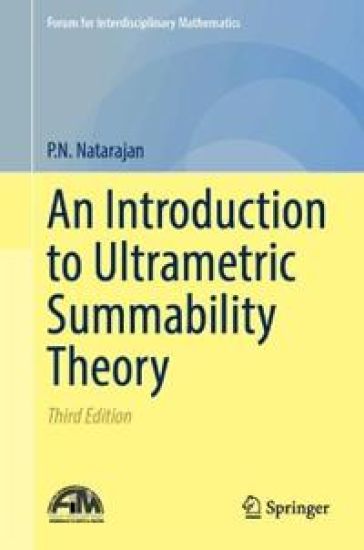
This is a completely revised and expanded edition of the author's first book, covering numerous new topics and recent developments in ultrametric summability theory. Ultrametric analysis has emerged as an important branch of mathematics in recent years. This book presents a brief survey of the research to date in ultrametric summability theory, which is a fusion of a classical branch of mathematics (summability theory) with a modern branch of analysis (ultrametric analysis). Several mathematicians have contributed to summability theory as well as functional analysis. Three entirely new chapters explore sequence spaces and summability matrices. The book will appeal to both young researchers and more experienced mathematicians who are looking to explore new areas in analysis. The book is also useful as a text for those who wish to specialize in ultrametric summability theory.
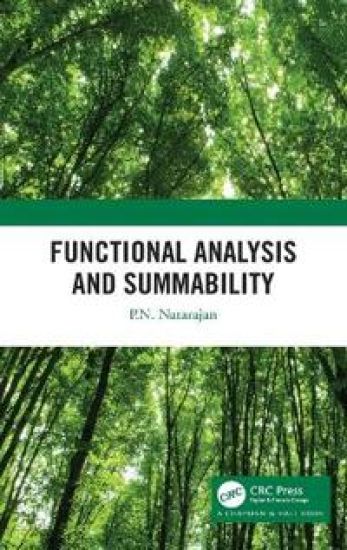
There are excellent books on both functional analysis and summability. Most of them are very terse. In Functional Analysis and Summability, the author makes a sincere attempt for a gentle introduction of these topics to students. In the functional analysis component of the book, the Hahn–Banach theorem, Banach–Steinhaus theorem (or uniform boundedness principle), the open mapping theorem, the closed graph theorem, and the Riesz representation theorem are highlighted. In the summability component of the book, the Silverman–Toeplitz theorem, Schur’s theorem, the Steinhaus theorem, and the Steinhaus-type theorems are proved. The utility of functional analytic tools like the uniform boundedness principle to prove some results in summability theory is also pointed out. Features A gentle introduction of the topics to the students is attempted. Basic results of functional analysis and summability theory and their applications are highlighted. Many examples are provided in the text. Each chapter ends with useful exercises. This book will be useful to postgraduate students, pre-research level students, and research scholars in mathematics. Students of physics and engineering will also find this book useful since topics in the book also have applications in related areas.
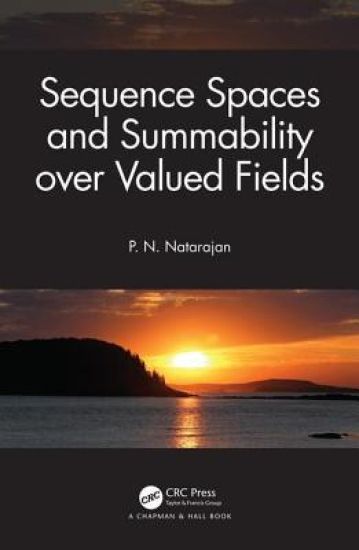
Sequence spaces and summability over valued fields is a research book aimed at research scholars, graduate students and teachers with an interest in Summability Theory both Classical (Archimedean) and Ultrametric (non-Archimedean). The book presents theory and methods in the chosen topic, spread over 8 chapters that seem to be important at research level in a still developing topic. Key FeaturesPresented in a self-contained mannerProvides examples and counterexamples in the relevant contextsProvides extensive references at the end of each chapter to enable the reader to do further research in the topicPresented in the same book, a comparative study of Archimedean and non-Archimedean Summability TheoryAppeals to young researchers and experienced mathematicians who wish to explore new areas in Summability TheoryThe book is written by a very experienced educator and researcher in Mathematical Analysis particularly Summability Theory.
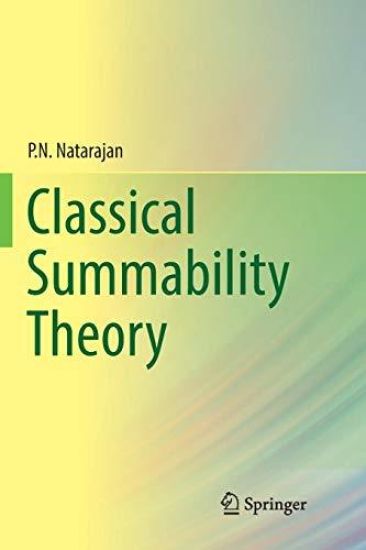
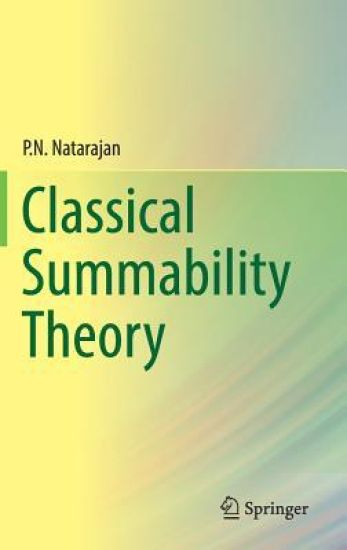
This book presents results about certain summability methods, such as the Abel method, the Norlund method, the Weighted mean method, the Euler method and the Natarajan method, which have not appeared in many standard books. It proves a few results on the Cauchy multiplication of certain summable series and some product theorems. It also proves a number of Steinhaus type theorems. In addition, it introduces a new definition of convergence of a double sequence and double series and proves the Silverman-Toeplitz theorem for four-dimensional infinite matrices, as well as Schur's and Steinhaus theorems for four-dimensional infinite matrices. The Norlund method, the Weighted mean method and the Natarajan method for double sequences are also discussed in the context of the new definition. Divided into six chapters, the book supplements the material already discussed in G. H. Hardy's Divergent Series. It appeals to young researchers and experienced mathematicians who wish to explore new areasin Summability Theory..
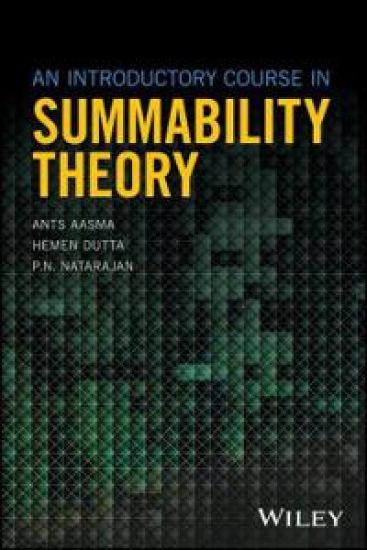
An introductory course in summability theory for students, researchers, physicists, and engineers In creating this book, the authors’ intent was to provide graduate students, researchers, physicists, and engineers with a reasonable introduction to summability theory. Over the course of nine chapters, the authors cover all of the fundamental concepts and equations informing summability theory and its applications, as well as some of its lesser known aspects. Following a brief introduction to the history of summability theory, general matrix methods are introduced, and the Silverman-Toeplitz theorem on regular matrices is discussed. A variety of special summability methods, including the Nörlund method, the Weighted Mean method, the Abel method, and the (C, 1) - method are next examined. An entire chapter is devoted to a discussion of some elementary Tauberian theorems involving certain summability methods. Following this are chapters devoted to matrix transforms of summability and absolute summability domains of reversible and normal methods; the notion of a perfect matrix method; matrix transforms of summability and absolute summability domains of the Cesàro and Riesz methods; convergence and the boundedness of sequences with speed; and convergence, boundedness, and summability with speed. • Discusses results on matrix transforms of several matrix methods • The only English-language textbook describing the notions of convergence, boundedness, and summability with speed, as well as their applications in approximation theory • Compares the approximation orders of Fourier expansions in Banach spaces by different matrix methods • Matrix transforms of summability domains of regular perfect matrix methods are examined • Each chapter contains several solved examples and end-of-chapter exercises, including hints for solutions An Introductory Course in Summability Theory is the ideal first text in summability theory for graduate students, especially those having a good grasp of real and complex analysis. It is also a valuable reference for mathematics researchers and for physicists and engineers who work with Fourier series, Fourier transforms, or analytic continuation. ANTS AASMA, PhD, is Associate Professor of Mathematical Economics in the Department of Economics and Finance at Tallinn University of Technology, Estonia. HEMEN DUTTA, PhD, is Senior Assistant Professor of Mathematics at Gauhati University, India. P. N. NATARAJAN, PhD, is Formerly Professor and Head of the Department of Mathematics, Ramakrishna Mission Vivekananda College, Chennai, Tamilnadu, India.
This book presents results about certain summability methods, such as the Abel method, the Norlund method, the Weighted mean method, the Euler method and the Natarajan method, which have not appeared in many standard books. It proves a few results on the Cauchy multiplication of certain summable series and some product theorems. It also proves a number of Steinhaus type theorems. In addition, it introduces a new definition of convergence of a double sequence and double series and proves the Silverman-Toeplitz theorem for four-dimensional infinite matrices, as well as Schur's and Steinhaus theorems for four-dimensional infinite matrices. The Norlund method, the Weighted mean method and the Natarajan method for double sequences are also discussed in the context of the new definition. Divided into six chapters, the book supplements the material already discussed in G. H. Hardy's Divergent Series. It appeals to young researchers and experienced mathematicians who wish to explore new areasin Summability Theory..
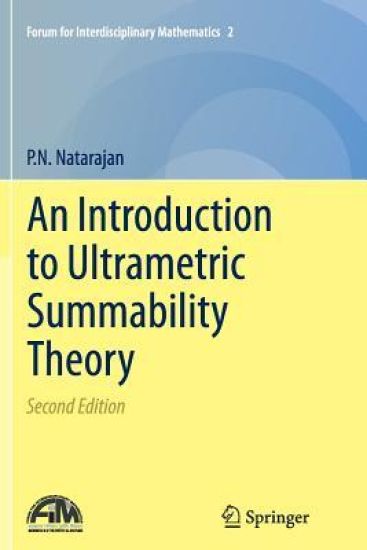
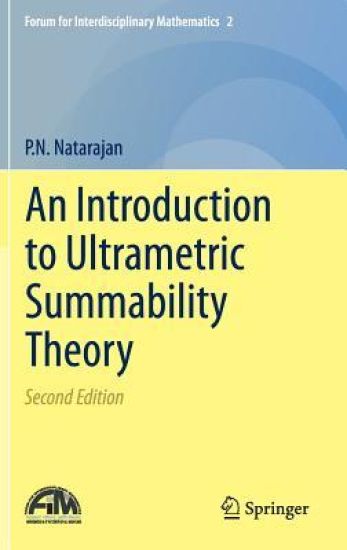
This is the second, completely revised and expanded edition of the author’s first book, covering numerous new topics and recent developments in ultrametric summability theory. Ultrametric analysis has emerged as an important branch of mathematics in recent years. This book presents a brief survey of the research to date in ultrametric summability theory, which is a fusion of a classical branch of mathematics (summability theory) with a modern branch of analysis (ultrametric analysis). Several mathematicians have contributed to summability theory as well as functional analysis. The book will appeal to both young researchers and more experienced mathematicians who are looking to explore new areas in analysis. The book is also useful as a text for those who wish to specialize in ultrametric summability theory.
This is the second, completely revised and expanded edition of the author’s first book, covering numerous new topics and recent developments in ultrametric summability theory. Ultrametric analysis has emerged as an important branch of mathematics in recent years. This book presents a brief survey of the research to date in ultrametric summability theory, which is a fusion of a classical branch of mathematics (summability theory) with a modern branch of analysis (ultrametric analysis). Several mathematicians have contributed to summability theory as well as functional analysis. The book will appeal to both young researchers and more experienced mathematicians who are looking to explore new areas in analysis. The book is also useful as a text for those who wish to specialize in ultrametric summability theory.
Ultrametric analysis has emerged as an important branch of mathematics in recent years. This book presents, for the first time, a brief survey of the research to date in ultrametric summability theory, which is a fusion of a classical branch of mathematics (summability theory) with a modern branch of analysis (ultrametric analysis). Several mathematicians have contributed to summability theory as well as functional analysis. The book will appeal to both young researchers and more experienced mathematicians who are looking to explore new areas in analysis.