Kirjojen hintavertailu – 12 903 725 kirjaa ja 27 kauppaa
Kirjailija
Pankaj Kumar
Kirjat ja teokset yhdessä paikassa: 58 kirjaa, julkaisuja vuosilta 2012–2026, suosituimpiin kuuluu Caught in an Avalanche. Vertaile teosten hintoja ja tarkista saatavuus suomalaisista kirjakaupoista.
This book will be useful for graduates, post-graduates, and research students as well various programmers, who either have an interest in this subject or have this subject as a part of their curriculum. The reader can be a beginner or an advanced learner. Fuzzy Logic, at present is a hot topic. It is based on the observation that people make decisions based on imprecise and non-numerical information. Fuzzy models or sets are mathematical means of representing vagueness and imprecise information (hence the term fuzzy). These models have the capability of recognizing, representing, manipulating, interpreting, and utilizing data and information that are vague and lack certainty. The various operators involved for Fuzzy Logic operation are explained. The basic concepts of Fuzzy Logic are discussed in detail using various solved examples. The applications of Fuzzy Logic are also dealt to make the readers understand the concept of Fuzzy Logic. This book can be used as a ready reference material for graduate students and research scholars.
This book is meant for a wide range of graduate students, who wishes to learn the basic concepts of Genetic Algorithms. It can also be meant for programmers, researchers and experts whose work is based on optimization techniques. The basic concepts of Genetic Algorithms are dealt in detail with the relevant information and knowledge available for understanding the optimization process. The various operators involved for Genetic Algorithm operation are explained. Genetic Algorithms, at present, is a hot topic among academicians, researchers and program developers. This book can be used as a ready reference materials for graduate students and research scholars.
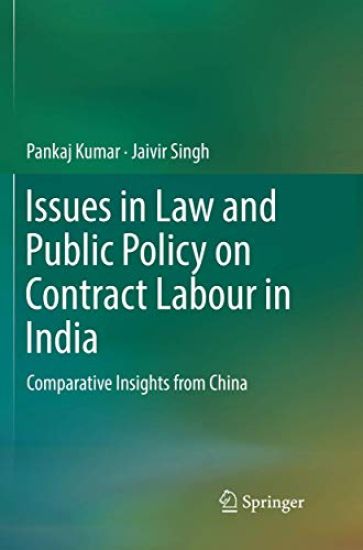
This book discusses the increasing use of contract labour in India that has accompanied attempts to liberalise the economy. After briefly examining Indian labour laws and public policy, it juxtaposes the country’s labour market practices with international labour standards. The questions that are raised are then explored through a series of empirical studies investigating the use of contract labour in a variety of industries and locations, manifesting a wide-spectrum of concerns including labour standards, productivity and employment relations. The set of comparative research studies within India are supplemented with a field study from the Shenzhen and Guangzhou industrial regions of South China, which are in an advanced stage of industrial development. The unprecedented inflow of capital into China has captivated many developing countries, including India, which has gone on to mimic similar strategies particularly in terms of labour market deregulation. In this context, a set of crucial questions arise – can enforcing ‘labour market flexibility’ in itself provide the required impetus for a nation’s industrial growth? Is the Chinese success in becoming the major destination for foreign direct investments (FDIs) a consequence of a flexible labour regime or is there some other concealed strength to be found in Chinese labour market institutions? In particular it needs to be noted that after double-digit growth for more than 25 consecutive years, China has recognised some of the fallacy of its development path and in 2008 adopted fairly stringent labour laws, which now regulate its labour market. This Chinese trajectory perhaps has lessons for India and other countries that are still struggling on the liberal path. In particular, the Chinese example helps put the Indian field studies in perspective and provides insights into India-specific policy recommendations that could also be useful for the developing world. The book concludes with the observation that where production entails long-term relationships, the interests of both the employer and the workers need to be maintained sustainably. As the title suggests, the book provides takeaways, not only for academics and researchers working in this field but also for lawyers, consultants, politicians, bureaucrats, and policymakers.
This book discusses the increasing use of contract labour in India that has accompanied attempts to liberalise the economy. After briefly examining Indian labour laws and public policy, it juxtaposes the country’s labour market practices with international labour standards. The questions that are raised are then explored through a series of empirical studies investigating the use of contract labour in a variety of industries and locations, manifesting a wide-spectrum of concerns including labour standards, productivity and employment relations. The set of comparative research studies within India are supplemented with a field study from the Shenzhen and Guangzhou industrial regions of South China, which are in an advanced stage of industrial development. The unprecedented inflow of capital into China has captivated many developing countries, including India, which has gone on to mimic similar strategies particularly in terms of labour market deregulation. In this context, a set of crucial questions arise – can enforcing ‘labour market flexibility’ in itself provide the required impetus for a nation’s industrial growth? Is the Chinese success in becoming the major destination for foreign direct investments (FDIs) a consequence of a flexible labour regime or is there some other concealed strength to be found in Chinese labour market institutions? In particular it needs to be noted that after double-digit growth for more than 25 consecutive years, China has recognised some of the fallacy of its development path and in 2008 adopted fairly stringent labour laws, which now regulate its labour market. This Chinese trajectory perhaps has lessons for India and other countries that are still struggling on the liberal path. In particular, the Chinese example helps put the Indian field studies in perspective and provides insights into India-specific policy recommendations that could also be useful for the developing world. The book concludes with the observation that where production entails long-term relationships, the interests of both the employer and the workers need to be maintained sustainably. As the title suggests, the book provides takeaways, not only for academics and researchers working in this field but also for lawyers, consultants, politicians, bureaucrats, and policymakers.
This book contains detailed information on the types, structure, fabrication, and characterization of organic solar cells (OSCs). It discusses processes to improve efficiencies and the prevention of degradation in OSCs. It compares the cost-effectiveness of OSCs to those based on crystalline silicon and discusses ways to make OSCs more economical. This book provides a practical guide for the fabrication, processing, and characterization of OSCs and paves the way for further development in OSC technology.