Kirjojen hintavertailu – 12 903 725 kirjaa ja 27 kauppaa
Kirjailija
Pankaj Tiwari
Kirjat ja teokset yhdessä paikassa: 14 kirjaa, julkaisuja vuosilta 2012–2025, suosituimpiin kuuluu The Rise Of Thoughts Vol. 1. Vertaile teosten hintoja ja tarkista saatavuus suomalaisista kirjakaupoista.
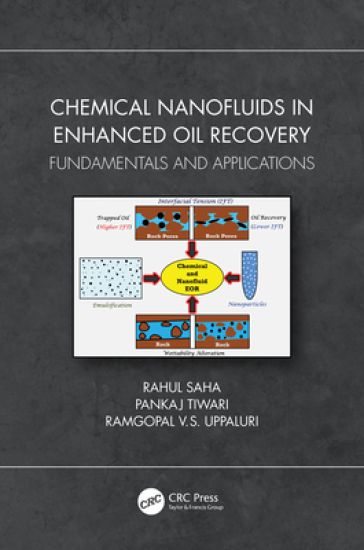
Sustainable world economy requires a steady supply of crude oil without any production constraints. Thus, the ever-increasing energy demand of the entire world can be mostly met through the enhanced production from crude oil from existing reservoirs. With the fact that newer reservoirs with large quantities of crude oil could not be explored at a faster pace, it will be inevitable to produce the crude oil from matured reservoirs at an affordable cost. Among alternate technologies, the chemical enhanced oil recovery (EOR) technique has promising potential to recover residual oil from matured reservoirs being subjected to primary and secondary water flooding operations. Due to pertinent complex phenomena that often have a combinatorial role and influence, the implementation of chemical EOR schemes such as alkali/surfactant/polymer flooding and their combinations necessitates upon a fundamental understanding of the potential mechanisms and their influences upon one another and desired response variables. Addressing these issues, the book attempts to provide useful screening criteria, guidelines, and rules of thumb for the identification of process parametric sets (including reservoir characteristics) and response characteristics (such as IFT, adsorption etc.,) that favor alternate chemical EOR systems. Finally, the book highlights the relevance of nanofluid/nanoparticle for conventional and unconventional reservoirs and serves as a needful resource to understand the emerging oil recovery technology. Overall, the volume will be of greater relevance for practicing engineers and consultants that wish to accelerate on field applications of chemical and nano-fluid EOR systems. Further, to those budding engineers that wish to improvise upon their technical know-how, the book will serve as a much-needed repository.
In this profound exploration of life's ultimate questions, Pankaj Tiwari delves deep into the mysteries that often evade our understanding. Through introspection and inquiry, the book challenges readers to confront existential dilemmas and seek meaningful answers. Addressing fundamental inquiries such as the nature of existence, the quest for happiness, and the purpose of life itself, Tiwari encourages a thoughtful examination that goes beyond mere existence. Each chapter invites readers to contemplate timeless queries, from the concept of God to the mysteries of life and death, in a journey towards personal enlightenment and truth. Drawing inspiration from the persistence of seeking truth, the author emphasizes the importance of continuous questioning and exploration. Through narratives and reflections, this book serves as a guide for those who yearn to unravel the profound mysteries of existence and embark on a transformative quest for understanding.
The Illusionary Game delves into the intricate world of human manipulation and the psychology behind it. Exploring various tactics and strategies, the book navigates through the blurred lines of power dynamics, ethical boundaries, and the art of influence. Through practical insights and thought-provoking examples, readers gain a deeper understanding of how manipulation operates in everyday interactions and how to navigate this complex terrain with awareness and integrity.
Die Karnalf ule, verursacht durch Tilletia indica Mitra (Neovossia indica Mitra (Mundkur)), wurde erstmals im April 1930 von der Botanischen Forschungsstation in Karnal (Haryana) an den Weizensorten Foundation und Punjab A festgestellt. Die Krankheit war auf dem Subkontinent seit langem verbreitet und infizierte einheimische Weizensorten, die im Nordwesten Indiens angebaut wurden, verursachte jedoch nie ernsthafte Ertragseinbu en. Mit der Einf hrung mexikanischer Zwergweizensorten in Indien und Pakistan Anfang der 1970er Jahre trat die Krankheit jedoch in gro em Umfang auf. Bis 1974-75 blieb die Krankheit auf Jammu und Kaschmir, Punjab und die Tarai-Region von Uttar Pradesh beschr nkt. An einigen Orten trat sie in verschiedenen Jahren in epidemischer Form auf. In Ermangelung strenger Quarant nevorschriften im Inland breitete sie sich auf neue Gebiete im nordwestlichen Weizeng rtel aus. Madhya Pradesh, das s dliche Rajasthan, Maharashtra und die indische Halbinsel sind jedoch aufgrund der hohen Temperaturen frei von der Karnal-Krankheit. Sie wird auch aus Nepal, Iran, Mexiko, den Vereinigten Staaten, S dafrika, Brasilien, Afghanistan, Syrien, der T rkei, dem Libanon, Schweden, Polen und Italien gemeldet.
Karnal bunt causado por Tilletia indica Mitra (Neovossia indica Mitra (Mundkur) foi registado pela primeira vez em Abril de 1930 da Esta o de Pesquisa Bot nica, Karnal (Haryana) sobre a cultivar de trigo, funda o e Punjab A. A doen a foi predominante no sub-continente desde h muito tempo, infectando o trigo nativo cultivado no Noroeste da ndia, mas nunca causou uma s ria redu o da produ o. Contudo, a doen a apareceu em propor es graves no in cio dos anos 70 com a introdu o de variedades an s de trigo mexicano na ndia e no Paquist o. At 1974-75, a doen a permaneceu restrita ao Jammu e Caxemira, Punjab e regi o de Tarai no Uttar Pradesh. Em alguns lugares, apareceu sob a forma de epidemia em anos diferentes. Na aus ncia de regulamenta o de quarentena dom stica rigorosa, a doen a propagou-se a novas reas na regi o noroeste do Cintur o de Trigo. No entanto, Madhya Pradesh, Rajasthan do sul, Maharashtra e a ndia Peninsular est o livres de Karnal bunt devido s altas temperaturas. Tamb m relatado do Nepal, Ir o, M xico, Estados Unidos, frica do Sul, Brasil, Afeganist o, S ria, Turquia, L bano, Su cia, Pol nia, It lia.
Il Karnal bunt, causato da Tilletia indica Mitra (Neovossia indica Mitra (Mundkur)), stato registrato per la prima volta nell'aprile del 1930 presso la Botanical Research Station di Karnal (Haryana) su cultivar di frumento, foundation e Punjab A. La malattia stata a lungo diffusa nel subcontinente, infettando i frumenti autoctoni coltivati nell'India nord-occidentale, ma non ha mai causato una grave riduzione della resa. Tuttavia, la malattia comparsa in proporzioni serie all'inizio degli anni '70 con l'introduzione di variet di grano messicane nane in India e Pakistan. Fino al 1974-75 la malattia rimasta circoscritta al Jammu e Kashmir, al Punjab e alla regione del Tarai dell'Uttar Pradesh. In alcune localit comparsa in forma epidemica in anni diversi. In assenza di rigide norme di quarantena domestica, si diffusa in nuove aree nella fascia del grano nord-occidentale. Tuttavia, il Madhya Pradesh, il Rajasthan meridionale, il Maharashtra e l'India peninsulare sono esenti dal Karnal bunt a causa delle alte temperature. stata segnalata anche in Nepal, Iran, Messico, Stati Uniti, Sudafrica, Brasile, Afghanistan, Siria, Turchia, Libano, Svezia, Polonia e Italia.
La carie de Karnal caus e par Tilletia indica Mitra (Neovossia indica Mitra (Mundkur) a t enregistr e pour la premi re fois en avril 1930 la station de recherche botanique de Karnal (Haryana) sur le cultivar de bl Foundation et Punjab A. La maladie tait r pandue sur le sous-continent depuis longtemps, infectant les bl s indig nes cultiv s dans le nord-ouest de l'Inde, mais elle n'a jamais caus de s rieuses r ductions de rendement. Cependant, la maladie est apparue dans des proportions s rieuses au d but des ann es 1970 avec l'introduction de vari t s naines de bl mexicain en Inde et au Pakistan. Jusqu'en 1974-75, la maladie est rest e limit e au Jammu et Cachemire, au Punjab et la r gion du Tarai de l'Uttar Pradesh. Dans certains endroits, elle est apparue sous forme pid mique au cours de diff rentes ann es. En l'absence d'une r glementation stricte de quarantaine domestique, elle s'est propag e de nouvelles zones dans la ceinture de bl du nord-ouest. Cependant, le Madhya Pradesh, le sud du Rajasthan, le Maharashtra et l'Inde p ninsulaire sont exempts de carie de Karnal en raison des temp ratures lev es. Elle est galement signal e au N pal, Iran, Mexique, Etats-Unis, Afrique du Sud, Br sil, Afghanistan, Syrie, Turquie, Liban, Su de, Pologne, Italie.
Sustainable world economy requires a steady supply of crude oil without any production constraints. Thus, the ever-increasing energy demand of the entire world can be mostly met through the enhanced production from crude oil from existing reservoirs. With the fact that newer reservoirs with large quantities of crude oil could not be explored at a faster pace, it will be inevitable to produce the crude oil from matured reservoirs at an affordable cost. Among alternate technologies, the chemical enhanced oil recovery (EOR) technique has promising potential to recover residual oil from matured reservoirs being subjected to primary and secondary water flooding operations. Due to pertinent complex phenomena that often have a combinatorial role and influence, the implementation of chemical EOR schemes such as alkali/surfactant/polymer flooding and their combinations necessitates upon a fundamental understanding of the potential mechanisms and their influences upon one another and desired response variables. Addressing these issues, the book attempts to provide useful screening criteria, guidelines, and rules of thumb for the identification of process parametric sets (including reservoir characteristics) and response characteristics (such as IFT, adsorption etc.,) that favor alternate chemical EOR systems. Finally, the book highlights the relevance of nanofluid/nanoparticle for conventional and unconventional reservoirs and serves as a needful resource to understand the emerging oil recovery technology. Overall, the volume will be of greater relevance for practicing engineers and consultants that wish to accelerate on field applications of chemical and nano-fluid EOR systems. Further, to those budding engineers that wish to improvise upon their technical know-how, the book will serve as a much-needed repository.
The investigation entitled "Biological Management of Nursery Diseases (Root rot and wilt) of Bael (Aegle marmelos Correa)" was conducted in the Narendra University of Agriculture and Technology, Kumarganj, Faizabad during 2012-2013. At nursery stage about 35-40% seedlings of Bael (Aegle marmelos Correa) were died due to root rot and wilt. The disease is highly prevalent during rainy season under warm and high humidity as well as low sunshine hours (4-6 hrs/day) that further aggravated the situationThe fungus isolated from infected seedlings, showed typical characters of Fusarium solani. The identity of the fungus was confirmed by the Indian Type Culture Collection (I. D. No. 8077.11), IARI, New Delhi. The efficacy of three Trichoderma species viz., T. harzianum, T. virens, T. viride against F. solani were tested by dual culture technique, T. virens and T. viride grew very fast before touching the colony of the F. solani.