Kirjojen hintavertailu – 12 903 725 kirjaa ja 27 kauppaa

Kirjailija

Panos Kouvelis

Kirjat ja teokset yhdessä paikassa: 5 kirjaa, julkaisuja vuosilta 1996–2017, suosituimpiin kuuluu Integrated Risk Management in Supply Chains. Vertaile teosten hintoja ja tarkista saatavuus suomalaisista kirjakaupoista.

5 kirjaa

Kirjojen julkaisuvuodet: 1996–2017.

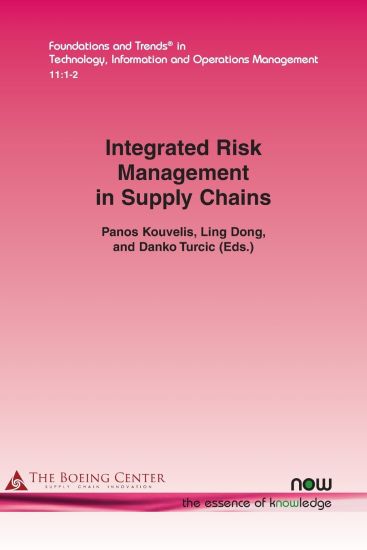
Integrated Risk Management in Supply Chains

Integrated Risk Management in Supply Chains

Panos Kouvelis; Long Dong; Danko Turcic

now publishers Inc
2017
nidottu
Integrated Risk Management in Supply Chains examines supply chain risk management. The increased interest in the topic is due to a number of factors including the increased volatility of commodity prices and exchange rates, recent natural disasters, and the increased importance of multinational corporations. The motivation for risk management comes from a variety of sources: financial distress costs, managerial incentives, and other important reasons discussed in the remainder of this book. Understanding the motives is important because they provide insights into which risks should be managed and how a firm's risk management operations should be organized. The first part examines Buffering Supply Chain Risk with Operational Flexibility and deals with uncertainty in the form of routine variability, which includes fluctuations in demand. Part 2 reviews Supply Disruption. Both the preponderance of natural disasters and huge economic swings can cause extreme challenges across the supply chains. Although these types of risks are rare, they are highly consequential and buffering is insufficient to mitigate them. Instead, firms facing these risks must engage in contingency planning and must maintain redundancies in the system. This is why contingency planning is on the interface of operations and finance. Part 3 looks at Commodity Price Risks, which includes five papers on managing price risks – the first three papers are fundamental in that they ask when and how firms should manage price risks with hedging and how hedging affects operating policy and the remaining two papers examine the best practices in specific industries.
Supply Chain Finance

Supply Chain Finance

Panos Kouvelis; Long Dong; Danko Turcic

now publishers Inc
2017
nidottu
Supply Chain Finance focuses is on creating liquidity in the supply chain through various Buyer or Seller-led solutions with or without a facilitating technology. The role of supply chain finance (SCF) is to optimize both the availability and cost of capital within a given buyer-supplier supply chain. To add further value, information on the physical flow of goods can be monitored. The coupling of information enables lenders to mitigate financial risk within the supply chain. The mitigation of risk allows more capital to be raised, capital to be accessed sooner, or capital to be raised at lower rates. Supply chain participants reside in diverse economic environments, are of different sizes, face a variety of uncertainties, have different bargaining powers over its trading partners, and have different accessibilities to capital markets. Many forms of financing arrangements between buyers and suppliers have emerged intending to overcome challenges in their specific economic and business environments. Part 1 examines Supplier Financing. The three papers included in this section discuss supplier based financing issues including: motivation and rationale for supplier based financing, the optimal mix of bank financing and supplier financing, and empirical study of the impact of trade credit on firm performance. Part 2 focuses on Buyer Financing including three papers included that discuss buyer based financing issues in supply chains including the rationales of different types of buyer based financing arrangements and their impacts on supply chain performance. Part 3 reviews Inventory Models and Financing Consideration and the two papers in this part of the book explore how to coordinate the management of the cash flow and inventory flow within an organization and the relationship between a firm's inventory policy and its cost of capital. Part 4 examines Operational Investments and Financing Issues and includes four papers that address operational investments with explicit financing considerations.
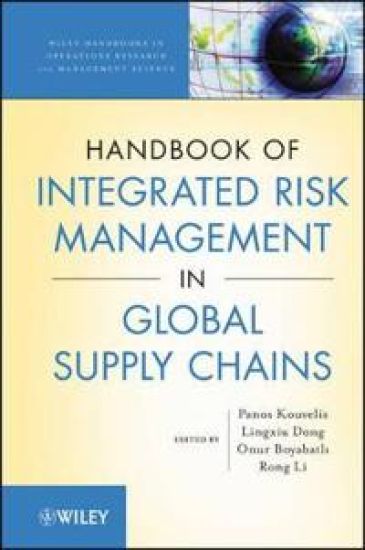
Handbook of Integrated Risk Management in Global Supply Chains

Handbook of Integrated Risk Management in Global Supply Chains

Panos Kouvelis; Lingxiu Dong; Onur Boyabatli; Rong Li

John Wiley Sons Inc
2011
sidottu
A comprehensive, one-stop reference for cutting-edge research in integrated risk management, modern applications, and best practices In the field of business, the ever-growing dependency on global supply chains has created new challenges that traditional risk management must be equipped to handle. Handbook of Integrated Risk Management in Global Supply Chains uses a multi-disciplinary approach to present an effective way to manage complex, diverse, and interconnected global supply chain risks. Contributions from leading academics and researchers provide an action-based framework that captures real issues, implementation challenges, and concepts emerging from industry studies. The handbook is divided into five parts: Foundations and Overview introduces risk management and discusses the impact of supply chain disruptions on corporate performanceIntegrated Risk Management: Operations and Finance Interface explores the joint use of operational and financial hedging of commodity price uncertaintiesSupply Chain Finance discusses financing alternatives and the role of financial services in procurement contracts; inventory management and capital structure; and bank financing of inventoriesOperational Risk Management Strategies outlines supply risks and challenges in decentralized supply chains, such as competition and misalignment of incentives between buyers and suppliersIndustrial Applications presents examples and case studies that showcase the discussed methodologies Each topic's presentation includes an introduction, key theories, formulas, and applications. Discussions conclude with a summary of the main concepts, a real-world example, and professional insights into common challenges and best practices. Handbook of Integrated Risk Management in Global Supply Chains is an essential reference for academics and practitioners in the areas of supply chain management, global logistics, management science, and industrial engineering who gather, analyze, and draw results from data. The handbook is also a suitable supplement for operations research, risk management, and financial engineering courses at the upper-undergraduate and graduate levels.
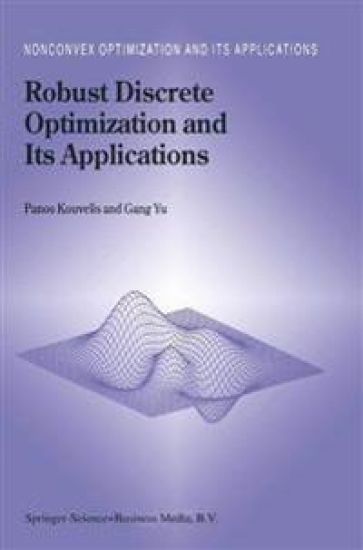
Robust Discrete Optimization and Its Applications

Robust Discrete Optimization and Its Applications

Panos Kouvelis

Springer-Verlag New York Inc.
2010
nidottu
This book deals with decision making in environments of significant data un­ certainty, with particular emphasis on operations and production management applications. For such environments, we suggest the use of the robustness ap­ proach to decision making, which assumes inadequate knowledge of the decision maker about the random state of nature and develops a decision that hedges against the worst contingency that may arise. The main motivating factors for a decision maker to use the robustness approach are: • It does not ignore uncertainty and takes a proactive step in response to the fact that forecasted values of uncertain parameters will not occur in most environments; • It applies to decisions of unique, non-repetitive nature, which are common in many fast and dynamically changing environments; • It accounts for the risk averse nature of decision makers; and • It recognizes that even though decision environments are fraught with data uncertainties, decisions are evaluated ex post with the realized data. For all of the above reasons, robust decisions are dear to the heart of opera­ tional decision makers. This book takes a giant first step in presenting decision support tools and solution methods for generating robust decisions in a variety of interesting application environments. Robust Discrete Optimization is a comprehensive mathematical programming framework for robust decision making.
Robust Discrete Optimization and Its Applications
This book deals with decision making in environments of significant data un­ certainty, with particular emphasis on operations and production management applications. For such environments, we suggest the use of the robustness ap­ proach to decision making, which assumes inadequate knowledge of the decision maker about the random state of nature and develops a decision that hedges against the worst contingency that may arise. The main motivating factors for a decision maker to use the robustness approach are: • It does not ignore uncertainty and takes a proactive step in response to the fact that forecasted values of uncertain parameters will not occur in most environments; • It applies to decisions of unique, non-repetitive nature, which are common in many fast and dynamically changing environments; • It accounts for the risk averse nature of decision makers; and • It recognizes that even though decision environments are fraught with data uncertainties, decisions are evaluated ex post with the realized data. For all of the above reasons, robust decisions are dear to the heart of opera­ tional decision makers. This book takes a giant first step in presenting decision support tools and solution methods for generating robust decisions in a variety of interesting application environments. Robust Discrete Optimization is a comprehensive mathematical programming framework for robust decision making.