Kirjojen hintavertailu – 12 903 725 kirjaa ja 27 kauppaa

Kirjailija

Paolo Grigolini

Kirjat ja teokset yhdessä paikassa: 8 kirjaa, julkaisuja vuosilta 1993–2023, suosituimpiin kuuluu Networks of Echoes. Vertaile teosten hintoja ja tarkista saatavuus suomalaisista kirjakaupoista.

8 kirjaa

Kirjojen julkaisuvuodet: 1993–2023.

Crucial Event Rehabilitation Therapy

Crucial Event Rehabilitation Therapy

Bruce J. West; Paolo Grigolini; Mauro Bologna

Springer International Publishing AG
2023
nidottu
This book describes a new strategy for rehabilitation from injury and/or disease using Crucial Event Therapy. Recent studies have shown that individuals can recuperate more rapidly from surgery and other invasive procedures intended to correct the negative effects of disease or injury through the use of life support systems that operate at the body's natural biofrequencies. The same observation has been clinically shown to reverse the degenerative effects of neurodegenerative diseases such as Parkinson’s and Alzheimer's Disease. Crucial Event Therapy describes medicine as the operational control of the functions of the human body treated as a network-of-networks, with 1/f-variable crucial events coding the dynamic states of health and disease through information flow within a network and information exchange between biomedical networks. A new way of thinking based on the statistics of Cortical Events is presented and the relevant literature is suitably referenced. This is anideal book for biophysicists and data scientists seeking to understand the connection of complexity measures for the study of consciousness with the clinical aspects of designing a rehabilitation strategy.
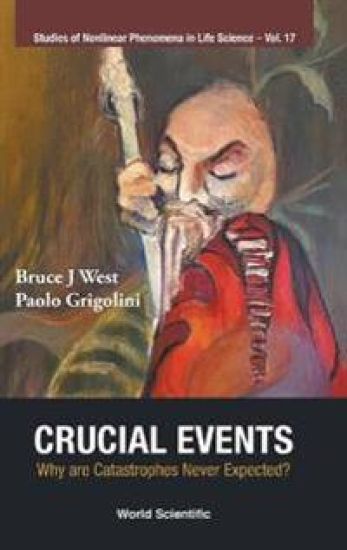
Crucial Events: Why Are Catastrophes Never Expected?

Crucial Events: Why Are Catastrophes Never Expected?

Bruce J West; Paolo Grigolini

World Scientific Publishing Co Pte Ltd
2021
sidottu
A nonsimple (complex) system indicates a mix of crucial and non-crucial events, with very different statistical properties. It is the crucial events that determine the efficiency of information exchange between complex networks. For a large class of nonsimple systems, crucial events determine catastrophic failures - from heart attacks to stock market crashes. This interesting book outlines a data processing technique that separates the effects of the crucial from those of the non-crucial events in nonsimple time series extracted from physical, social and living systems. Adopting an informal conversational style, without sacrificing the clarity necessary to explain, the contents will lead the reader through concepts such as fractals, complexity and randomness, self-organized criticality, fractional-order differential equations of motion, and crucial events, always with an eye to helping to interpret what mathematics usually does in the development of new scientific knowledge. Both researchers and novitiate will find Crucial Events useful in learning more about the science of nonsimplicity.
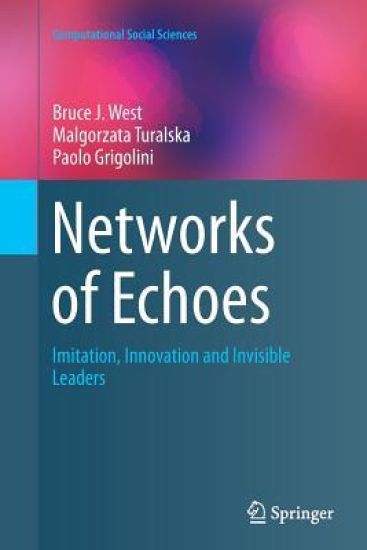
Networks of Echoes

Networks of Echoes

Bruce J. West; Malgorzata Turalska; Paolo Grigolini

Springer International Publishing AG
2016
nidottu
Networks of Echoes: Imitation, Innovation and Invisible Leaders is a mathematically rigorous and data rich book on a fascinating area of the science and engineering of social webs. There are hundreds of complex network phenomena whose statistical properties are described by inverse power laws. The phenomena of interest are not arcane events that we encounter only fleetingly, but are events that dominate our lives. We examine how this intermittent statistical behavior intertwines itself with what appears to be the organized activity of social groups. The book is structured as answers to a sequence of questions such as: How are decisions reached in elections and boardrooms? How is the stability of a society undermined by zealots and committed minorities and how is that stability re-established? Can we learn to answer such questions about human behavior by studying the way flocks of birds retain their formation when eluding a predator? These questions and others are answered using a generic model of a complex dynamic network—one whose global behavior is determined by a symmetric interaction among individuals based on social imitation. The complexity of the network is manifest in time series resulting from self-organized critical dynamics that have divergent first and second moments, are non-stationary, non-ergodic and non-Poisson. How phase transitions in the network dynamics influence such activity as decision making is a fascinating story and provides a context for introducing many of the mathematical ideas necessary for understanding complex networks in general. The decision making model (DMM) is selected to emphasize that there are features of complex webs that supersede specific mechanisms and need to be understood from a general perspective. This insightful overview of recent tools and their uses may serve as an introduction and curriculum guide in related courses.
Networks of Echoes

Networks of Echoes

Bruce J. West; Malgorzata Turalska; Paolo Grigolini

Springer International Publishing AG
2014
sidottu
Networks of Echoes: Imitation, Innovation and Invisible Leaders is a mathematically rigorous and data rich book on a fascinating area of the science and engineering of social webs. There are hundreds of complex network phenomena whose statistical properties are described by inverse power laws. The phenomena of interest are not arcane events that we encounter only fleetingly, but are events that dominate our lives. We examine how this intermittent statistical behavior intertwines itself with what appears to be the organized activity of social groups. The book is structured as answers to a sequence of questions such as: How are decisions reached in elections and boardrooms? How is the stability of a society undermined by zealots and committed minorities and how is that stability re-established? Can we learn to answer such questions about human behavior by studying the way flocks of birds retain their formation when eluding a predator? These questions and others are answered using a generic model of a complex dynamic network—one whose global behavior is determined by a symmetric interaction among individuals based on social imitation. The complexity of the network is manifest in time series resulting from self-organized critical dynamics that have divergent first and second moments, are non-stationary, non-ergodic and non-Poisson. How phase transitions in the network dynamics influence such activity as decision making is a fascinating story and provides a context for introducing many of the mathematical ideas necessary for understanding complex networks in general. The decision making model (DMM) is selected to emphasize that there are features of complex webs that supersede specific mechanisms and need to be understood from a general perspective. This insightful overview of recent tools and their uses may serve as an introduction and curriculum guide in related courses.
Physics of Fractal Operators

Physics of Fractal Operators

Bruce West; Mauro Bologna; Paolo Grigolini

Springer-Verlag New York Inc.
2011
nidottu
This text describes the statistcal behavior of complex systems and shows how the fractional calculus can be used to model the behavior. The discussion emphasizes physical phenomena whose evolution is best described using the fractional calculus, such as systems with long-range spatial interactions or long-time memory. The book gives general strategies for understanding wave propagation through random media, the nonlinear response of complex materials, and the fluctuations of heat transport in heterogeneous materials.
Complex Webs

Complex Webs

Bruce J. West; Paolo Grigolini

Cambridge University Press
2010
sidottu
Complex Webs synthesises modern mathematical developments with a broad range of complex network applications of interest to the engineer and system scientist, presenting the common principles, algorithms, and tools governing network behaviour, dynamics, and complexity. The authors investigate multiple mathematical approaches to inverse power laws and expose the myth of normal statistics to describe natural and man-made networks. Richly illustrated throughout with real-world examples including cell phone use, accessing the Internet, failure of power grids, measures of health and disease, distribution of wealth, and many other familiar phenomena from physiology, bioengineering, biophysics, and informational and social networks, this book makes thought-provoking reading. With explanations of phenomena, diagrams, end-of-chapter problems, and worked examples, it is ideal for advanced undergraduate and graduate students in engineering and the life, social, and physical sciences. It is also a perfect introduction for researchers who are interested in this exciting new way of viewing dynamic networks.
Physics of Fractal Operators

Physics of Fractal Operators

Bruce West; Mauro Bologna; Paolo Grigolini

Springer-Verlag New York Inc.
2003
sidottu
This text describes the statistcal behavior of complex systems and shows how the fractional calculus can be used to model the behavior. The discussion emphasizes physical phenomena whose evolution is best described using the fractional calculus, such as systems with long-range spatial interactions or long-time memory. The book gives general strategies for understanding wave propagation through random media, the nonlinear response of complex materials, and the fluctuations of heat transport in heterogeneous materials.
Quantum Mechanical Irreversibility And Measurement

Quantum Mechanical Irreversibility And Measurement

Paolo Grigolini

World Scientific Publishing Co Pte Ltd
1993
sidottu
This book is intended as a tutorial approach to some of the techniques used to deal with quantum dissipation and irreversibility, with special focus on their applications to the theory of measurements. The main purpose is to provide readers without a deep expertise in quantum statistical mechanics with the basic tools to develop a critical judgement on whether the major achievements in this field have to be considered a satisfactory solution of quantum paradox, or rather this ambitious achievement has to be postponed to when a new physics, more general than quantum and classical physics, will be discovered.