Kirjojen hintavertailu – 12 903 725 kirjaa ja 27 kauppaa

Kirjailija

Paolo Massimo Buscema

Kirjat ja teokset yhdessä paikassa: 4 kirjaa, julkaisuja vuosilta 2014–2025, suosituimpiin kuuluu AI: A Broad and a Different Perspective. Vertaile teosten hintoja ja tarkista saatavuus suomalaisista kirjakaupoista.

4 kirjaa

Kirjojen julkaisuvuodet: 2014–2025.

AI: A Broad and a Different Perspective

AI: A Broad and a Different Perspective

Paolo Massimo Buscema; Weldon A. Lodwick; Giulia Massini; Pier Luigi Sacco; Masoud Asadi-Zeydabadi; Francis Newman; Riccardo Petritoli; Marco Breda

Springer International Publishing AG
2025
nidottu
One of the primary objectives of this book is to highlight the profound difference between two types of AI that pursue distinct goals: emulative AI, which seeks to build machines whose output is similar to, or even superior to, that of the human brain, and investigative AI, whose purpose is to make invisible information within data visible by uncovering the laws through which individual behaviors self-organize into collective behaviors. The former is better known, as it serves as a useful tool for automating human labor and generating market profits; the latter is less widely recognized but is more scientifically oriented towards saving lives (in the medical field), explaining otherwise inexplicable phenomena (in the geophysical field), and enhancing our understanding of the material and abstract world. Both are valuable yet distinct: the emulative approach generates immediate profits and creates illusions of human-like power, while the investigative approach enhances fundamental scientific research and will yield its greatest benefits over time. The investigative approach presented in this volume seeks to rebuild the bridge between humanity and nature.
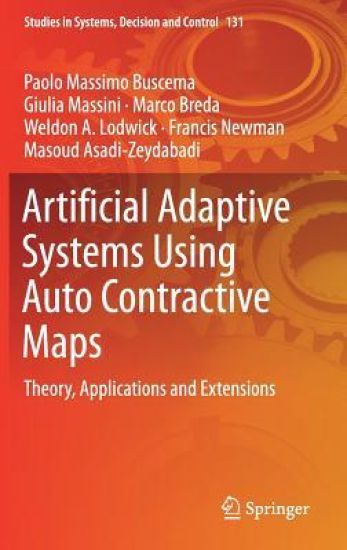
Artificial Adaptive Systems Using Auto Contractive Maps

Artificial Adaptive Systems Using Auto Contractive Maps

Paolo Massimo Buscema; Giulia Massini; Marco Breda; Weldon A. Lodwick; Francis Newman; Masoud Asadi-Zeydabadi

Springer Nature Switzerland AG
2018
nidottu
This book offers an introduction to artificial adaptive systems and a general model of the relationships between the data and algorithms used to analyze them. It subsequently describes artificial neural networks as a subclass of artificial adaptive systems, and reports on the backpropagation algorithm, while also identifying an important connection between supervised and unsupervised artificial neural networks. The book’s primary focus is on the auto contractive map, an unsupervised artificial neural network employing a fixed point method versus traditional energy minimization. This is a powerful tool for understanding, associating and transforming data, as demonstrated in the numerous examples presented here. A supervised version of the auto contracting map is also introduced as an outstanding method for recognizing digits and defects. In closing, the book walks the readers through the theory and examples of how the auto contracting map can be used in conjunction with another artificial neural network, the “spin-net,” as a dynamic form of auto-associative memory.
Artificial Adaptive Systems Using Auto Contractive Maps

Artificial Adaptive Systems Using Auto Contractive Maps

Paolo Massimo Buscema; Giulia Massini; Marco Breda; Weldon A. Lodwick; Francis Newman; Masoud Asadi-Zeydabadi

Springer International Publishing AG
2018
sidottu
This book offers an introduction to artificial adaptive systems and a general model of the relationships between the data and algorithms used to analyze them. It subsequently describes artificial neural networks as a subclass of artificial adaptive systems, and reports on the backpropagation algorithm, while also identifying an important connection between supervised and unsupervised artificial neural networks. The book’s primary focus is on the auto contractive map, an unsupervised artificial neural network employing a fixed point method versus traditional energy minimization. This is a powerful tool for understanding, associating and transforming data, as demonstrated in the numerous examples presented here. A supervised version of the auto contracting map is also introduced as an outstanding method for recognizing digits and defects. In closing, the book walks the readers through the theory and examples of how the auto contracting map can be used in conjunction with another artificial neural network, the “spin-net,” as a dynamic form of auto-associative memory.
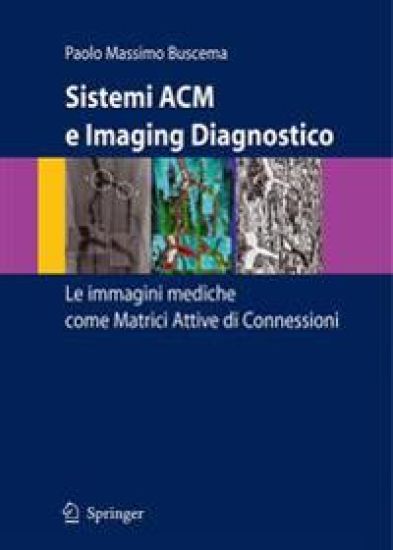
Sistemi ACM e Imaging Diagnostico

Sistemi ACM e Imaging Diagnostico

Paolo Massimo Buscema; E. Grossi

Springer Verlag
2014
nidottu
La prima ipotesi sulla quale si fondano i sistemi ACM (Active Connections Matrix) è che ogni immagine a N dimensioni puo' essere trasformata in una rete di pixel tra loro connessi che si sviluppa nel tempo, tramite operazioni locali, deterministiche e iterative. L'immagine cosi' trasformata puo' mostrare, in uno spazio dimensionale più ampio, delle regolarità morfologiche e dinamiche che, nelle dimensioni originarie, sarebbero non visibili oppure qualificabili come rumore. Questa ipotesi permette di esplicitare la seconda ipotesi alla base dei sistemi ACM: ogni immagine contiene al suo interno le matematiche inerenti che l'hanno prodotta. In pratica, è come se ogni immagine nascondesse al suo interno altre due immagini non visibili. I sistemi ACM le estraggono e le rendeno visibili. L'opera descrive inoltre le applicazioni possibili in ambito di diagnostica per immagini ed è pertanto rivolta a fisici, informatici, radiologi e tecnici di laboratorio che si occupano di "image processing". Dalla Presentazione di Enzo Grossi "... Alcuni dettagli possono sfuggire, altri aspetti notevoli, come un piccolo nodulo di 1 mm, possono essere non visti: sono i limiti dell'occhio umano. E' in questo scenario che dobbiamo immaginare l'avvento dei sistemi ACM. Essi funzionano come un terzo occhio, non più legato alla esperienza, alla interpretazione e alla sensibilità soggettiva dell'operatore,ma direttamente riferiti alla struttura matematica e quindi anatomica dell'immagine stessa. Si', il terzo occhio di cui parliamo è proprio quello dell'immagine, che, come per magia, interroga se stessa e si mostra al radiologo sotto una veste diversa, spesso molto più informativa."