Kirjojen hintavertailu – 12 859 819 kirjaa ja 27 kauppaa

Kirjailija

Paolo Savona

Kirjat ja teokset yhdessä paikassa: 8 kirjaa, julkaisuja vuosilta 2005–2019, suosituimpiin kuuluu Securing the Global Economy. Vertaile teosten hintoja ja tarkista saatavuus suomalaisista kirjakaupoista.

8 kirjaa

Kirjojen julkaisuvuodet: 2005–2019.

Governing Global Finance

Governing Global Finance

Michele Fratianni; Paolo Savona

Routledge
2019
nidottu
This title was first published in 2002: As the twenty-first century began, it was easy to assume that the reforms to the international financial system undertaken in the last half of the 1990s were adequate to the core tasks of ensuring stability, sustained growth and broadly shared benefits in the world economy. That comfortable consensus has now been shattered. This volume critically assesses fundamental issues including: -the elements and adequacy of recent G7-led efforts at international financial reform -current causes of and prospects for growth in the new global economy -the challenges of crisis prevention -private sector participation and IFI responsibilities -the world’s monetary supply and sovereignty in the face of market forces. These key topics are examined by leading economists and scholars of political economy from both academic and policy communities in G7 countries, making it an essential addition to the collections of all those concerned with the challenges facing the world economy in the coming years.
Governing Global Finance

Governing Global Finance

Michele Fratianni; Paolo Savona

Routledge
2017
sidottu
This title was first published in 2002: As the twenty-first century began, it was easy to assume that the reforms to the international financial system undertaken in the last half of the 1990s were adequate to the core tasks of ensuring stability, sustained growth and broadly shared benefits in the world economy. That comfortable consensus has now been shattered. This volume critically assesses fundamental issues including: -the elements and adequacy of recent G7-led efforts at international financial reform -current causes of and prospects for growth in the new global economy -the challenges of crisis prevention -private sector participation and IFI responsibilities -the world’s monetary supply and sovereignty in the face of market forces. These key topics are examined by leading economists and scholars of political economy from both academic and policy communities in G7 countries, making it an essential addition to the collections of all those concerned with the challenges facing the world economy in the coming years.
New Perspectives on Global Governance

New Perspectives on Global Governance

Michele Fratianni; Paolo Savona

Routledge
2017
nidottu
On its 30th anniversary in 2004 responsibility for hosting the G8 Summit fell into the hands of an allegedly unilateralist America. An America still reeling from the shock of the September 11th terrorist attacks, the resulting economic recession, bitter divisions with its NATO allies and disappointment with the United Nations Institutions over the 2003 Iraq war. So why does America still need the G8? New Perspectives on Global Governance offers new insight into the role of the Group of Eight's major market democracies and challenges the assumption that the G8 is simply a forum for binding a unilateralist hegemonic America. In contrast to seeing the G8 as a means of imposing an American world order this unique collection of new writings suggests that a now vulnerable America must rely on the G8 as a central instrument of foreign policy. America needs the G8 to achieve its security, economic and political interests in the world and to shape the twenty-first central global order it so desperately wants.
Securing the Global Economy

Securing the Global Economy

Andreas Freytag; Paolo Savona

Routledge
2016
nidottu
Securing the Global Economy explores how and why the G8 and other institutions of global governance deal with increasingly comprehensive and complex economic-security connections. These connections are explored from an interdisciplinary perspective, with economists, political scientists and those in the policy world bringing their insights to bear. Moreover, this volume explores this economic-security connection from a constitutional or institutional perspective. In a classical liberal spirit, it is concerned with the organizing principles of a liberal international economic order and the framework of rules that enables it to survive and flourish. Security issues, national trade policies, the multilateral trade system and the detailed technical issues they subsume are analysed from this higher vantage point. This is thus a work about global governance as a whole and at its core, rather than a problem-solving manual for a few of the issues now at centre stage. Furthermore, it applies this larger vision to the current G8 and global economic-security agenda to generate a set of policy recommendations about how the global community, through and outside the G8, can better cope with the complex interconnected challenges it now confronts. Its innovative policy recommendations are especially timely when the recent global financial crisis, economic recession and fragile recovery place great strains on the liberal economic order, while new challenges from Iran, ongoing terrorist threats and corruption make this security-economic connection critically important.
Global Financial Crisis

Global Financial Crisis

Paolo Savona; Chiara Oldani

Ashgate Publishing Limited
2011
sidottu
Out of the debate over the effectiveness of the policy responses to the 2008 global financial crisis as well as over the innovativeness of global governance comes this collection by leading academics and practitioners who explore the dynamics of economic crisis and impact. Edited by Paolo Savona, John J. Kirton, and Chiara Oldani Global Financial Crisis: Global Impact and Solutions examines the nature of the recent crisis, its consequences in major regions and countries, the innovations in the ideas, instruments and institutions that constitute national and regional policy responses, building on the G8's response at its L'Aquila Summit. Experts from Africa, North America, Asia and Europe examine the implications of those responses for international cooperation, coordination and institutional change in global economic governance, and identify ways to reform and even replace the architecture created in the mid 20th century in order to meet the global challenges of the 21st.
Securing the Global Economy

Securing the Global Economy

Andreas Freytag; Paolo Savona

Ashgate Publishing Limited
2011
sidottu
Securing the Global Economy explores how and why the G8 and other institutions of global governance deal with increasingly comprehensive and complex economic-security connections. These connections are explored from an interdisciplinary perspective, with economists, political scientists and those in the policy world bringing their insights to bear. Moreover, this volume explores this economic-security connection from a constitutional or institutional perspective. In a classical liberal spirit, it is concerned with the organizing principles of a liberal international economic order and the framework of rules that enables it to survive and flourish. Security issues, national trade policies, the multilateral trade system and the detailed technical issues they subsume are analysed from this higher vantage point. This is thus a work about global governance as a whole and at its core, rather than a problem-solving manual for a few of the issues now at centre stage. Furthermore, it applies this larger vision to the current G8 and global economic-security agenda to generate a set of policy recommendations about how the global community, through and outside the G8, can better cope with the complex interconnected challenges it now confronts. Its innovative policy recommendations are especially timely when the recent global financial crisis, economic recession and fragile recovery place great strains on the liberal economic order, while new challenges from Iran, ongoing terrorist threats and corruption make this security-economic connection critically important.
Corporate, Public and Global Governance

Corporate, Public and Global Governance

Michele Fratianni; Paolo Savona

Ashgate Publishing Limited
2007
sidottu
The intensifying pace of globalization has led to a questioning of the traditional approaches to governance at the corporate, national and international levels. The crash of the dot-com bubble and the outbreak of corporate accounting scandals in the United States, along with the debt burden of financial institutions in Japan and Europe, have led to demands for major reforms. Consequently, national governments are confronting stronger demands for new ways to regulate corporations to fulfil their social responsibilities and generate growth in a competitive world. This volume explores three central questions: what forms of corporate governance are most desirable for the globalizing world of the twenty-first century? What forms of public governance are most appropriate in this new age? And how well are the world's leading national governments pioneering the needed policies and practices? The book offers an analysis of the G8's role in assisting governments and corporations to work together to design and deliver a superior approach.
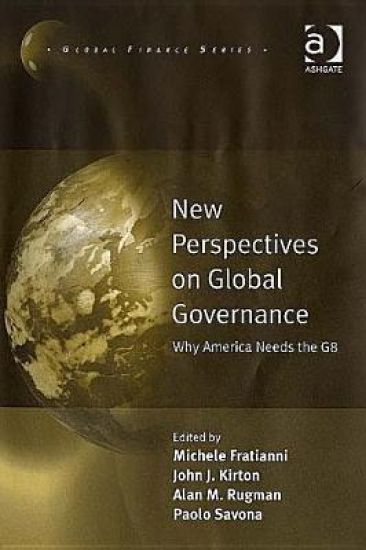
New Perspectives on Global Governance

New Perspectives on Global Governance

Michele Fratianni; Paolo Savona

Ashgate Publishing Limited
2005
sidottu
On its 30th anniversary in 2004 responsibility for hosting the G8 Summit fell into the hands of an allegedly unilateralist America. An America still reeling from the shock of the September 11th terrorist attacks, the resulting economic recession, bitter divisions with its NATO allies and disappointment with the United Nations Institutions over the 2003 Iraq war. So why does America still need the G8? New Perspectives on Global Governance offers new insight into the role of the Group of Eight's major market democracies and challenges the assumption that the G8 is simply a forum for binding a unilateralist hegemonic America. In contrast to seeing the G8 as a means of imposing an American world order this unique collection of new writings suggests that a now vulnerable America must rely on the G8 as a central instrument of foreign policy. America needs the G8 to achieve its security, economic and political interests in the world and to shape the twenty-first central global order it so desperately wants.