Kirjojen hintavertailu – 12 859 818 kirjaa ja 27 kauppaa

Kirjailija

Patricia Roberts-Miller

Kirjat ja teokset yhdessä paikassa: 14 kirjaa, julkaisuja vuosilta 1999–2025, suosituimpiin kuuluu Deliberating War. Vertaile teosten hintoja ja tarkista saatavuus suomalaisista kirjakaupoista.

14 kirjaa

Kirjojen julkaisuvuodet: 1999–2025.

Deliberating War

Deliberating War

Patricia Roberts-Miller

Springer International Publishing AG
2025
nidottu
This book argues that treating politics as war derails essential democratic processes, including deliberation and policy argumentation, in complicated ways. "Politics is war" is not always just a figure of speech, but often a sincere expression of how people see disagreement--they mean it literally--and they use it to evade the responsibilities of rhetoric. This book takes the metaphor seriously. Using a series of case studies ranging from the 432 BCE "Debate at Sparta" to Bill O'Reilly's recent invention of a "War on Christmas," Deliberating War illustrates pathologies of deliberation that arise when a community understands itself to be at political war. This book identifies recurrent rhetorical strategies that constrain or even effectively prohibit deliberation, such as deflecting, reframing, threat inflation, appealing to paired terms, claiming moral license, radicalizing a base. In short, what seems to be an effective solution to an immediate rhetorical problem--using hyperbole and demagoguery to persuade people to adopt a specific leader or policy--is a trap that prevents democratic practices of compromise, deliberation, fairness, reciprocity. Unhappily, threat inflation--even when well-intentioned--At some point, hyperbolic rhetoric becomes threat inflation, and then that inflated threat becomes the premise of policies, both foreign and domestic. And then agreeing as to the obvious existential threat posed by the Other and uniting behind the obvious policy solution is a necessary sign of being on the side of Good. Once communities become persuaded that they are in an apocalyptic battle between Good and Evil, politics as war can quickly become real war--often with far-reaching and catastrophic consequences.
Deliberating War

Deliberating War

Patricia Roberts-Miller

Springer International Publishing AG
2024
sidottu
This book argues that treating politics as war derails essential democratic processes, including deliberation and policy argumentation, in complicated ways. “Politics is war” is not always just a figure of speech, but often a sincere expression of how people see disagreement—they mean it literally—and they use it to evade the responsibilities of rhetoric. This book takes the metaphor seriously. Using a series of case studies ranging from the 432 BCE “Debate at Sparta” to Bill O’Reilly’s recent invention of a “War on Christmas,” Deliberating War illustrates pathologies of deliberation that arise when a community understands itself to be at political war. This book identifies recurrent rhetorical strategies that constrain or even effectively prohibit deliberation, such as deflecting, reframing, threat inflation, appealing to paired terms, claiming moral license, radicalizing a base. In short, what seems to be an effective solution to an immediate rhetorical problem—using hyperbole and demagoguery to persuade people to adopt a specific leader or policy—is a trap that prevents democratic practices of compromise, deliberation, fairness, reciprocity. Unhappily, threat inflation—even when well-intentioned--At some point, hyperbolic rhetoric becomes threat inflation, and then that inflated threat becomes the premise of policies, both foreign and domestic. And then agreeing as to the obvious existential threat posed by the Other and uniting behind the obvious policy solution is a necessary sign of being on the side of Good. Once communities become persuaded that they are in an apocalyptic battle between Good and Evil, politics as war can quickly become real war—often with far-reaching and catastrophic consequences.
Rhetoric and Religion in the Twenty-First Century

Rhetoric and Religion in the Twenty-First Century

Jonathan Alexander; Patricia Bizzell; John Brereton; Martin Camper; Beth Daniell; Rasha Diab; Janice W. Fernheimer; Cynthia Gannett; TJ Geiger; Andre E. Johnson; Lisa King; Beverly Moss; Laurent Pernot; Patricia Roberts-Miller; Kurt Spellmeyer; Elizabeth Vander Lei; Robert P. Yagelski; Lisa Zimmerelli

SOUTHERN ILLINOIS UNIVERSITY PRESS
2023
nidottu
Expanding the scope of religious rhetoric/B> Over the past twenty-five years, the intersection of rhetoric and religion has become one of the most dynamic areas of inquiry in rhetoric and writing studies. One of few volumes to include multiple traditions in one conversation, Rhetoric and Religion in the Twenty-First Century engages with religious discourses and issues that continue to shape public life in the United States. This collection of essays centralizes the study of religious persuasion and pluralism, considers religion’s place in U. S. society, and expands the study of rhetoric and religion in generative ways. The volume showcases a wide range of religious traditions and challenges the very concepts of rhetoric and religion. The book’s eight essays explore African American, Buddhist, Christian, Indigenous, Islamic, and Jewish rhetoric and discuss the intersection of religion with feminism, race, and queer rhetoric—along with offering reflections on how to approach religious traditions through research and teaching. In addition, the volume includes seven short interludes in which some of the field’s most accomplished scholars recount their experiences engaging with religious rhetorics and invite readers to engage these exigent lines of inquiry. By featuring these diverse religious perspectives, Rhetoric and Religion in the Twenty-First Century complicates the field’s emphasis on Western, Hellenistic, and Christian ideologies. The collection also offers teachers of writing and rhetoric a range of valuable approaches for preparing today’s students for public citizenship in our religiously diverse global context.
Speaking of Race

Speaking of Race

Patricia Roberts-Miller

The Experiment LLC
2021
nidottu
From a scholar of communication comes a guide to healing our fractured discourse on race and racism by infusing thetopic with more constructive and enriching dialogue. It's happened to virtually all of us: Someone calls something "racist" and you're not sure you agree. (Or someone calls you racist, and you definitely don't agree.) But before you say anything - before the argument escalates, as it almost always does, leaving everyone upset - professor of rhetoric Patricia Roberts-Miller would like to talk to you about how we talk about race. Roberts-Miller believes that these potentially explosive conversations are, in fact, opportunities to bring us together - if we have them constructively. In this concise, pocket-sized guide, she explains exactly how to do so: Rather than fall into the all-too-common traps of discussing personal identity, intentions, and emotions, we need to keep focused on actions. We can't assume that everyone has the same idea of racism - they don't - and so, Roberts-Miller provides a helpful working definition. In short, Speaking of Race teaches us to talk about racism the way an expert of rhetoric does. We may find that it makes our polarised world more eloquent - and less racist.
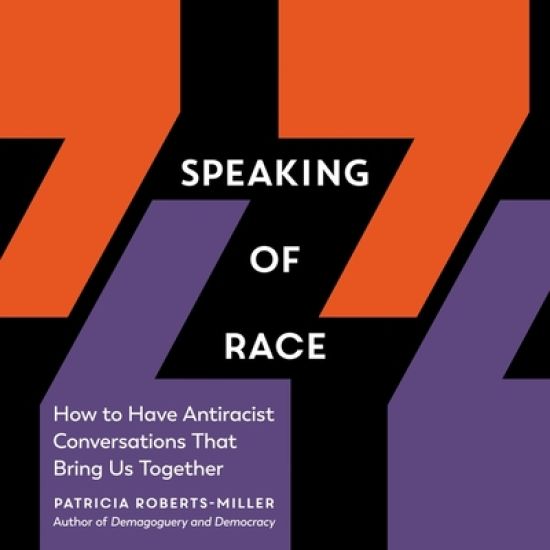
Speaking of Race Lib/E: How to Have Antiracist Conversations That Bring Us Together
It's easy to say that racism is wrong. But it's surprisingly hard to agree on what it is. Does a tired stereotype in your favorite movie make it racist? Does watching it anyway mean you're racist? Even among like-minded friends, such discussions can quickly escalate to hurt feelings all around--and when they do, we lose valuable opportunities to fight racism. Patricia Roberts-Miller is a scholar of rhetoric--the art of understanding misunderstandings. In Speaking of Race, she explains why the subject is a "third rail" and how we can do better: We can acknowledge that, in a racist society, racism is not the sole provenance of "bad people." We can focus on the harm it causes rather than the intent of offenders. And, when someone illuminates our own racist blind spots, we can take it not as a criticism, but as a kindness--and an opportunity to learn and to become less racist ourselves.
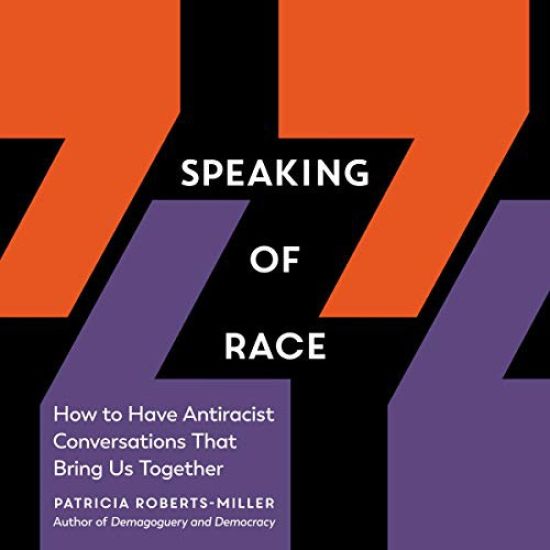
Speaking of Race: How to Have Antiracist Conversations That Bring Us Together
It's easy to say that racism is wrong. But it's surprisingly hard to agree on what it is. Does a tired stereotype in your favorite movie make it racist? Does watching it anyway mean you're racist? Even among like-minded friends, such discussions can quickly escalate to hurt feelings all around--and when they do, we lose valuable opportunities to fight racism. Patricia Roberts-Miller is a scholar of rhetoric--the art of understanding misunderstandings. In Speaking of Race, she explains why the subject is a "third rail" and how we can do better: We can acknowledge that, in a racist society, racism is not the sole provenance of "bad people." We can focus on the harm it causes rather than the intent of offenders. And, when someone illuminates our own racist blind spots, we can take it not as a criticism, but as a kindness--and an opportunity to learn and to become less racist ourselves.
Demagoguery and Democracy

Demagoguery and Democracy

Patricia Roberts-Miller

The Experiment LLC
2020
nidottu
A clear-eyed guide to demagoguery--and how we can defeat it What is demagoguery? Some demagogues are easy to spot: They rise to power through pandering, charisma, and prejudice. But, as professor Patricia Roberts-Miller explains, a demagogue is anyone who reduces all questions to us vs. them. Why is it dangerous? Demagoguery is democracy's greatest threat. It erodes rational debate, so that intelligent policymaking grinds to a halt. The idea that we never fall for it--that all the blame lies with them--is equally dangerous. How can we stop it? Demagogues follow predictable patterns in what they say and do to gain power. The key to resisting demagoguery is to name it when you see it--and to know where it leads.
Rhetoric and Demagoguery

Rhetoric and Demagoguery

Patricia Roberts-Miller

Southern Illinois University Press
2019
nidottu
In a culture of profit-driven media, demagoguery is a savvy short-term rhetorical strategy. Once it becomes the norm, individuals are more likely to employ it and, in that way, increase its power by making it seem the only way of disagreeing with or about others. When that happens, arguments about policy are replaced by arguments about identity—and criticism is met with accusations that the critic has the wrong identity (weak, treacherous, membership in an out-group) or the wrong feelings (uncaring, heartless). Patricia Roberts-Miller proposes a definition of demagoguery based on her study of groups and cultures that have talked themselves into disastrously bad decisions. She argues for seeing demagoguery as a way for people to participate in public discourse, and not necessarily as populist or heavily emotional. Demagoguery, she contends, depoliticizes political argument by making all issues into questions of identity. She broaches complicated questions about its effectiveness at persuasion, proposes a new set of criteria, and shows how demagoguery plays out in regard to individuals not conventionally seen as demagogues. Roberts-Miller looks at the discursive similarities among the Holocaust in early twentieth-century Germany, the justification of slavery in the antebellum South, the internment of Japanese Americans in the United States during World War II, and the U. S.-led invasion of Iraq in 2003, among others. She examines demagoguery among powerful politicians and jurists (Earl Warren, chief justice of the U. S. Supreme Court) as well as more conventional populists (Theodore Bilbo, two-time governor of Mississippi; E. S. Cox, cofounder of the Anglo-Saxon Clubs of America). She also looks at notorious demagogues (Athenian rhetor Cleon, Ann Coulter) and lesser-known public figures (William Hak-Shing Tam, Gene Simmons).
Voices in the Wilderness

Voices in the Wilderness

Patricia Roberts-Miller

The University of Alabama Press
2014
nidottu
What has gone wrong with discourse and deliberation in the United States? It remains monologic, argues Patricia Roberts-Miller in Voices in the Wilderness, which traces America’s dominant form of argumentation back to its roots in the rhetorical tradition of 17th-century American Puritans. A work of composition theory, rhetorical theory, and cultural criticism, this volume ultimately provides not only new approaches to argumentation and the teaching of rhetoric, composition, and communication but also an original perspective on the current debate over public discourse. Both Jürgen Habermas and Wayne Booth—two of the most influential theorists in the domain of public discourse and good citizenry—argue for an inclusive public deliberation that involves people who are willing to listen to one another, to identify points of agreement and disagreement, and to make good faith attempts to validate any disputed claims. The Puritan voice crying in the wilderness, Roberts-Miller shows, does none of these things. To this individual of conscience engaged in a ceaseless battle of right and wrong against greedy philistines, all inclusion, mediation, and reciprocity are seen as evil, corrupting, and unnecessary. Hence, the voice in the wilderness does not in any real sense participate in public deliberation, only in public pronouncement. Arguing that our culture’s continuing affection for the ethos of the voice crying in the wilderness is one of our more troubling inheritances from the early American ambivalence to public discourse—including the Puritan denigration of rhetoric—Roberts-Miller contends that the monologic discourse of the Puritans in fact contains within it arguments for dialogism. Thus, the history of rhetoric can provide much richer fields for reimagining discourse than heretofore credited. Roberts-Miller concludes by extending her findings into their practical applications for argumentation in the public sphere and in the composition classroom.
Fanatical Schemes

Fanatical Schemes

Patricia Roberts-Miller

The University of Alabama Press
2010
nidottu
What was the relationship between rhetoric and slavery, and how did rhetoric fail as an alternative to violence, becoming instead its precursor? Fanatical Schemes is a study of proslavery rhetoric in the 1830s. A common understanding of the antebellum slavery debate is that the increased stridency of abolitionists in the 1830s, particularly the abolitionist pamphlet campaign of 1835, provoked proslavery politicians into greater intransigence and inflammatory rhetoric. Patricia Roberts-Miller argues that, on the contrary, inflammatory rhetoric was inherent to proslavery ideology and predated any shift in abolitionist practices. She examines novels, speeches, and defenses of slavery written after the pamphlet controversy to underscore the tenets of proslavery ideology and the qualities that made proslavery rhetoric effective. She also examines anti-abolitionist rhetoric in newspapers from the spring of 1835 and the history of slave codes (especially anti-literacy laws) to show that anti-abolitionism and extremist rhetoric long preceded more strident abolitionist activity in the 1830s. The consensus that was achieved by proslavery advocates, argues Roberts-Miller, was not just about slavery, nor even simply about race. It was also about manhood, honor, authority, education, and political action. In the end, proslavery activists worked to keep the realm of public discourse from being a place in which dominant points of view could be criticized--an achievement that was, paradoxically, both a rhetorical success and a tragedy.
Fanatical Schemes

Fanatical Schemes

Patricia Roberts-Miller

The University of Alabama Press
2009
sidottu
What was the relationship between rhetoric and slavery, and how did rhetoric fail as an alternative to violence, becoming instead its precursor? "Fanatical Schemes" is a study of proslavery rhetoric in the 1830s. A common understanding of the antebellum slavery debate is that the increased stridency of abolitionists in the 1830s, particularly the abolitionist pamphlet campaign of 1835, provoked proslavery politicians into greater intransigence and inflammatory rhetoric. Patricia Roberts-Miller argues that, on the contrary, inflammatory rhetoric was inherent to proslavery ideology and predated any shift in abolitionist practices. Roberts-Miller examines novels, speeches, and defenses of slavery written after the pamphlet controversy to underscore the tenets of proslavery ideology and the qualities that made proslavery rhetoric effective. She also examines anti-abolitionist rhetoric in newspapers from the spring of 1835 and the history of slave codes (especially anti-literacy laws) to show that anti-abolitionism and extremist rhetoric long preceded more strident abolitionist activity in the 1830s. The consensus that was achieved by proslavery advocates, argues Roberts-Miller, was not just about slavery, nor even simply about race. It was also about manhood, honor, authority, education, and political action. In the end, proslavery activists worked to keep the realm of public discourse from being a place in which dominant points of view could be criticized - an achievement that was, paradoxically, both a rhetorical success and a tragedy.
Deliberate Conflict

Deliberate Conflict

Patricia Roberts-Miller

Southern Illinois University Press
2007
nidottu
In ""Deliberate Conflict: Argument, Political Theory, and Composition Classes"", Patricia Roberts-Miller argues that much current discourse about argument pedagogy is hampered by fundamental unspoken disagreements over what democratic public discourse should look like. The book's pivotal question is, In what kind of public discourse do we want our students to engage? To answer this, the text provides a taxonomy, discussion, and evaluation of political theories that underpin democratic discourse, high-lighting the relationship between various models of the public sphere and rhetorical theory. ""Deliberate Conflict"" cogently advocates reintegrating instruction in argumentation with the composition curriculum. By linking effective argumentation in the public sphere with the ability to effect social change, Roberts-Miller pushes compositionists beyond a simplistic Aristotelian conception of how argumentation works and offers a means by which to prepare students for active participation in public discourse.
Voices in the Wilderness

Voices in the Wilderness

Patricia Roberts-Miller

The University of Alabama Press
1999
sidottu
This volume traces America's dominant form of argumentation back to its roots in the rhetorical tradition of the 17th-century American Puritans. It provides approaches to argumentation and the teaching of rhetoric, composition and communication, and a perspective on debates over public discourse.