Kirjojen hintavertailu – 12 876 591 kirjaa ja 26 kauppaa

Kirjailija

Patrick Baert

Kirjat ja teokset yhdessä paikassa: 13 kirjaa, julkaisuja vuosilta 1998–2020, suosituimpiin kuuluu The Sociology of Intellectuals. Vertaile teosten hintoja ja tarkista saatavuus suomalaisista kirjakaupoista.

13 kirjaa

Kirjojen julkaisuvuodet: 1998–2020.

The Dark Side of Podemos?

The Dark Side of Podemos?

Josh Booth; Patrick Baert

Routledge
2020
nidottu
In 2014 a new progressive party, Podemos, emerged on the Spanish political scene. Within just over two years it had become the country’s third-biggest party, winning a slew of seats in parliament and regularly making headline news. While some see Podemos as the saviour of Spanish democracy, others have accused it of corrosive populism. But what few have noticed is that behind its distinctive rhetoric lies a thinker closely associated with Germany’s Third Reich: Carl Schmitt. Why has an ostensibly progressive and avowedly anti-fascist political party taken up Schmitt’s ideas? The puzzle only deepens when we learn of Schmitt’s links with Francisco Franco’s dictatorship. In The Dark Side of Podemos?, Booth and Baert explain why Schmittian theory resonated with Podemos’ founders. In doing so, the authors position Podemos and the ideas that guide it within the context of recent Spanish history and ongoing politics of memory, revealing a story about how personal and political narratives have combined to produce a formidable political force. This enlightening monograph will appeal to undergraduates and postgraduates, as well as postdoctoral researchers, interested in fields such as Politics, Political Theory and Sociology. It will also be relevant to those curious about contemporary Spanish politics, the nature of populism, the future of the European left, or Carl Schmitt and his links with Spain.

The Sociology of Intellectuals

The Sociology of Intellectuals

Simon Susen; Patrick Baert

Springer International Publishing AG
2018
nidottu
This volume offers an unprecedented account of recent and future developments in the sociology of intellectuals. It presents a critical exchange between two leading contemporary social theorists, Patrick Baert and Simon Susen, advancing debates at the cutting edge of scholarship on the changing role of intellectuals in the increasingly interconnected societies of the twenty-first century. The discussion centres on Baert’s most recent contribution to this field of inquiry, The Existentialist Moment: The Rise of Sartre as a Public Intellectual (2015), demonstrating that it has opened up hitherto barely explored avenues for the sociological study of intellectuals. In addition, the authors provide an overview of various alternative approaches that are available for understanding the sociology of intellectuals – such as those of Pierre Bourdieu, Randall Collins, and Neil Gross. In doing so, they grapple with the question of the extent to which intellectuals canplay a constructive role in influencing social and political developments in the modern era. This insightful volume will appeal to students and scholars of the humanities and social sciences, particularly to those interested in social theory and the history of intellectual thought.
The Dark Side of Podemos?

The Dark Side of Podemos?

Josh Booth; Patrick Baert

CRC Press Inc
2018
sidottu
In 2014 a new progressive party, Podemos, emerged on the Spanish political scene. Within just over two years it had become the country’s third-biggest party, winning a slew of seats in parliament and regularly making headline news. While some see Podemos as the saviour of Spanish democracy, others have accused it of corrosive populism. But what few have noticed is that behind its distinctive rhetoric lies a thinker closely associated with Germany’s Third Reich: Carl Schmitt. Why has an ostensibly progressive and avowedly anti-fascist political party taken up Schmitt’s ideas? The puzzle only deepens when we learn of Schmitt’s links with Francisco Franco’s dictatorship. In The Dark Side of Podemos?, Booth and Baert explain why Schmittian theory resonated with Podemos’ founders. In doing so, the authors position Podemos and the ideas that guide it within the context of recent Spanish history and ongoing politics of memory, revealing a story about how personal and political narratives have combined to produce a formidable political force. This enlightening monograph will appeal to undergraduates and postgraduates, as well as postdoctoral researchers, interested in fields such as Politics, Political Theory and Sociology. It will also be relevant to those curious about contemporary Spanish politics, the nature of populism, the future of the European left, or Carl Schmitt and his links with Spain.
The Sociology of Intellectuals

The Sociology of Intellectuals

Simon Susen; Patrick Baert

Springer International Publishing AG
2017
sidottu
This volume offers an unprecedented account of recent and future developments in the sociology of intellectuals. It presents a critical exchange between two leading contemporary social theorists, Patrick Baert and Simon Susen, advancing debates at the cutting edge of scholarship on the changing role of intellectuals in the increasingly interconnected societies of the twenty-first century. The discussion centres on Baert’s most recent contribution to this field of inquiry, The Existentialist Moment: The Rise of Sartre as a Public Intellectual (2015), demonstrating that it has opened up hitherto barely explored avenues for the sociological study of intellectuals. In addition, the authors provide an overview of various alternative approaches that are available for understanding the sociology of intellectuals – such as those of Pierre Bourdieu, Randall Collins, and Neil Gross. In doing so, they grapple with the question of the extent to which intellectuals canplay a constructive role in influencing social and political developments in the modern era. This insightful volume will appeal to students and scholars of the humanities and social sciences, particularly to those interested in social theory and the history of intellectual thought.
The Existentialist Moment

The Existentialist Moment

Patrick Baert

Polity Press
2015
nidottu
Choice Outstanding Academic Title for 2015Jean-Paul Sartre is often seen as the quintessential public intellectual, but this was not always the case. Until the mid-1940s he was not so well-known, even in France. Then suddenly, in a very short period of time, Sartre became an intellectual celebrity. How can we explain this remarkable transformation? The Existentialist Moment retraces Sartre?s career and provides a compelling new explanation of his meteoric rise to fame. Baert takes the reader back to the confusing and traumatic period of the Second World War and its immediate aftermath and shows how the unique political and intellectual landscape in France at this time helped to propel Sartre and existentialist philosophy to the fore. The book also explores why, from the early 1960s onwards, in France and elsewhere, the interest in Sartre and existentialism eventually waned. The Existentialist Moment ends with a bold new theory for the study of intellectuals and a provocative challenge to the widespread belief that the public intellectual is a species now on the brink of extinction.
The Existentialist Moment

The Existentialist Moment

Patrick Baert

Polity Press
2015
sidottu
Choice Outstanding Academic Title for 2015Jean-Paul Sartre is often seen as the quintessential public intellectual, but this was not always the case. Until the mid-1940s he was not so well-known, even in France. Then suddenly, in a very short period of time, Sartre became an intellectual celebrity. How can we explain this remarkable transformation? The Existentialist Moment retraces Sartre?s career and provides a compelling new explanation of his meteoric rise to fame. Baert takes the reader back to the confusing and traumatic period of the Second World War and its immediate aftermath and shows how the unique political and intellectual landscape in France at this time helped to propel Sartre and existentialist philosophy to the fore. The book also explores why, from the early 1960s onwards, in France and elsewhere, the interest in Sartre and existentialism eventually waned. The Existentialist Moment ends with a bold new theory for the study of intellectuals and a provocative challenge to the widespread belief that the public intellectual is a species now on the brink of extinction.
Social Theory in the Twentieth Century and Beyond

Social Theory in the Twentieth Century and Beyond

Patrick Baert; Filipe Carreira da Silva

Polity Press
2009
sidottu
This revised edition of Patrick Baert's widely acclaimed Social Theory in the Twentieth Century, now benefitting from the collaboration of Filipe Carreira da Silva has been brought right up-to-date with cutting-edge developments in social theory today. It offers an easy-to-read but provocative account of the development of social theory, covering a range of key figures and classic schools of thought. The authors bridge the gap between philosophy and social theory, locating the theoretical views of individuals such as Michel Foucault, Anthony Giddens and Jürgen Habermas within wider historical traditions. The revised edition includes new material on French pragmatist sociology and cultural sociology, and on contemporary social thinkers such as Zygmunt Bauman, Ulrich Beck, Manuel Castells, Randall Collins, Michael Mann, Saskia Sassen and Theda Skocpol. The authors conclude with a bold, new pragmatist agenda for social theory and the social sciences. Written in a lively style, and avoiding jargon, Social Theory in the Twentieth Century and Beyond is aimed at students who wish to gain an understanding of the main debates and dilemmas driving social theory. Like its predecessor, it will be a standard introduction to modern social theory for students in sociology, politics and anthropology.
Social Theory in the Twentieth Century and Beyond

Social Theory in the Twentieth Century and Beyond

Patrick Baert; Filipe Carreira da Silva

Polity Press
2009
nidottu

Halvin toimitettuna 35,50 €

This revised edition of Patrick Baert's widely acclaimed Social Theory in the Twentieth Century, now benefitting from the collaboration of Filipe Carreira da Silva has been brought right up-to-date with cutting-edge developments in social theory today. It offers an easy-to-read but provocative account of the development of social theory, covering a range of key figures and classic schools of thought. The authors bridge the gap between philosophy and social theory, locating the theoretical views of individuals such as Michel Foucault, Anthony Giddens and Jürgen Habermas within wider historical traditions. The revised edition includes new material on French pragmatist sociology and cultural sociology, and on contemporary social thinkers such as Zygmunt Bauman, Ulrich Beck, Manuel Castells, Randall Collins, Michael Mann, Saskia Sassen and Theda Skocpol. The authors conclude with a bold, new pragmatist agenda for social theory and the social sciences. Written in a lively style, and avoiding jargon, Social Theory in the Twentieth Century and Beyond is aimed at students who wish to gain an understanding of the main debates and dilemmas driving social theory. Like its predecessor, it will be a standard introduction to modern social theory for students in sociology, politics and anthropology.
Philosophy of the Social Sciences

Philosophy of the Social Sciences

Patrick Baert

Polity Press
2005
sidottu
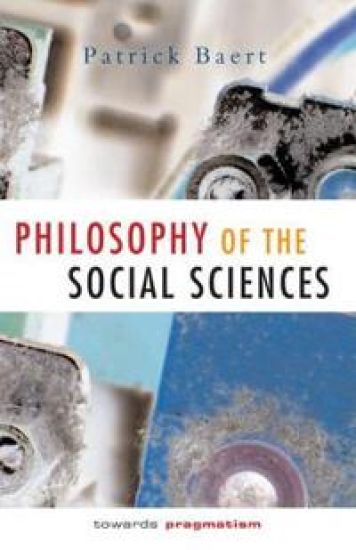
In this ground-breaking new text, Patrick Baert analyses the central perspectives in the philosophy of social science, critically investigating the work of Durkheim, Weber, Popper, critical realism, critical theory, and Rorty's neo pragmatism. Places key writers in their social and political contexts, helping to make their ideas meaningful to students. Shows how these authors’ views have practical uses in empirical research. Lively approach that makes complex ideas understandable to upper-level students, as well as having scholarly appeal.
Philosophy of the Social Sciences

Philosophy of the Social Sciences

Patrick Baert

Polity Press
2005
nidottu

Halvin toimitettuna 31,10 €

In this ground-breaking new text, Patrick Baert analyses the central perspectives in the philosophy of social science, critically investigating the work of Durkheim, Weber, Popper, critical realism, critical theory, and Rorty's neo pragmatism. Places key writers in their social and political contexts, helping to make their ideas meaningful to students. Shows how these authors’ views have practical uses in empirical research. Lively approach that makes complex ideas understandable to upper-level students, as well as having scholarly appeal.
Social Theory in the Twentieth Century

Social Theory in the Twentieth Century

Patrick Baert

New York University Press
1998
sidottu
"I think this is an outstanding book. The coverage is comprehensive, the lines of thought and exposition are clear, and the level of discussion is very high yet remarkably lively and accessible. It has an underlying intellectual seriousness and engagement which shines out through the individual chapters, and the author's unwillingness to make do with secondary analyses and received ideas gives it a strength and freshness of approach which is extremely welcome." --Professor William Outhwaite, University of Sussex Social Theory in the Twentieth Century offers an easy-to-read but provocative account of the development of social theory. Patrick Baert covers a wide range of key figures and schools of thought, including Giddens, Foucault and Habermas. Written in a lively style and avoiding jargon, this book is aimed at students who wish to understand the main debates and dilemmas driving social theory. Rather than providing a neutral summary of the different thinkers and theories, Baert challenges the conventional readings of social theory with new and original interpretations. In effect, he bridges the gap between philosophy and social theory by placing the theoretical views within wider historical traditions. Social Theory in the Twentieth Century will undoubtedly become the standard introduction to social theory for students in sociology, politics, and anthropology.
Social theory in the twentieth century

Social theory in the twentieth century

Patrick Baert

Blackwell Publishers
1998
pokkari
Providing an account of the development of social theory, this text covers a range of key figures and schools of thought, including Elster, Giddens, Foucault and Habermas. It is aimed at students who wish to gain an understanding of the main debates and dilemmas driving social theory.
Social Theory in the Twentieth Century

Social Theory in the Twentieth Century

Patrick Baert

New York University Press
1998
pokkari
"I think this is an outstanding book. The coverage is comprehensive, the lines of thought and exposition are clear, and the level of discussion is very high yet remarkably lively and accessible. It has an underlying intellectual seriousness and engagement which shines out through the individual chapters, and the author's unwillingness to make do with secondary analyses and received ideas gives it a strength and freshness of approach which is extremely welcome." --Professor William Outhwaite, University of Sussex Social Theory in the Twentieth Century offers an easy-to-read but provocative account of the development of social theory. Patrick Baert covers a wide range of key figures and schools of thought, including Giddens, Foucault and Habermas. Written in a lively style and avoiding jargon, this book is aimed at students who wish to understand the main debates and dilemmas driving social theory. Rather than providing a neutral summary of the different thinkers and theories, Baert challenges the conventional readings of social theory with new and original interpretations. In effect, he bridges the gap between philosophy and social theory by placing the theoretical views within wider historical traditions. Social Theory in the Twentieth Century will undoubtedly become the standard introduction to social theory for students in sociology, politics, and anthropology.