Kirjojen hintavertailu – 12 859 818 kirjaa ja 27 kauppaa

Kirjailija

Patrick McConvell

Kirjat ja teokset yhdessä paikassa: 4 kirjaa, julkaisuja vuosilta 2013–2023, suosituimpiin kuuluu A Grammar of Gurindji. Vertaile teosten hintoja ja tarkista saatavuus suomalaisista kirjakaupoista.

4 kirjaa

Kirjojen julkaisuvuodet: 2013–2023.

A Grammar of Gurindji

A Grammar of Gurindji

Felicity Meakins; Patrick McConvell

De Gruyter
2023
isokokoinen pokkari
Felicity Meakins was awarded the Kenneth L. Hale Award 2021by the Linguistic Society of America (LSA) for outstanding work on the documentation of endangered languages Gurindji is a Pama-Nyungan language of north-central Australia. It is a member of the Ngumpin subgroup which forms a part of the Ngumpin-Yapa group. The phonology is typically Pama-Nyungan; the phoneme inventory contains five places of articulation for stops which have corresponding nasals. It also has three laterals, two rhotics and three vowels. There are no fricatives and, among the stops, voicing is not phonemically distinctive. One striking morpho-phonological process is a nasal cluster dissimilation (NCD) rule. Gurindji is morphologically agglutinative and suffixing, exhibiting a mix of dependent-marking and head-marking. Nominals pattern according to an ergative system and bound pronouns show an accusative pattern. Gurindji marks a further 10 cases. Free and bound pronouns distinguish person (1st inclusive and exclusive, 2nd and 3rd) and three numbers (minimal, unit augmented and augmented). The Gurindji verb complex consists of an inflecting verb and coverb. Inflecting verbs belong to a closed class of 34 verbs which are grammatically obligatory. Coverbs form an open class, numbering in the hundreds and carrying the semantic weight of the complex verb
A Grammar of Gurindji

A Grammar of Gurindji

Felicity Meakins; Patrick McConvell

De Gruyter Mouton
2021
sidottu
Felicity Meakins was awarded the Kenneth L. Hale Award 2021by the Linguistic Society of America (LSA) for outstanding work on the documentation of endangered languages Gurindji is a Pama-Nyungan language of north-central Australia. It is a member of the Ngumpin subgroup which forms a part of the Ngumpin-Yapa group. The phonology is typically Pama-Nyungan; the phoneme inventory contains five places of articulation for stops which have corresponding nasals. It also has three laterals, two rhotics and three vowels. There are no fricatives and, among the stops, voicing is not phonemically distinctive. One striking morpho-phonological process is a nasal cluster dissimilation (NCD) rule. Gurindji is morphologically agglutinative and suffixing, exhibiting a mix of dependent-marking and head-marking. Nominals pattern according to an ergative system and bound pronouns show an accusative pattern. Gurindji marks a further 10 cases. Free and bound pronouns distinguish person (1st inclusive and exclusive, 2nd and 3rd) and three numbers (minimal, unit augmented and augmented). The Gurindji verb complex consists of an inflecting verb and coverb. Inflecting verbs belong to a closed class of 34 verbs which are grammatically obligatory. Coverbs form an open class, numbering in the hundreds and carrying the semantic weight of the complex verb
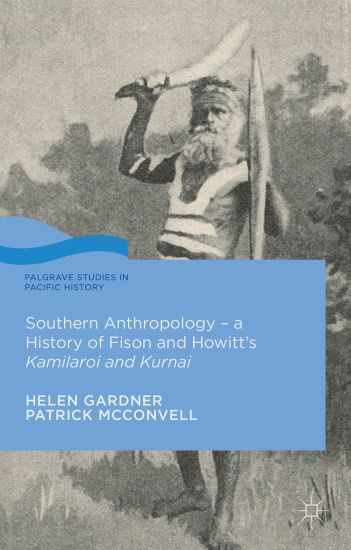
Southern Anthropology - a History of Fison and Howitt’s Kamilaroi and Kurnai
Southern Anthropology, the history of Fison and Howitt's Kamilaroi and Kurnai is the biography of Kamilaroi and Kurnai (1880) written from both a historical and anthropological perspective. Southern Anthropology investigates the authors' work on Aboriginal and Pacific people and the reception of their book in metropolitan centres.
Kinship Systems

Kinship Systems

Patrick McConvell

University of Utah Press,U.S.
2013
sidottu
Kinship systems are the glue that holds social groups together. This volume presents a novel approach to understanding the genesis of these systems and how and why they change. The editors bring together experts from the disciplines of anthropology and linguistics to explore kinship in societies around the world and to reconstruct kinship in ancient times. Kinship Systems presents evidence of renewed activity and advances in this field in recent years which will contribute to the current interdisciplinary focus on the evolution of society. While all continents are touched on in this book, there is special emphasis on Australian indigenous societies, which have been a source of fascination in kinship studies. One key argument in the book is that linguistic evidence for reconstruction of ancient terminologies can provide strong independent evidence to complement anthropologists’ notions of structural kinship transformations, and ground them in actual historical and geographical contexts. There are principles that we all share, no matter what kind of society we live in, and these provide a common “language” for anthropology and linguistics. With this language we can accurately compare how family relations are organised in different societies, as well as how we talk about such relations. Because this concept has often been denied by the trajectories in anthropology over the last few decades, Kinship Systems represents a reassertion of, and advances on, classical kinship theory and methods. Innovations and interdisciplinary methods are described by the originators of the new approaches and other leading regional experts.