Kirjojen hintavertailu – 12 903 725 kirjaa ja 27 kauppaa

Kirjailija

Paul A. Samuelson

Kirjat ja teokset yhdessä paikassa: 5 kirjaa, julkaisuja vuosilta 1998–2008, suosituimpiin kuuluu The Price of Prosperity. Vertaile teosten hintoja ja tarkista saatavuus suomalaisista kirjakaupoista.

5 kirjaa

Kirjojen julkaisuvuodet: 1998–2008.

The Price of Prosperity

The Price of Prosperity

Peter L. Bernstein; Paul A. Samuelson

John Wiley Sons Inc
2008
nidottu
One of the foremost financial writers of his generation, Peter Bernstein has the unique ability to synthesize intellectual history and economics with the theory and practice of investment management. Now, with classic titles such as Economist on Wall Street, A Primer on Money, Banking, and Gold, and The Price of Prosperity?which have forewords by financial luminaries and new introductions by the author?you can enjoy some of the best of Bernstein in his earlier Wall Street days. First published in 1962, The Price of Prosperity speaks to today's uncertainties as clearly as to those of the past. With chapters like "The Burden of Government" and "The Economics of Democracy," Bernstein probes the future of an economy during rapidly changing times and the appropriate role of government in determining the ultimate outcome. The questions have not changed over time, but Bernstein's answers help us understand these issues from today's perspective. How much government control is too much control? How much can government spend? How can government influence the level of unemployment? As Bernstein shows how to navigate an ever-changing economic landscape, his timeless insights throughout these pages make The Price of Prosperity as vital and important today as when it appeared in an environment fundamentally different from our own.
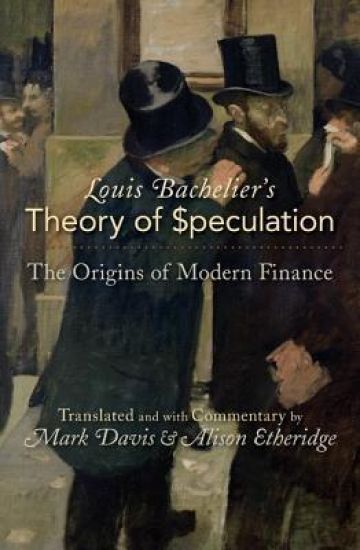
Louis Bachelier's Theory of Speculation

Louis Bachelier's Theory of Speculation

Louis Bachelier; Paul A. Samuelson

PRINCETON UNIVERSITY PRESS
2006
sidottu
March 29, 1900, is considered by many to be the day mathematical finance was born. On that day a French doctoral student, Louis Bachelier, successfully defended his thesis Theorie de la Speculation at the Sorbonne. The jury, while noting that the topic was "far away from those usually considered by our candidates," appreciated its high degree of originality. This book provides a new translation, with commentary and background, of Bachelier's seminal work. Bachelier's thesis is a remarkable document on two counts. In mathematical terms Bachelier's achievement was to introduce many of the concepts of what is now known as stochastic analysis. His purpose, however, was to give a theory for the valuation of financial options. He came up with a formula that is both correct on its own terms and surprisingly close to the Nobel Prize-winning solution to the option pricing problem by Fischer Black, Myron Scholes, and Robert Merton in 1973, the first decisive advance since 1900. Aside from providing an accurate and accessible translation, this book traces the twin-track intellectual history of stochastic analysis and financial economics, starting with Bachelier in 1900 and ending in the 1980s when the theory of option pricing was substantially complete. The story is a curious one. The economic side of Bachelier's work was ignored until its rediscovery by financial economists more than fifty years later. The results were spectacular: within twenty-five years the whole theory was worked out, and a multibillion-dollar global industry of option trading had emerged.
New Frontiers in Economics

New Frontiers in Economics

Paul A. Samuelson

Cambridge University Press
2004
pokkari
Leading economists analyze the new directions that subdisciplines of economics have taken in the face of modern economic challenges. These essays represent invention and discovery in the areas of information, macroeconomics and public policies, international trade and development, finance, business, contracts, law, gaming, and government, as these areas of study evolve through the different phases of the scientific process. They offer a wealth of factual information on the current state of the economy. Theoretical and empirical innovations conceptualize reality and values in different ways from their predecessors. Together the essays offer the reader a balanced look at the various fields, approaches, and dimensions that comprise future directions in economic theory, research, and practice. The extensive introduction by the editors not only summarizes and reviews the implications of the contributions presented in the volume, but also examines how scientific progress takes place, with special reference to economics and finance.
New Frontiers in Economics

New Frontiers in Economics

Paul A. Samuelson

Cambridge University Press
2004
sidottu
Leading economists analyze the new directions that subdisciplines of economics have taken in the face of modern economic challenges. These essays represent invention and discovery in the areas of information, macroeconomics and public policies, international trade and development, finance, business, contracts, law, gaming, and government, as these areas of study evolve through the different phases of the scientific process. They offer a wealth of factual information on the current state of the economy. Theoretical and empirical innovations conceptualize reality and values in different ways from their predecessors. Together the essays offer the reader a balanced look at the various fields, approaches, and dimensions that comprise future directions in economic theory, research, and practice. The extensive introduction by the editors not only summarizes and reviews the implications of the contributions presented in the volume, but also examines how scientific progress takes place, with special reference to economics and finance.
Passion and Craft

Passion and Craft

Michael Szenberg; Paul A. Samuelson

The University of Michigan Press
1998
nidottu
Most celebrities have to wait until the end of their careers to publish their autobiographies. Here, twenty economists in mid-career (nineteen scholars and an economics journalist) bring together personal accounts of their work and lives. The contributors were asked to elaborate on their methods of working and their private thoughts. The result is a rich set of biographies, addressing issues such as the effects of politics on work and vice versa, family life, creativity in and inspired by the workplace, the study of law and economics, and the conducting of research, and the role of women in this male-dominated field. The contributing economists represent a wide range of endeavors in economics such as research, education, law, and journalism, and include Francine D. Blau, David Colander, William Darity, Jr., Avinash Dixit, Benjamin M. Friedman, Claudia Goldin, David M. Gordon, Elhanan Helpman, Paul Krugman, William M. Landes, N. Gregory Mankiw, Deirdre N. McCloskey, Rachel McCulloch, Philip Mirowski, Roger B. Myerson, Susan Rose-Ackerman, Richard Schmalensee, Hal R. Varian, David Warsh, and Gavin Wright. Michael Szenberg provides an introduction. Passion and Craft provides a fascinating glimpse into the minds and lives of some of the most interesting economists of our time. It will be inspiring reading for economists as well as all other social scientists, students considering a career in economics, and anyone interested in how great minds work. Passion and Craft is a worthy sequel to Eminent Economists. It should be of greatest interest to young scholars who want to know what it is like to 'do economics' and to senior economists who will learn how things have changed (or have they?). --Victor R. Fuchs, Stanford UniversityMichael Szenberg is Director, Center for Applied Research, and Professor of Economics, Lubin School of Business, Pace University. He also serves as editor of The American Economist.