Kirjojen hintavertailu – 12 859 828 kirjaa ja 27 kauppaa

Kirjailija

Paul Babie

Kirjat ja teokset yhdessä paikassa: 7 kirjaa, julkaisuja vuosilta 2011–2025, suosituimpiin kuuluu Neoliberalism and the Biblical Voice. Vertaile teosten hintoja ja tarkista saatavuus suomalaisista kirjakaupoista.

7 kirjaa

Kirjojen julkaisuvuodet: 2011–2025.

Private Property is Ego

Private Property is Ego

Paul Babie

Routledge
2025
sidottu
Drawing on Badiou’s statement: ‘Property as ego", this book argues that the reality of neo-liberalism means that rather than seeing it as ego, we need to understand that private property is ego. The book is divided into three parts. Part I discusses the neo-liberal account of private property as a liberal choice in respect of the use of goods and resources, which can be controlled. The book challenges this view arguing that private property cannot be justified, regardless of how much restraint the state tries to impose on choice. Ultimately private property is not choice, it is ego. Part II develops a theory of private property as the expression of the neo-liberal ego. Working from Badiou’s statement, it argues that all of the liberal and neo-liberal theorising about the content of private property, and the justifications for it merely seek to defend the exercise of ego as concerns the allocation, use and control of the planet’s goods and resources. Part III calls for the rejection of private property as the means of apportioning the world. It offers reflections on alternatives as to how the earth’s things might be allocated, forcing us to reflect upon how a world without private property might look.

Neoliberalism and the Biblical Voice

Neoliberalism and the Biblical Voice

Paul Babie; Michael Trainor

Routledge
2019
nidottu
This book compares our contemporary preoccupation with ownership and consumption with the role of property and possessions in the biblical world, contending that Christian theology provides a valuable entry point to discussing the issue of private property—a neoliberal tool with the capacity to shape the world in which we live by exercising control over the planet’s resources. Babie and Trainor draw on the teaching on property and possessions of Jesus of Nazareth. They demonstrate how subsequent members of the Jesus movement—the writers of early collection of Jesus sayings (called ‘Q’), and the gospels of Mark and Luke—reformulated Jesus’ teaching for different contexts that was radical and challenging for their own day. Their view of wealth and possessions continues today to be as relevant as ever. By placing the insights of the Galilean Jesus and the early Jesus movement into conversation with contemporary views on private property and consumer culture, the authors develop legal, philosophical and theological insights, what they describe as ‘seven theses’, into how our desire for ethical living fares in the neoliberal marketplace.
Neoliberalism and the Biblical Voice

Neoliberalism and the Biblical Voice

Paul Babie; Michael Trainor

Routledge
2017
sidottu
This book compares our contemporary preoccupation with ownership and consumption with the role of property and possessions in the biblical world, contending that Christian theology provides a valuable entry point to discussing the issue of private property—a neoliberal tool with the capacity to shape the world in which we live by exercising control over the planet’s resources. Babie and Trainor draw on the teaching on property and possessions of Jesus of Nazareth. They demonstrate how subsequent members of the Jesus movement—the writers of early collection of Jesus sayings (called ‘Q’), and the gospels of Mark and Luke—reformulated Jesus’ teaching for different contexts that was radical and challenging for their own day. Their view of wealth and possessions continues today to be as relevant as ever. By placing the insights of the Galilean Jesus and the early Jesus movement into conversation with contemporary views on private property and consumer culture, the authors develop legal, philosophical and theological insights, what they describe as ‘seven theses’, into how our desire for ethical living fares in the neoliberal marketplace.
Law as Change

Law as Change

Paul Babie; Paul Leadbeter

University of Adelaide Press
2014
pokkari
In 2011, Professor Adrian J Bradbrook retired from a distinguished scholarly career spanning over forty years. During this time, he made a significant contribution to teaching and scholarship not only in property law -- specifically to leasehold tenancies law and easements and restrictive covenants -- but also to energy law, especially the emerging and growing field of solar energy. This book brings together those people who worked closely with Bradbrook, each an expert in their own right, to honour a career by critically engaging with the contributions Bradbrook made to property and energy law. Each author has chosen a topic that both fits with their own cutting-edge research and explores the related contributions made by Bradbrook. Most unusually, this collection ranges widely across property law, energy law and human rights.
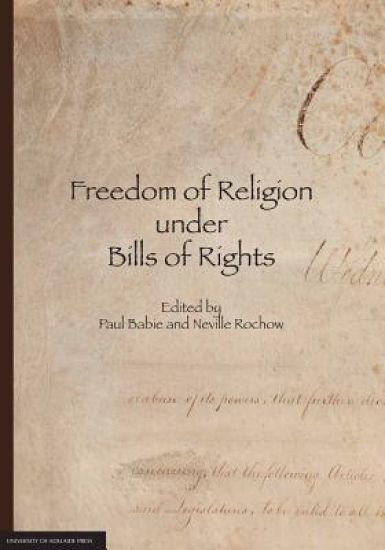
Freedom of Religion Under Bills of Rights

Freedom of Religion Under Bills of Rights

Paul Babie

University of Adelaide Press
2011
nidottu
'The Australian Constitution contains no guarantee of freedom of religion or freedom of conscience. Indeed, it contains very few provisions dealing with rights -- in essence, it is a Constitution that confines itself mainly to prescribing a framework for federal government, setting out the various powers of government and limiting them as between federal and state governments and the three branches of government without attempting to define the rights of citizens except in minor respects. ...]Whether Australia should have a national bill of rights has been a controversial issue for quite some time. This is despite the fact that Australia has acceded to the ICCPR, as well as the First Optional Protocol to the ICCPR, thereby accepting an international obligation to bring Australian law into line with the ICCPR, an obligation that Australia has not discharged. Australia is the only country in the Western world without a national bill of rights. The chapters that follow in this book debate the situation in Australia and in various other Western jurisdictions.'