
Kirjailija
Paul Carroll
Kirjat ja teokset yhdessä paikassa: 7 kirjaa, julkaisuja vuosilta 1999–2025, suosituimpiin kuuluu Baroque Woodwind Instruments. Vertaile teosten hintoja ja tarkista saatavuus suomalaisista kirjakaupoista.
7 kirjaa
Kirjojen julkaisuvuodet: 1999–2025.

A Brief History of a Perfect Future
Chunka Mui; Paul Carroll; Tim Andrews
Future Histories Press
2021
sidottu
What if, instead of trying to predict the future, we could just pick the one we want - and then invent it? Well, we can. This book describes seven stunning technological advances that will occur by 2050 and shows how to combine them, starting now, to build a future that will let billions thrive. The smartphone in your pocket could guide 120 million Apollo-era spacecraft to the moon and back, all at the same time. And whatever replaces that phone in 30 years will be a million times more powerful. Many other technologies are on similar trajectories, and the core tools of genomics - which let us understand and even manipulate genetic code - are actually improving far faster, with broad implications for our health, for the foods we eat, and for just about everything else. How can a person even visualize a MILLION-fold improvement over 30 years, let alone a series of them that will interact with each other in profound ways? The traditional approach has been to think in bite-sized increments, of perhaps three to five years, and to let the rest of the future take care of itself. The authors propose a different way. They propose to harness the future, not to just let it happen. They do the million-fold imagining for the reader, describing seven so-incredible-as-to-be-almost-magical technological building blocks that will be available to all of us in 2050. These building blocks-in computing, communication, information, genomics, energy, water, and transportation-are following what the authors have dubbed the Laws of Zero. The technologies are increasing in power so fast in cost that you can count on them heading toward zero(ish) cost over the next three decades, meaning that infinite(ish) amounts of those resources will be available. The book paints visions of how the world could look if we all start planning now and experiment our way toward taking full advantage of the technological marvels that will be available. The authors provide what they call "future histories" - short, provocative "news" articles set in 2050 that describe how key aspects of the world might look in areas such as transportation, health care, climate, and trust. It's easy to imagine falling into dystopian scenarios, a la those depicted in classics like 1984 and Brave New World. This book provides an optimistic vision of the future, very much grounded in facts and the lessons of history, while showing how individuals, companies, and governments can make this vision a reality. The authors aren't claiming they can predict the future. They very much abide by the oft-used line that "it is difficult to make predictions, especially about the future." No, rather than predict the future, they want to draw on a lesson they learned from personal computing pioneer Alan Kay: "The best way to predict the future is to invent it." The authors want to invent a perfect future. More precisely, they want to help you invent it.

A DNA ANCESTRY TEST OPENS UP A PANDORAâ?? S BOX OF SECRETS. When a fragile Elsa Watson takes a DNA ancestry test out of idle curiosity she little imagines the devastating consequences she is about to unleash.
The late 17th century through to the end of the 18th century saw rapid progress in the development of woodwind instruments and the composition of a vast body of music for those instruments. During this period a large amount of music for domestic consumption was written for a growing amateur market, a market which has regrown in the latter part of the 20th century. The last 30 years has also seen the standard of performance by professionals on these instruments rise enormously. This book provides a guide to the history of the four main woodwind instruments of the Baroque, the flute, oboe, recorder and bassoon, and this is complemented by a repertoire list for each instrument. It also guides those interested towards a basic technique for playing these instruments - a certain level of musical literacy is assumed - and it can be used by students, professionals and amateurs. Advice is also given on buying a suitable reproduction instrument from a market where now virtually any Baroque instrument can be obtained as a faithful copy. This is the first book of its kind and has its origins in the wind tutors of the 18th century.
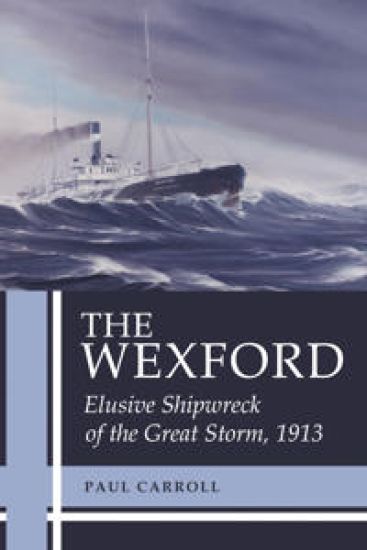
The steamer Wexford, with her flared bow, tall masts, and her open, canvas-sided hurricane deck, charmed spectators as she carried cargo across the Great Lakes. The romance and adventure of her British and French history in the South American trade followed her. Under newly appointed 24-year-old captain Bruce Cameron, her fateful final voyage was punctuated with opportunities to be saved from destruction , but his persistence in trying to make port at Goderich led to tragedy - a victim of the storm of 1913. Over a period of 87 years, she eluded many efforts to locate her remains, but was finally discovered in 2000 by a sailor using a fish-finding device. Since then, she has been visited by thousands, but sadly plundered. Our story traces her history from her British origins in 1883, through the transition to become a "Laker," the eventful storm, the search, and her ultimate discovery in southern Lake Huron, and the controversy over how she should be protected.
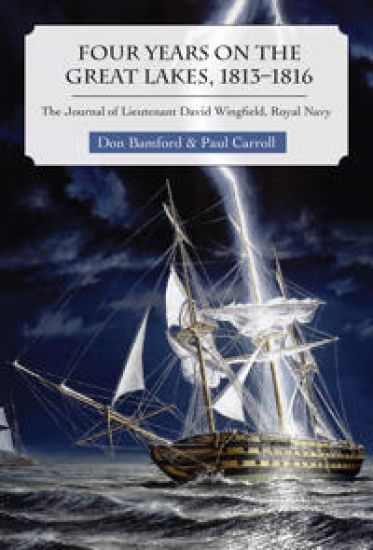
Four Years on the Great Lakes, 1813-1816
Don Bamford; Paul Carroll
Natural Heritage Books
2009
pokkari
David Wingfield joined the Royal Navy in 1806, at the age of fourteen. His service took him to the Great Lakes during the War of 1812. Captured, he was a POW in the United States for nine months. Following his release, Wingfield had some intriguing adventures on the Upper Great Lakes before returning to England. Once home, he used his handwritten notes, kept during his time in North America, as the basis for an account of his experiences there This unique account of the history of Canada during the events of the War of 1812 and the stories of the people and places he was exposed to during this time is being made available in book form for the first time. This is the only account of the War of 1812 as seen through the eyes of a young seaman. Included is a Wingfield genealogical description that spans the modern world.
The late 17th century through to the end of the 18th century saw rapid progress in the development of woodwind instruments and the composition of a vast body of music for those instruments. During this period a large amount of music for domestic consumption was written for a growing amateur market, a market which has regrown in the latter part of the 20th century. The last 30 years has also seen the standard of performance by professionals on these instruments rise enormously. This book provides a guide to the history of the four main woodwind instruments of the Baroque, the flute, oboe, recorder and bassoon, and this is complemented by a repertoire list for each instrument. It also guides those interested towards a basic technique for playing these instruments - a certain level of musical literacy is assumed - and it can be used by students, professionals and amateurs. Advice is also given on buying a suitable reproduction instrument from a market where now virtually any Baroque instrument can be obtained as a faithful copy. This is the first book of its kind and has its origins in the wind tutors of the 18th century.