

Kirjailija
Paul Dale
Kirjat ja teokset yhdessä paikassa: 11 kirjaa, julkaisuja vuosilta 1998–2023, suosituimpiin kuuluu Sewer Gators. Vertaile teosten hintoja ja tarkista saatavuus suomalaisista kirjakaupoista.
11 kirjaa
Kirjojen julkaisuvuodet: 1998–2023.



'How did a kid from the country who dreamed of joining the Victoria Police, end up on the wrong side of the bars? There are a lot of reasons, and I hope this story will help clarify some of them, not only for you, the reader, but for me too, because a lot of the time I am left shaking my head, wondering how things went so wrong.'Paul Dale knows he is tainted. After almost fifteen years as a cop, working in Homicide and rising to the rank of Detective Sergeant in the Victorian Drug Squad, he saw the worst of what people can do. But when he was accused and jailed firstly for drug offences and then for murder, Dale realised the murky world he was navigating was going to take him under too. Dale dealt with crims like Carl Williams, Terry Hodson and Tommy Ivanovic on the Melbourne streets. But when a burglary ended in Hodson's arrest, Dale's life started to unravel. He turned to Nicola Gobbo, a lawyer and friend he thought could help: the lawyer who became known as Lawyer X. Eventually exonerated of any crimes, Paul Dale's story reveals the shocking deals done at the highest levels of the Victorian Police Force and the damage wrought by Victoria Police's use of Lawyer X.

Conquer the world-check. Assume the title Dark Lord Emperor-check. Job done. Or not so done. Morden Deathwing thought he could kick back and enjoy holding sway over the world but no. There just wasn't pleasing some people. Something was going to have to be done. Something drastic. The Dark Lord's Handbook: Empire is the concluding chapter of The Dark Lord's Handbook trilogy. --- The series is written as a humorous take on classic fantasy tropes, with a dash of satire thrown in for good measure. Of course, there are dragons, elves, orcs and that kind of thing. Big battles and such-like. It is epic fantasy after all.

The Dark Lord's Handbook: Conquest
Paul Dale
Createspace Independent Publishing Platform
2014
nidottu
It's not easy being a Dark Lord. Morden has to finish building his fortress, gather the last of his host, issue forth to conquer the world, and keep his Dark Queen happy. And it's not made easy by dragon slayers, heroes, and old men standing in his way on the path to world domination. Fortunately, he has The Dark Lord's Handbook to give him sage advice to see him through these tough times.

To become a Dark Lord is no easy thing. The simple ambition to hold dominion over the world and bend all to your will sounds straightforward but it's not. There are armies to raise, fortresses to build, heroes to defeat, battles to be fought, hours of endless soliloquy in front of the mirror - it's a never ending job. Not to mention deciding what to wear. (After hours, days, even weeks of consideration, it will be black.)After many spectacular failures, Evil decided to lend more than inspiration to these would be tyrants. He wrote an easy to follow Dark Lord's Handbook. And yet the next Dark Lord that came along screwed up like all the others. It had been hundreds of years, and the Handbook had been lost in the annals of time, along with all that was mythic and exciting in the world, until one day a randy dragon had a chance encounter. Nine months later a Dark Lord was born. It took a while but the orc who had been looking after the Handbook all this time delivered it to this new contender, Morden. To become a Dark Lord is no easy thing. Morden had better be a quick study.
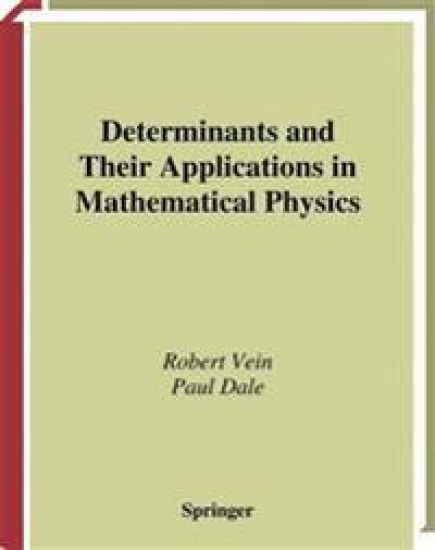
Determinants and Their Applications in Mathematical Physics
Robert Vein; Paul Dale
Springer-Verlag New York Inc.
2013
nidottu
The last treatise on the theory of determinants, by T. Muir, revised and enlarged by W. H. Metzler, was published by Dover Publications Inc. in 1960. It is an unabridged and corrected republication of the edition ori- nally published by Longman, Green and Co. in 1933 and contains a preface by Metzler dated 1928. The Table of Contents of this treatise is given in Appendix 13. A small number of other books devoted entirely to determinants have been published in English, but they contain little if anything of importance that was not known to Muir and Metzler. A few have appeared in German and Japanese. In contrast, the shelves of every mathematics library groan under the weight of books on linear algebra, some of which contain short chapters on determinants but usually only on those aspects of the subject which are applicable to the chapters on matrices. There appears to be tacit agreement among authorities on linear algebra that determinant theory is important only as a branch of matrix theory. In sections devoted entirely to the establishment of a determinantal relation, many authors de?ne a determinant by ?rst de?ning a matrixM and then adding the words: “Let detM be the determinant of the matrix M” as though determinants have no separate existence. This belief has no basis in history.


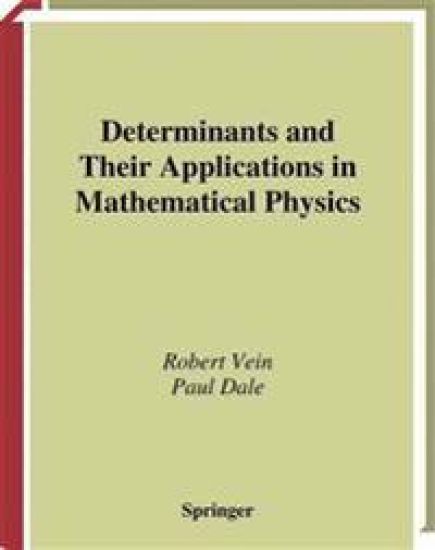
Determinants and Their Applications in Mathematical Physics
Robert Vein; Paul Dale
Springer-Verlag New York Inc.
1998
sidottu
The last treatise on the theory of determinants, by T. Muir, revised and enlarged by W. H. Metzler, was published by Dover Publications Inc. in 1960. It is an unabridged and corrected republication of the edition ori- nally published by Longman, Green and Co. in 1933 and contains a preface by Metzler dated 1928. The Table of Contents of this treatise is given in Appendix 13. A small number of other books devoted entirely to determinants have been published in English, but they contain little if anything of importance that was not known to Muir and Metzler. A few have appeared in German and Japanese. In contrast, the shelves of every mathematics library groan under the weight of books on linear algebra, some of which contain short chapters on determinants but usually only on those aspects of the subject which are applicable to the chapters on matrices. There appears to be tacit agreement among authorities on linear algebra that determinant theory is important only as a branch of matrix theory. In sections devoted entirely to the establishment of a determinantal relation, many authors de?ne a determinant by ?rst de?ning a matrixM and then adding the words: “Let detM be the determinant of the matrix M” as though determinants have no separate existence. This belief has no basis in history.