Kirjojen hintavertailu – 12 859 827 kirjaa ja 27 kauppaa

Kirjailija

Paul Ekins

Kirjat ja teokset yhdessä paikassa: 8 kirjaa, julkaisuja vuosilta 1992–2023, suosituimpiin kuuluu Energy 2050. Vertaile teosten hintoja ja tarkista saatavuus suomalaisista kirjakaupoista.

8 kirjaa

Kirjojen julkaisuvuodet: 1992–2023.

Stopping Climate Change

Stopping Climate Change

Paul Ekins

TAYLOR FRANCIS LTD
2023
nidottu
Written by one of the leading experts in the field, Paul Ekins, Stopping Climate Change provides a comprehensive overview of what is required to achieve ‘real zero’ carbon dioxide emissions by 2050, and negative emissions thereafter, which is the only way to stop human- induced climate change. This will require innovation in socio-technical systems, and in human behaviour, on an unprecedented scale. Stopping Climate Change describes the changes required to meet this goal: in technologies, social institutions and individual activities. Paul Ekins examines in detail issues around the supply and demand of energy and materials, and the efficiency of their use. It also analyses greenhouse gas removal technologies, offsetting and geoengineering, and plots the reduction of the non- CO2 greenhouse gas-emitting activities. Having set out the changes required, Ekins considers the economic implications, in terms of both the innovation and investments that are necessary to bring them about, and the effects that these are likely to have on national economies. The evidence presented points clearly to the economic impacts of decarbonisation being positive for the majority of countries, and for the world as a whole, even before considering the benefits of avoided climate change. When the health benefits of stopping the burning of fossil fuels are factored in, the global net benefits of decarbonisation are unequivocal. Drawing on examples from the UK and Europe, but with wider relevance at a global scale, Stopping Climate Change clearly shows how determined policy action at different levels could stop climate change. It will be of great interest to students, scholars and policymakers researching and working in the field of climate change and energy policy.
Stopping Climate Change

Stopping Climate Change

Paul Ekins

TAYLOR FRANCIS LTD
2023
sidottu
Written by one of the leading experts in the field, Paul Ekins, Stopping Climate Change provides a comprehensive overview of what is required to achieve ‘real zero’ carbon dioxide emissions by 2050, and negative emissions thereafter, which is the only way to stop human- induced climate change. This will require innovation in socio-technical systems, and in human behaviour, on an unprecedented scale. Stopping Climate Change describes the changes required to meet this goal: in technologies, social institutions and individual activities. Paul Ekins examines in detail issues around the supply and demand of energy and materials, and the efficiency of their use. It also analyses greenhouse gas removal technologies, offsetting and geoengineering, and plots the reduction of the non- CO2 greenhouse gas-emitting activities. Having set out the changes required, Ekins considers the economic implications, in terms of both the innovation and investments that are necessary to bring them about, and the effects that these are likely to have on national economies. The evidence presented points clearly to the economic impacts of decarbonisation being positive for the majority of countries, and for the world as a whole, even before considering the benefits of avoided climate change. When the health benefits of stopping the burning of fossil fuels are factored in, the global net benefits of decarbonisation are unequivocal. Drawing on examples from the UK and Europe, but with wider relevance at a global scale, Stopping Climate Change clearly shows how determined policy action at different levels could stop climate change. It will be of great interest to students, scholars and policymakers researching and working in the field of climate change and energy policy.
A New World Order

A New World Order

Paul Ekins

Routledge
2016
sidottu
Begins by identifying a global problematique, a coincidence of four sustained factors; war, insecurity and militarisation; the persistance of poverty, the denial of human rights; environmental destruction. The conventional policy approaches to these problems are analysed through a rigorous critique of the three United Nations reports of the 1980s. Describing the partial solutions of the Brandt, Palme and Bruntland Commissions, attention is turned to the individuals and organisations involved in policy and action at the grassroots level. Peace and security, human rights, economic development are all discussed. The author argues that if the root causes for crisis lie in Western scientism, developmentalism and the construct of the nations state, it is on the success of `alternative' work that a new world order, based on peace, human dignity and ecological sustainability, can be created.
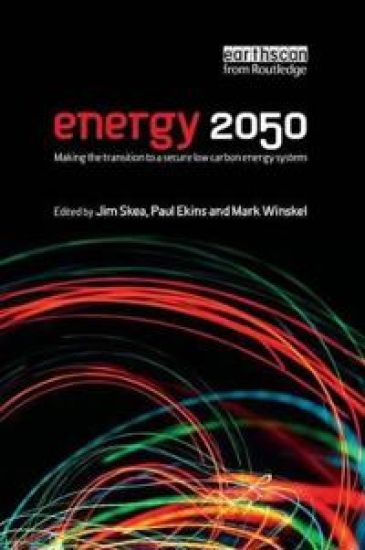
Energy 2050

Energy 2050

Jim Skea; Paul Ekins; Mark Winskel

Routledge
2015
nidottu
The United Kingdom is committed to reducing its greenhouse gas emissions by at least eighty per cent by 2050, a target that will only be achieved by transforming the way that energy is supplied and used. At the same time there are anxieties about the security of energy provision in terms of European dependency on natural gas and the reliability of electricity supply. This book explores in detail those factors which could help or hinder the attainment of the UK's climate change targets, and how these factors interact with the parallel objective of maintaining a robust and secure energy system. The book is the result of a major national energy research effort by the UK Energy Research Centre, which includes some of the UK's leading energy experts. The results and recommendations are essential reading for policymakers, professionals, researchers, and anyone concerned with achieving large-scale reductions in carbon emissions, both from the UK and internationally. Energy 2050 begins by exploring the evolution of the UK energy system over recent decades: the trends, technologies and environmental impacts related to energy use, and the structures and institutions of governance that have influenced this evolution. It then moves on to changes in energy policy to emphasise decarbonization and resilience, and introduce the approach to scenarios and modelling used in the rest of the book. Later chapters explore different aspects of the uncertainties that may enable or constrain the creation of a low-carbon, resilient UK energy system, related to accelerated technology development, the creation of an infrastructure to support de-centralized energy and microgeneration, to lifestyle and behaviour change, and to public attitudes to wider environmental impacts associated with energy system change.
Energy 2050

Energy 2050

Jim Skea; Paul Ekins; Mark Winskel

Earthscan Ltd
2010
sidottu
The United Kingdom is committed to reducing its greenhouse gas emissions by at least eighty per cent by 2050, a target that will only be achieved by transforming the way that energy is supplied and used. At the same time there are anxieties about the security of energy provision in terms of European dependency on natural gas and the reliability of electricity supply. This book explores in detail those factors which could help or hinder the attainment of the UK's climate change targets, and how these factors interact with the parallel objective of maintaining a robust and secure energy system. The book is the result of a major national energy research effort by the UK Energy Research Centre, which includes some of the UK's leading energy experts. The results and recommendations are essential reading for policymakers, professionals, researchers, and anyone concerned with achieving large-scale reductions in carbon emissions, both from the UK and internationally. Energy 2050 begins by exploring the evolution of the UK energy system over recent decades: the trends, technologies and environmental impacts related to energy use, and the structures and institutions of governance that have influenced this evolution. It then moves on to changes in energy policy to emphasise decarbonization and resilience, and introduce the approach to scenarios and modelling used in the rest of the book. Later chapters explore different aspects of the uncertainties that may enable or constrain the creation of a low-carbon, resilient UK energy system, related to accelerated technology development, the creation of an infrastructure to support de-centralized energy and microgeneration, to lifestyle and behaviour change, and to public attitudes to wider environmental impacts associated with energy system change.
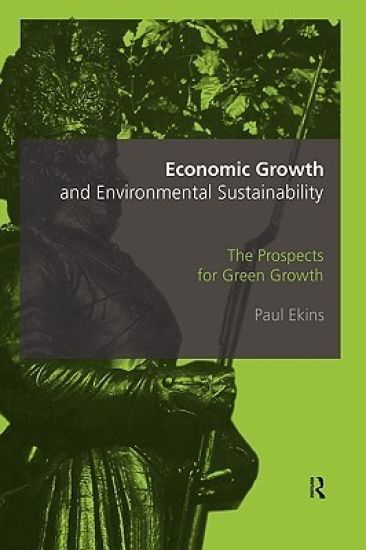
Economic Growth and Environmental Sustainability
A key area of public policy in the last twenty years is the question of how, and how much, to protect vthe environment. At the heart of this has been the heated debate over the nature of the relationship between economic growth and environmental sustainability. Is environemental sustainability economic growth or `green growth', a contradiction in terms? Avoiding the confusion that often surrounds these issues, Ekins provides rigorous expositions of the concept of sustainability, integrated environmental and economic accounting, the Environmental Kuznets Curve, the economics of climate change and environmental taxation. Individual chapters are organised as self-contained, state-of-the-art expositions of the core issues of environmental economics, with extensive cross-referencing from one chapter to another, in order to guide the student or policy-maker through these complex problems. Paul Ekins breaks new ground in defining the conditions of compatibility between economic growth and environmental sustainability, and provides measures and criteria by which the environmental sustainability of economic growth, as it occurs in the real world, may be judged. It is argued that `green growth' is not only theoretically possible but economically achievable and the authors show what environmental and economic policies are required to achieve this. Economic Growth and Environmental Sustainability will be welcolmed by students of and researchers in environmental economics and environmental studies, as well as all interested policy-makers.
A New World Order

A New World Order

Paul Ekins

Routledge
1992
nidottu
Begins by identifying a global problematique, a coincidence of four sustained factors; war, insecurity and militarisation; the persistance of poverty, the denial of human rights; environmental destruction. The conventional policy approaches to these problems are analysed through a rigorous critique of the three United Nations reports of the 1980s. Describing the partial solutions of the Brandt, Palme and Bruntland Commissions, attention is turned to the individuals and organisations involved in policy and action at the grassroots level. Peace and security, human rights, economic development are all discussed. The author argues that if the root causes for crisis lie in Western scientism, developmentalism and the construct of the nations state, it is on the success of `alternative' work that a new world order, based on peace, human dignity and ecological sustainability, can be created.