Kirjojen hintavertailu – 12 859 828 kirjaa ja 27 kauppaa

Kirjailija

Paul J. Lavrakas

Kirjat ja teokset yhdessä paikassa: 13 kirjaa, julkaisuja vuosilta 1993–2024, suosituimpiin kuuluu Advances in Telephone Survey Methodology. Vertaile teosten hintoja ja tarkista saatavuus suomalaisista kirjakaupoista.

Nimi esiintyy myös muodoissa: Paul J Lavrakas

13 kirjaa

Kirjojen julkaisuvuodet: 1993–2024.

Advances in Telephone Survey Methodology

Advances in Telephone Survey Methodology

James M. Lepkowski; N. Clyde Tucker; J. Michael Brick; Edith D. de Leeuw; Lilli Japec; Paul J. Lavrakas; Michael W. Link; Roberta L. Sangster

John Wiley Sons Inc
2007
nidottu
A complete and comprehensive collaboration providing insight on future approaches to telephone survey methodology Over the past fifteen years, advances in technology have transformed the field of survey methodology, from how interviews are conducted to the management and analysis of compiled data. Advances in Telephone Survey Methodology is an all—encompassing and authoritative resource that presents a theoretical, methodological, and statistical treatment of current practices while also establishing a discussion on how state—of—the—art developments in telecommunications have and will continue to revolutionize the telephone survey process. Seventy—five prominent international researchers and practitioners from government, academic, and private sectors have collaborated on this pioneering volume to discuss basic survey techniques and introduce the future directions of the telephone survey. Concepts and findings are organized in four parts—sampling and estimation, data collection, operations, and nonresponse—equipping the reader with the needed practical applications to approach issues such as choice of target population, sample design, questionnaire construction, interviewing training, and measurement error. The book also introduces important topics that have been overlooked in previous literature, including: The impact of mobile telephones on telephone surveys and the rising presence of mobile—only households worldwide The design and construction of questionnaires using Computer Assisted Telephone Interviewing (CATI) software The emerging use of wireless communication and Voice over Internet Protocol (VoIP) versus the telephone Methods for measuring and improving interviewer performance and productivity Privacy, confidentiality, and respondent burden as main factors in telephone survey nonresponse Procedures for the adjustment of nonresponse in telephone surveys In—depth reviews of the literature presented along with a full bibliography, assembled from references throughout the world Advances in Telephone Survey Methodology is an indispensable reference for survey researchers and practitioners in almost any discipline involving research methods such as sociology, social psychology, survey methodology, and statistics. This book also serves as an excellent text for courses and seminars on survey methods at the undergraduate and graduate levels.
Presidential Polls And The News Media

Presidential Polls And The News Media

Paul J Lavrakas; Michael Traugott; Peter V Miller

TAYLOR FRANCIS LTD
2024
nidottu
Most news media are "data rich but analysis poor" when it comes to election polling. Since election polls clearly have the power to influence campaigns and election post-mortems, it is important that "spin" not take precedence over significance in the reporting of poll results. In this volume, experts in the media and in academe challenge the conventional approaches that most news media take in their poll-based campaign coverage. The book reports new research findings on news coverage of recent presidential elections and provides a myriad of examples of how journalists and news media executives can improve their analysis of poll data, thereby better serving our political processes.
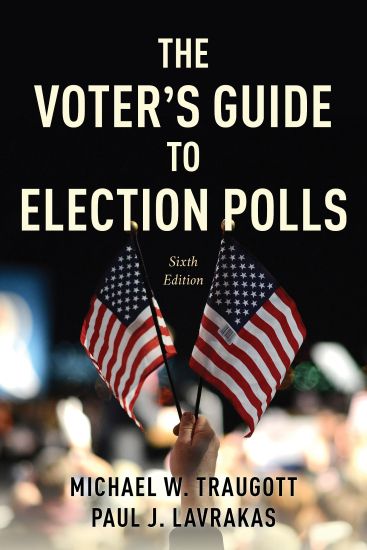
The Voter's Guide to Election Polls

The Voter's Guide to Election Polls

Michael W. Traugott; Paul J. Lavrakas

BLOOMSBURY PUBLISHING PLC
2023
sidottu
Everything you need to know about election polls can be found in this compact, conversational, and current volume. When it comes to tapping the public’s opinion on candidates and issues at the ballot box, the stakes are high. Acclaimed scholars Michael W. Traugott and Paul J. Lavrakas—who also have regularly conducted polls, not just studied them—cover the latest technologies used for data collection and data analysis, including internet polls, as well as how polls are used in campaigns and media organizations. In straightforward language and an accessible question-and-answer format, the authors cover issues such as: How do political candidates and organizations use poll data? How do news organizations collect and report polls? Why do pollsters use samples? Can internet polls really reflect a representative swath of the population? They also examine common problems and complaints about polls, such as the increasing use of “push polls” and whether polls can impact how citizens vote. Their decades of experience and insight not only answer the nuts and bolts questions, but most importantly, why it all matters in American democracy.
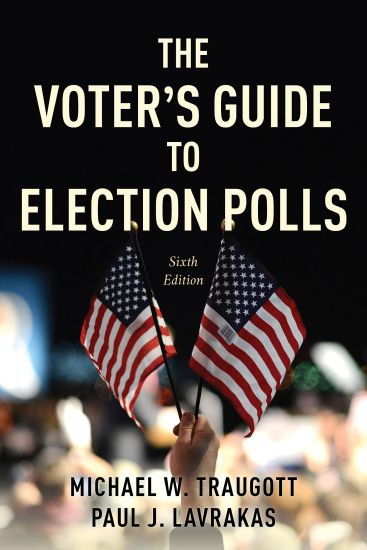
The Voter's Guide to Election Polls

The Voter's Guide to Election Polls

Michael W. Traugott; Paul J. Lavrakas

ROWMAN LITTLEFIELD
2023
nidottu
Everything you need to know about election polls can be found in this compact, conversational, and current volume. When it comes to tapping the public’s opinion on candidates and issues at the ballot box, the stakes are high. Acclaimed scholars Michael W. Traugott and Paul J. Lavrakas—who also have regularly conducted polls, not just studied them—cover the latest technologies used for data collection and data analysis, including internet polls, as well as how polls are used in campaigns and media organizations. In straightforward language and an accessible question-and-answer format, the authors cover issues such as: How do political candidates and organizations use poll data? How do news organizations collect and report polls? Why do pollsters use samples? Can internet polls really reflect a representative swath of the population? They also examine common problems and complaints about polls, such as the increasing use of “push polls” and whether polls can impact how citizens vote. Their decades of experience and insight not only answer the nuts and bolts questions, but most importantly, why it all matters in American democracy.
Presidential Polls And The News Media

Presidential Polls And The News Media

Paul J Lavrakas; Michael Traugott; Peter V Miller

Routledge
2019
sidottu
Most news media are "data rich but analysis poor" when it comes to election polling. Since election polls clearly have the power to influence campaigns and election post-mortems, it is important that "spin" not take precedence over significance in the reporting of poll results. In this volume, experts in the media and in academe challenge the conventional approaches that most news media take in their poll-based campaign coverage. The book reports new research findings on news coverage of recent presidential elections and provides a myriad of examples of how journalists and news media executives can improve their analysis of poll data, thereby better serving our political processes.
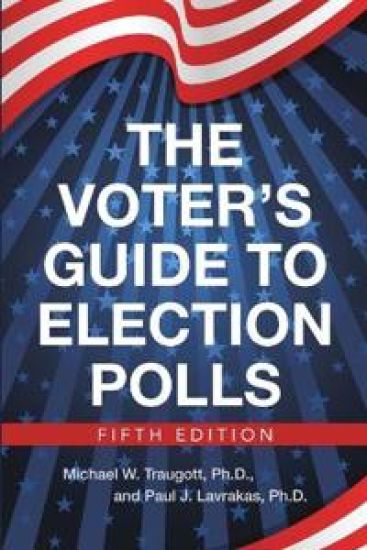
The Voter's Guide to Election Polls

The Voter's Guide to Election Polls

Ph D Michael W Traugott; Paul J Lavrakas

Lulu Publishing Services
2016
pokkari
Fifth Edition. For the sixth presidential election running, Michael W. Traugott and Paul J. Lavrakas team up to give voters everything they need to know about election polls. When it comes to polls, the stakes are high, which is why this edition has been revised to incorporate information on the latest technologies used for data collection and data analysis. In straightforward language, the authors answer questions such as: - How do political candidates and organizations use poll data? - How do news organizations collect and report poll data? - Why do pollsters use samples? - How do media organizations analyze polls? They also examine common problems and complaints about polls, such as the increasing use of "push polls"-a political telemarketing technique-and polls conducted on the Internet that attract a large number of respondents who may not be representative of the general public.
The Voter's Guide to Election Polls

The Voter's Guide to Election Polls

Ph D Michael W Traugott; Paul J Lavrakas

Lulu Publishing Services
2016
sidottu
Fifth Edition. For the sixth presidential election running, Michael W. Traugott and Paul J. Lavrakas team up to give voters everything they need to know about election polls. When it comes to polls, the stakes are high, which is why this edition has been revised to incorporate information on the latest technologies used for data collection and data analysis. In straightforward language, the authors answer questions such as: How do political candidates and organizations use poll data? How do news organizations collect and report poll data? Why do pollsters use samples? How do media organizations analyze polls? They also examine common problems and complaints about polls, such as the increasing use of "push polls"-a political telemarketing technique-and polls conducted on the Internet that attract a large number of respondents who may not be representative of the general public."
Applied Qualitative Research Design

Applied Qualitative Research Design

Margaret R. Roller; Paul J. Lavrakas

Guilford Press
2015
nidottu
This unique text provides a comprehensive framework for creating, managing, and interpreting qualitative research studies that yield valid and useful information. Examples of studies from a wide range of disciplines illustrate the strengths, limitations, and applications of the primary qualitative methods: in-depth interviews, focus group discussions, ethnography, content analysis, and case study and narrative research. Following a consistent format, chapters show students and researchers how to implement each method within a paradigm-neutral and flexible Total Quality Framework (TQF) comprising four interrelated components: Credibility, Analyzability, Transparency, and Usefulness. Unlike other texts that relegate quality issues to one or two chapters, detailed discussions of such crucial topics as construct validity, interresearcher reliability, researcher bias, and verification strategies are featured throughout. The book also addresses applications of the TQF to the writing, review, and evaluation of qualitative research proposals and manuscripts. Pedagogical Features *Summary tables that highlight important content, such as the application of a method to vulnerable or hard-to-reach populations. *Case studies that illustrate TQF standards in practice for each method. *Guidelines for effective documentation (via thick descriptions) of each type of study. *End-of-chapter discussion topics, exercises, and suggested further reading and Web resources. *Chapters open with a preview and close with a bulleted summary of key ideas. *Extensive glossary. 2021 Winner--American Association for Public Opinion Research (AAPOR) Book Award
Applied Qualitative Research Design

Applied Qualitative Research Design

Margaret R. Roller; Paul J. Lavrakas

Guilford Press
2015
sidottu

Halvin toimitettuna 126,40 €

This unique text provides a comprehensive framework for creating, managing, and interpreting qualitative research studies that yield valid and useful information. Examples of studies from a wide range of disciplines illustrate the strengths, limitations, and applications of the primary qualitative methods: in-depth interviews, focus group discussions, ethnography, content analysis, and case study and narrative research. Following a consistent format, chapters show students and researchers how to implement each method within a paradigm-neutral and flexible Total Quality Framework (TQF) comprising four interrelated components: Credibility, Analyzability, Transparency, and Usefulness. Unlike other texts that relegate quality issues to one or two chapters, detailed discussions of such crucial topics as construct validity, interresearcher reliability, researcher bias, and verification strategies are featured throughout. The book also addresses applications of the TQF to the writing, review, and evaluation of qualitative research proposals and manuscripts. Pedagogical Features *Summary tables that highlight important content, such as the application of a method to vulnerable or hard-to-reach populations. *Case studies that illustrate TQF standards in practice for each method. *Guidelines for effective documentation (via thick descriptions) of each type of study. *End-of-chapter discussion topics, exercises, and suggested further reading and Web resources. *Chapters open with a preview and close with a bulleted summary of key ideas. *Extensive glossary. 2021 Winner--American Association for Public Opinion Research (AAPOR) Book Award
Encyclopedia of Survey Research Methods

Encyclopedia of Survey Research Methods

Paul J. Lavrakas

SAGE Publications Inc
2008
muu
To the uninformed, surveys appear to be an easy type of research to design and conduct, but when students and professionals delve deeper, they encounter the vast complexities that the range and practice of survey methods present. To complicate matters, technology has rapidly affected the way surveys can be conducted; today, surveys are conducted via cell phone, the Internet, email, interactive voice response, and other technology-based modes. Thus, students, researchers, and professionals need both a comprehensive understanding of these complexities and a revised set of tools to meet the challenges. In conjunction with top survey researchers around the world and with Nielsen Media Research serving as the corporate sponsor, the Encyclopedia of Survey Research Methods presents state-of-the-art information and methodological examples from the field of survey research. Although there are other "how-to" guides and references texts on survey research, none is as comprehensive as this Encyclopedia, and none presents the material in such a focused and approachable manner. With more than 600 entries, this resource uses a Total Survey Error perspective that considers all aspects of possible survey error from a cost-benefit standpoint. Key Features Covers all major facets of survey research methodology, from selecting the sample design and the sampling frame, designing and pretesting the questionnaire, data collection, and data coding, to the thorny issues surrounding diminishing response rates, confidentiality, privacy, informed consent and other ethical issues, data weighting, and data analyses Presents a Reader's Guide to organize entries around themes or specific topics and easily guide users to areas of interest Offers cross-referenced terms, a brief listing of Further Readings, and stable Web site URLs following most entries The Encyclopedia of Survey Research Methods is specifically written to appeal to beginning, intermediate, and advanced students, practitioners, researchers, consultants, and consumers of survey-based information.
Taking a Bite Out of Crime

Taking a Bite Out of Crime

Garrett J. O'Keefe; Dennis P. Rosenbaum; Paul J. Lavrakas; Kathaleen Reid; Renee A. Botta

SAGE Publications Inc
1996
nidottu
The reporting of the evaluation of the McGruff campaign is quite comprehensive, and the conclusions and recommendations in the final chapter offer specific guidance to the developers of the McGruff campaign as well as others involved in the mass media campaigns, whether they be national campaigns or closer to home. --Janice A. Roehl, Ph. D., President, Justice Research Center, Pacific Grove, California "Garrett J. O'Keefe and his colleagues present findings from their extensive evaluation of the 'Take a Bite Out of Crime' campaign, a nationwide effort to foster citizen responsibility for combating crime. The book is quite comprehensive and informative as well as clearly written. It covers a topic of genuine interest to crime prevention scholars, law enforcement practitioners, and media experts, especially those examining the power of the media to influence people's attitudes and behaviors. The book is also sweeping in its appeal and will interest readers of varying backgrounds and levels of knowledge." --Arthur J. Lurigio, Loyola University of Chicago "Taking a Bite Out of Crime covers an important aspect of the relationship between the media, crime, and criminal justice. It presents the latest research and is an important contribution in this area." --Ray Surette, Department of Criminal Justice and Legal Studies, University of Central Florida Do you remember the McGruff character and his message? Taking a Bite Out of Crime examines the development and content of the campaign with that very slogan that motivated countless individuals and communities to take action to prevent crime. Comprehensive and informative, this volume presents a case study of the 14-year national information effort to stir public awareness about crime and evaluates the campaign's impact. Drawing on data from a national survey, the authors analyze the inner workings of the campaign and find an increase over the past decade in its popularity and effectiveness. A thriving, effective blend of communication and action initiatives, the campaign's strengths have included persistence, consistency of impact, and broadness of scope not seen in previous information campaign research. This volume also features state-of-the-art evaluation of the public's perceptions and attitudes toward crime and provides excellent data-based recommendations for future campaigns. A unique study of a campaign that has reached more than 80% of the American public, Taking a Bite Out of Crime offers a case study that combines elements of interest to both criminal justice and media researchers. Policy makers, law enforcement specialists in crime prevention, public campaign planners in a range of fields, program evaluation specialists, and marketers will also find the book rich with relevant information.
Taking a Bite Out of Crime

Taking a Bite Out of Crime

Garrett J. O'Keefe; Dennis P. Rosenbaum; Paul J. Lavrakas; Kathaleen Reid; Renee A. Botta

SAGE Publications Inc
1996
sidottu
The reporting of the evaluation of the McGruff campaign is quite comprehensive, and the conclusions and recommendations in the final chapter offer specific guidance to the developers of the McGruff campaign as well as others involved in the mass media campaigns, whether they be national campaigns or closer to home. --Janice A. Roehl, Ph. D., President, Justice Research Center, Pacific Grove, California "Garrett J. O'Keefe and his colleagues present findings from their extensive evaluation of the 'Take a Bite Out of Crime' campaign, a nationwide effort to foster citizen responsibility for combating crime. The book is quite comprehensive and informative as well as clearly written. It covers a topic of genuine interest to crime prevention scholars, law enforcement practitioners, and media experts, especially those examining the power of the media to influence people's attitudes and behaviors. The book is also sweeping in its appeal and will interest readers of varying backgrounds and levels of knowledge." --Arthur J. Lurigio, Loyola University of Chicago "Taking a Bite Out of Crime covers an important aspect of the relationship between the media, crime, and criminal justice. It presents the latest research and is an important contribution in this area." --Ray Surette, Department of Criminal Justice and Legal Studies, University of Central Florida Do you remember the McGruff character and his message? Taking a Bite Out of Crime examines the development and content of the campaign with that very slogan that motivated countless individuals and communities to take action to prevent crime. Comprehensive and informative, this volume presents a case study of the 14-year national information effort to stir public awareness about crime and evaluates the campaign's impact. Drawing on data from a national survey, the authors analyze the inner workings of the campaign and find an increase over the past decade in its popularity and effectiveness. A thriving, effective blend of communication and action initiatives, the campaign's strengths have included persistence, consistency of impact, and broadness of scope not seen in previous information campaign research. This volume also features state-of-the-art evaluation of the public's perceptions and attitudes toward crime and provides excellent data-based recommendations for future campaigns. A unique study of a campaign that has reached more than 80% of the American public, Taking a Bite Out of Crime offers a case study that combines elements of interest to both criminal justice and media researchers. Policy makers, law enforcement specialists in crime prevention, public campaign planners in a range of fields, program evaluation specialists, and marketers will also find the book rich with relevant information.
Telephone Survey Methods

Telephone Survey Methods

Paul J. Lavrakas

SAGE Publications Inc
1993
nidottu
From generating phone numbers to structuring the work of interviewers and supervisors, this book covers it all. New to this edition is a focus on the total survey error concept, a comparison of CATI and PAPI procedures, mixed-mode surveys, and new telecommunication technologies. --Canadian Journal of Communication "Telephone Survey Methods is a useful and practical guide to conducting telephone surveys particularly for those who are seeking sampling and administrative guidelines." --Journal of Official Statistics What quality control methods can be employed most effectively to structure and monitor interviews and convert refusals? What telephone numbers should be used in random digit dialing? How can eligible respondents be chosen and their cooperation secured? Addressing these and other survey issues, this completely revised edition of Telephone Survey Methods offers researchers a guide to thinking about and executing telephone surveys. From generating phone numbers to structuring the work of interviewers and supervisers, this book covers it all. New to this edition is a focus on the total survey error concept, a comparison of CATI with PAPI procedures, mixed-mode surveys, and new telecommunication technologies. In addition, the book covers such topics as how to control the sampling pool, how to identify the appropriate respondent, and how to improve on-the-job training of interviewers.