Kirjojen hintavertailu – 12 859 826 kirjaa ja 27 kauppaa

Kirjailija

Paul J. Thibault

Kirjat ja teokset yhdessä paikassa: 7 kirjaa, julkaisuja vuosilta 1996–2022, suosituimpiin kuuluu Multimodal Transcription and Text Analysis. Vertaile teosten hintoja ja tarkista saatavuus suomalaisista kirjakaupoista.

7 kirjaa

Kirjojen julkaisuvuodet: 1996–2022.

Distributed Languaging, Affective Dynamics, and the Human Ecology Volume II
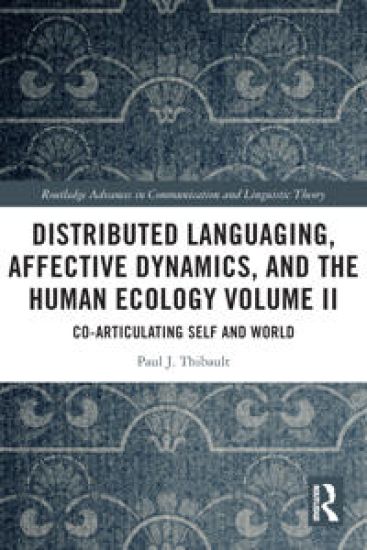
Language plays a central role in human life. However, the term "language" as defined in the language sciences of the 20th century and the traditions these have drawn on, have arguably limited our thinking about what language is and does. The two inter-linked volumes of Thibault’s study articulate crucially important aspects of an emerging new perspective shift on language—the Distributed Language view—that is now receiving more and more attention internationally. Rejecting the classical view that the fundamental architecture of language can be localised as a number of inter-related levels of formal linguistic organisation that function as the coded inputs and outputs to each other, the distributed language view argues that languaging behaviour is a bio-cultural organiation of process that is embodied, multimodal, and integrated across multiple space-time scales. Thibault argues that we need to think of human languaging as the distinctively human mode of our becoming and being selves in the extended human ecology and the kinds of experiencing that this makes possible. Paradoxically, this also means thinking about language in non-linguistic ways that break the grip of the conventional meta-languages for thinking about human languaging. Thibault’s book grounds languaging in process theory: languaging and the forms of experience it actualises is always an event, not a thing that we "use". In taking a distinctively interdisciplinary approach, the book relates dialogical theories of human sense-making to the distributed view of human cognition, to recent thinking about distributed language, to ecological psychology, and to languaging as inter-individual affective dynamics grounded in the subjective lives of selves. In taking this approach, the book considers the coordination of selves in social encounters, the emergent forms of self-reflexivity that characterise these encounters, and the implications for how we think of and live our human sociality, not as something that is mediated by over-arching codes and systems, but as emerging from the endogenous subjectivities of selves when they seek to coordinate with other selves and with the situations, artefacts, social institutions, and technologies that populate the extended human ecology. The two volumes aim to bring our understanding of human languaging closer to human embodiment, experience, and feeling while also showing how languaging enables humans to transcend local circumstances and thus to dialogue with cultural tradition. Volume I focuses on the shorter timescales of bodily dynamics in languaging activity. Volume II integrates the shorter timescales of body dynamics to the longer cultural–historical timescales of the linguistic and cultural norms and patterns to which bodily dynamics are integrated.
Distributed Languaging, Affective Dynamics, and the Human Ecology Volume I
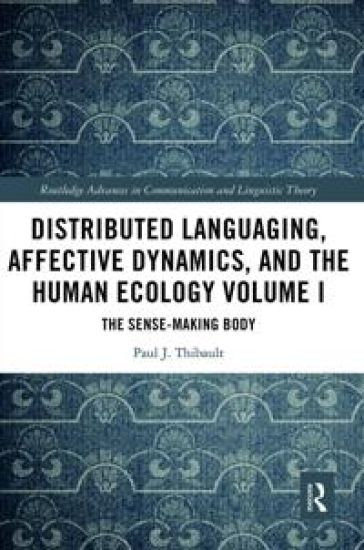
Language plays a central role in human life. However, the term ‘language’ as defined in the language sciences of the 20th century and the traditions these have drawn on, have arguably, limited our thinking about what language is and does. The two inter-linked volumes of Thibault’s study articulate crucially important aspects of an emerging new perspective shift on language - the Distributed Language view – that is now receiving more and more attention internationally. Rejecting the classical view that the fundamental architecture of language can be localized as a number of inter-related levels of formal linguistic organization that function as the coded inputs and outputs to each other, the distributed language view argues that languaging behaviour is a bio-cultural organisation of process that is embodied, multimodal, and integrated across multiple space-time scales. Thibault argues that we need to think of human languaging as the distinctively human mode of our becoming and being selves in the extended human ecology and the kinds of experiencing that this makes possible. Paradoxically, this also means thinking about language in non-linguistic ways that break the grip of the conventional meta-languages for thinking about human languaging. Thibault’s book grounds languaging in process theory: languaging and the forms of experience it actualizes is always an event, not a thing that we ‘use’. In taking a distinctively interdisciplinary approach, the book relates dialogical theories of human sense-making to the distributed view of human cognition, to recent thinking about distributed language, to ecological psychology, and to languaging as inter-individual affective dynamics grounded in the subjective lives of selves. In taking this approach, the book considers the coordination of selves in social encounters, the emergent forms of self-reflexivity that characterise these encounters, and the implications for how we think of and live our human sociality, not as something that is mediated by over-arching codes and systems, but as emerging from the endogenous subjectivities of selves when they seek to coordinate with other selves and with the situations, artefacts, social institutions, and technologies that populate the extended human ecology. The two volumes aim to bring our understanding of human languaging closer to human embodiment, experience, and feeling while also showing how languaging enables humans to transcend local circumstances and thus to dialogue with cultural tradition. Volume 1 focuses on the shorter timescales of bodily dynamics in languaging activity. Volume II integrates the shorter timescales of body dynamics to the longer cultural-historical timescales of the linguistic and cultural norms and patterns to which bodily dynamics are integrated.
Distributed Languaging, Affective Dynamics, and the Human Ecology Volume II
Language plays a central role in human life. However, the term "language" as defined in the language sciences of the 20th century and the traditions these have drawn on, have arguably limited our thinking about what language is and does. The two inter-linked volumes of Thibault’s study articulate crucially important aspects of an emerging new perspective shift on language—the Distributed Language view—that is now receiving more and more attention internationally. Rejecting the classical view that the fundamental architecture of language can be localised as a number of inter-related levels of formal linguistic organisation that function as the coded inputs and outputs to each other, the distributed language view argues that languaging behaviour is a bio-cultural organiation of process that is embodied, multimodal, and integrated across multiple space-time scales. Thibault argues that we need to think of human languaging as the distinctively human mode of our becoming and being selves in the extended human ecology and the kinds of experiencing that this makes possible. Paradoxically, this also means thinking about language in non-linguistic ways that break the grip of the conventional meta-languages for thinking about human languaging. Thibault’s book grounds languaging in process theory: languaging and the forms of experience it actualises is always an event, not a thing that we "use". In taking a distinctively interdisciplinary approach, the book relates dialogical theories of human sense-making to the distributed view of human cognition, to recent thinking about distributed language, to ecological psychology, and to languaging as inter-individual affective dynamics grounded in the subjective lives of selves. In taking this approach, the book considers the coordination of selves in social encounters, the emergent forms of self-reflexivity that characterise these encounters, and the implications for how we think of and live our human sociality, not as something that is mediated by over-arching codes and systems, but as emerging from the endogenous subjectivities of selves when they seek to coordinate with other selves and with the situations, artefacts, social institutions, and technologies that populate the extended human ecology. The two volumes aim to bring our understanding of human languaging closer to human embodiment, experience, and feeling while also showing how languaging enables humans to transcend local circumstances and thus to dialogue with cultural tradition. Volume I focuses on the shorter timescales of bodily dynamics in languaging activity. Volume II integrates the shorter timescales of body dynamics to the longer cultural–historical timescales of the linguistic and cultural norms and patterns to which bodily dynamics are integrated.
Distributed Languaging, Affective Dynamics, and the Human Ecology Volume I
Language plays a central role in human life. However, the term ‘language’ as defined in the language sciences of the 20th century and the traditions these have drawn on, have arguably, limited our thinking about what language is and does. The two inter-linked volumes of Thibault’s study articulate crucially important aspects of an emerging new perspective shift on language - the Distributed Language view – that is now receiving more and more attention internationally. Rejecting the classical view that the fundamental architecture of language can be localized as a number of inter-related levels of formal linguistic organization that function as the coded inputs and outputs to each other, the distributed language view argues that languaging behaviour is a bio-cultural organisation of process that is embodied, multimodal, and integrated across multiple space-time scales. Thibault argues that we need to think of human languaging as the distinctively human mode of our becoming and being selves in the extended human ecology and the kinds of experiencing that this makes possible. Paradoxically, this also means thinking about language in non-linguistic ways that break the grip of the conventional meta-languages for thinking about human languaging. Thibault’s book grounds languaging in process theory: languaging and the forms of experience it actualizes is always an event, not a thing that we ‘use’. In taking a distinctively interdisciplinary approach, the book relates dialogical theories of human sense-making to the distributed view of human cognition, to recent thinking about distributed language, to ecological psychology, and to languaging as inter-individual affective dynamics grounded in the subjective lives of selves. In taking this approach, the book considers the coordination of selves in social encounters, the emergent forms of self-reflexivity that characterise these encounters, and the implications for how we think of and live our human sociality, not as something that is mediated by over-arching codes and systems, but as emerging from the endogenous subjectivities of selves when they seek to coordinate with other selves and with the situations, artefacts, social institutions, and technologies that populate the extended human ecology. The two volumes aim to bring our understanding of human languaging closer to human embodiment, experience, and feeling while also showing how languaging enables humans to transcend local circumstances and thus to dialogue with cultural tradition. Volume 1 focuses on the shorter timescales of bodily dynamics in languaging activity. Volume II integrates the shorter timescales of body dynamics to the longer cultural-historical timescales of the linguistic and cultural norms and patterns to which bodily dynamics are integrated.
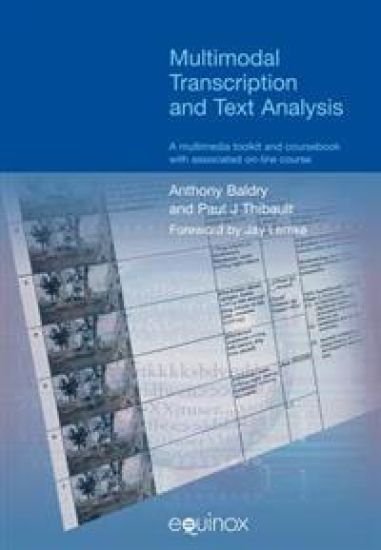
Multimodal Transcription and Text Analysis

Multimodal Transcription and Text Analysis

Anthony Baldry; Paul J. Thibault; Jay Lemke

Equinox Publishing Ltd
2006
pokkari
What are multimodal texts? How can we transcribe and analyse them? How can multimedia and internet help us in multimodal discourse analysis? What postproduction and authoring skills are needed to analyse a multimodal text or to develop a corpus of multimodal texts? How does integrating multimedia meaning-making resources into hypertext multiply our meaning-making potential? How does the study of language relate to multimodality and multimedia, in particular in the e-learning age? How, and to what extent, will multimodal discourse analysis re-shape linguistics? In its attempt to provide answers to the questions raised above, and many others, this book proposes concrete solutions to the problems of multimodal text analysis and transcription of printed texts, websites and film. As such, it constitutes a much needed course in multimodal text transcription and analysis. It also suggests ways in which multimodal discourse analysis can help both educators and students understand how meaning is made in the e-learning environments that now play such an important role in our lives. In both these respects, readers are encouraged to use the book in conjunction with an associated and freely accessible website which provides many illustrations and exercises that further contextualise and exemplify the insights and descriptions provided by the book. As befits a coursebook, the individual chapters of the book are carefully organised in such a way as to provide a step-by-step progression in theoretical and descriptive complexity.
Re-reading Saussure

Re-reading Saussure

Paul J. Thibault

Routledge
1996
sidottu
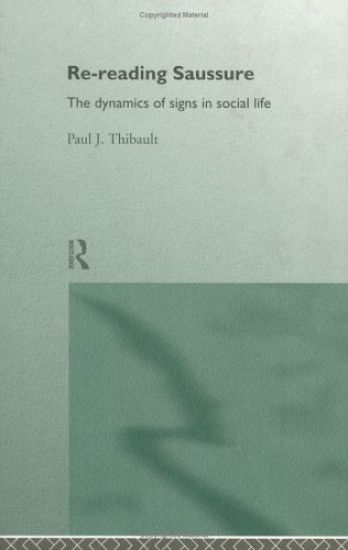
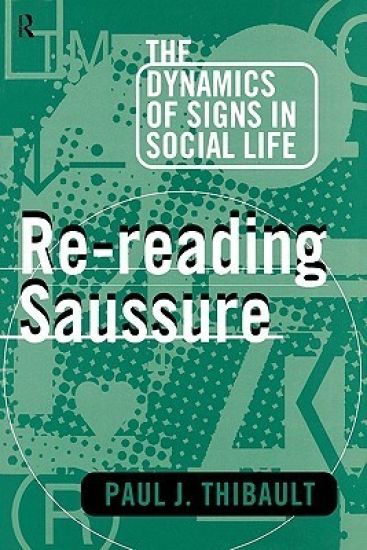
Through a detailed re-reading of Saussures's work in the light of contemporary developments in the human, life and physical sciences, Paul Thibault provides us with the means to redefine and refocus our theories of social meaning-making. Saussure's theory of language is generally considered to be a formal theory of abstract sign-types and sign-systems, separate from our individual and social practices of making meaning. In this challenging book, Thibault presents a different view of Saussure. Paying close attention to the original texts, including the Cours de Linguistic Generale he demonstrates that Saussure was centrally concerned with trying to formulate a theory of how meanings are made. Re-reading Saussure does more than simply engage with Saussure's theory in a new and up-to-date way, however. In addition to demonstrating the continuing viability of Saussure's thinking through a range of examples, it makes an important intervention in contemporary linguistic and semiotic debate.
Re-reading Saussure

Re-reading Saussure

Paul J. Thibault

Routledge
1996
nidottu
Through a detailed re-reading of Saussures's work in the light of contemporary developments in the human, life and physical sciences, Paul Thibault provides us with the means to redefine and refocus our theories of social meaning-making. Saussure's theory of language is generally considered to be a formal theory of abstract sign-types and sign-systems, separate from our individual and social practices of making meaning. In this challenging book, Thibault presents a different view of Saussure. Paying close attention to the original texts, including the Cours de Linguistic Generale he demonstrates that Saussure was centrally concerned with trying to formulate a theory of how meanings are made. Re-reading Saussure does more than simply engage with Saussure's theory in a new and up-to-date way, however. In addition to demonstrating the continuing viability of Saussure's thinking through a range of examples, it makes an important intervention in contemporary linguistic and semiotic debate.