Kirjojen hintavertailu – 12 903 735 kirjaa ja 27 kauppaa

Kirjailija

Paul Light

Kirjat ja teokset yhdessä paikassa: 4 kirjaa, julkaisuja vuosilta 1999–2005, suosituimpiin kuuluu Social Processes in Children's Learning. Vertaile teosten hintoja ja tarkista saatavuus suomalaisista kirjakaupoista.

4 kirjaa

Kirjojen julkaisuvuodet: 1999–2005.

The Four Pillars of High Performance

The Four Pillars of High Performance

Paul Light

McGraw-Hill Professional
2005
sidottu
How to stay on course and achieve extraordinary performance in a sea of change In today's change-or-die business environment, companies that achieve the highest levels of performance are "robust organizations"--those that adapt quickly and without losing their strategic direction. Distilling decades of research conducted by Rand, one of the nation's most respected business think tanks, The Four Pillars of High Performance explores the strategies to truly manage change. Using examples, author Paul C. Light extracts powerful lessons for managers and executives, and he provides readers with: Never-before-published research by Rand on the shared traits of the highest-performing companies Cutting-edge techniques for improving performance across an organization Valuable insights into the five major attributes of agility, alignment, metrics, incentives, and impact Case studies and vignettes drawn from the experiences of industry leaders in every sector
Social Processes in Children's Learning

Social Processes in Children's Learning

Paul Light; Karen Littleton

Cambridge University Press
2000
sidottu
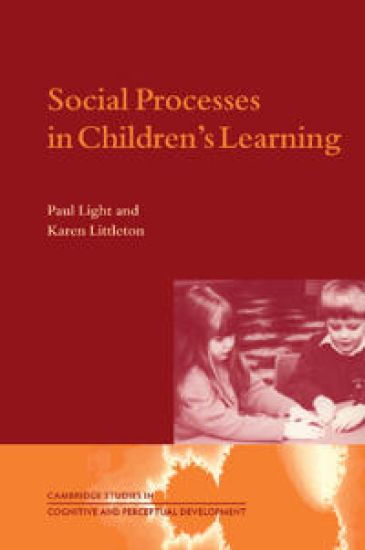
This book, first published in 2000, is about children's learning and problem-solving behaviour. It reflects the increasingly close integration seen in recent years between social and cognitive approaches to researching the learning process. In particular, Paul Light and Karen Littleton examine the ways in which interactions between children influence learning outcomes. They begin by placing this topic in a broad theoretical and empirical context and go on to present a substantial series of their own experimental studies, which focus on children of late primary and early secondary school age. These investigations address peer facilitation of problem solving, social comparison effects on learning and social context effects upon the interpretation of tasks. Many of the studies involve computer-based learning but the findings have implications both for classroom practice and the understanding of the learning process. This book will be a valuable tool for researchers, teachers and practitioners interested in the social processes of children's learning.
Social Processes in Children's Learning

Social Processes in Children's Learning

Paul Light; Karen Littleton

Cambridge University Press
2000
pokkari
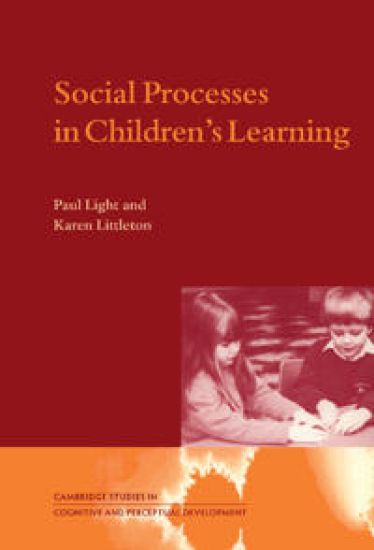
This book is about children’s learning and problem-solving behaviour. It reflects the increasingly close integration seen in recent years between social and cognitive approaches to researching the learning process. In particular, Paul Light and Karen Littleton examine the ways in which interactions between children influence learning outcomes. They begin by placing this topic in a broad theoretical and empirical context and go on to present a substantial series of their own experimental studies, which focus on children of late primary and early secondary school age. These investigations address peer facilitation of problem solving, social comparison effects on learning and social context effects upon the interpretation of tasks. Many of the studies involve computer-based learning but the findings have implications both for classroom practice and the understanding of the learning process. This book will be a valuable tool for researchers, teachers and practitioners interested in the social processes of children’s learning.
The President's Agenda

The President's Agenda

Paul Light

Johns Hopkins University Press
1999
pokkari
In this third edition of THE PRESIDENT'S AGENDA, Paul Light brings his acclaimed study up to date by weighing the successes and failures of the Bush and Clinton presidencies in setting a legislative agenda of domestic issues for Congress. The most noticeable development, according to Light, is the shrinking of the agenda and the absence of fresh new ideas. Explaining the emergence of "the derivative Presidency" he attributes this increasingly limited agenda to the problems associated with the end of the welfare state, the thickening of government, the problems of the budget, the "Reagan effect," and the changing nature of party politics. With Light's latest judgments and insights, THE PRESIDENT'S AGENDA remains an invaluable text for courses on the American presidency. "What has changed is the content of the President's agenda. Even under similar political conditions, both Bush and Clinton had fewer proposals than their predecessors, and both tended to favor modifications of the status quo over bold breaks with the past. Although there are important differences between the two Presidents, not the least of which is Bush's high proportion of small-scale, old ideas, the two share a pronounced tendency to look backward for inspiration rather than forward."-from the Preface Praise for previous editions: "Superb ... An important and well-thought-out analysis of presidential domestic politics, examining many variables in a president's term ... A vital addition to the libraries of those interested in our most idiosyncratic political institution."-Perspectives on Political Science