Kirjojen hintavertailu – 12 859 819 kirjaa ja 27 kauppaa

Kirjailija

Paul Ricoeur

Kirjat ja teokset yhdessä paikassa: 64 kirjaa, julkaisuja vuosilta 1976–2026, suosituimpiin kuuluu Reflections on the Just. Vertaile teosten hintoja ja tarkista saatavuus suomalaisista kirjakaupoista.

Nimi esiintyy myös muodoissa: Paul Ricœur

64 kirjaa

Kirjojen julkaisuvuodet: 1976–2026.

Being, Essence and Substance in Plato and Aristotle
Paul Ricoeur (1913-2005) was one of the outstanding French philosophers of the 20th century and his work is widely read in the English-speaking world. This unique volume comprises the lectures that Ricoeur gave on Plato and Aristotle at the University of Strasbourg in 1953-54. The aim of these lectures is to analyse the metaphysics of Plato and Aristotle and to discern in their work the ontological foundations of Western philosophy. The relation between Plato and Aristotle is commonly portrayed as a contrast between a philosophy of essence and a philosophy of substance, but Ricoeur shows that this opposition is too simple. Aristotelian ontology is not a simple antithesis to Platonism: the radical ontology of Aristotle stands in a far more subtle relation of continuity and opposition to that of Plato and it is this relation we have to reconstruct and understand. Ricoeur’s lectures offer a brilliant analysis of the great works of Plato and Aristotle which has withstood the test of time. They also provide a unique insight into the development of Ricoeur’s thinking in the early 1950s, revealing that, even at this early stage of his work, Ricoeur was focused sharply on issues of language and the text.
Being, Essence and Substance in Plato and Aristotle
Paul Ricoeur (1913-2005) was one of the outstanding French philosophers of the 20th century and his work is widely read in the English-speaking world. This unique volume comprises the lectures that Ricoeur gave on Plato and Aristotle at the University of Strasbourg in 1953-54. The aim of these lectures is to analyse the metaphysics of Plato and Aristotle and to discern in their work the ontological foundations of Western philosophy. The relation between Plato and Aristotle is commonly portrayed as a contrast between a philosophy of essence and a philosophy of substance, but Ricoeur shows that this opposition is too simple. Aristotelian ontology is not a simple antithesis to Platonism: the radical ontology of Aristotle stands in a far more subtle relation of continuity and opposition to that of Plato and it is this relation we have to reconstruct and understand. Ricoeur’s lectures offer a brilliant analysis of the great works of Plato and Aristotle which has withstood the test of time. They also provide a unique insight into the development of Ricoeur’s thinking in the early 1950s, revealing that, even at this early stage of his work, Ricoeur was focused sharply on issues of language and the text.
Hermeneutics

Hermeneutics

Paul Ricoeur

Polity Press
2013
sidottu
Paul Ricoeur’s contribution to the theory of interpretation, or hermeneutics, is considerable: he ranks among the masters of this discipline alongside Schleiermacher, Dilthey, Heidegger and Gadamer. In addition to major works like The Conflict of Interpretations, he wrote many articles and shorter texts which deserve to be discovered and rediscovered. These allow us to gain a deeper understanding of the development of his work over time and to appreciate the full range of his contribution. Some of the texts examine the nature of metaphor while others guide the reader through the many challenges of the hermeneutic problem - from the symbol to the text, then to the text as action, taking full account of the ethical implications. Here one encounters Ricoeur’s reflections on the future of hermeneutics and his abiding concern to explore the relations between hermeneutics and analytical philosophy. Ricoeur’s contribution to biblical hermeneutics has also been decisive. Two masterful studies in this volume attest to Ricoeur’s attempt to explore the relations between revelation and truth, on the one hand, and between myths of salvation and reason, on the other. This book - the second volume of Ricoeur’s writings and lectures - brings together texts which appeared between 1972 and 2006. It is published under the auspices of Le Fonds Ricoeur.
Hermeneutics

Hermeneutics

Paul Ricoeur

Polity Press
2013
nidottu
Paul Ricoeur’s contribution to the theory of interpretation, or hermeneutics, is considerable: he ranks among the masters of this discipline alongside Schleiermacher, Dilthey, Heidegger and Gadamer. In addition to major works like The Conflict of Interpretations, he wrote many articles and shorter texts which deserve to be discovered and rediscovered. These allow us to gain a deeper understanding of the development of his work over time and to appreciate the full range of his contribution. Some of the texts examine the nature of metaphor while others guide the reader through the many challenges of the hermeneutic problem - from the symbol to the text, then to the text as action, taking full account of the ethical implications. Here one encounters Ricoeur’s reflections on the future of hermeneutics and his abiding concern to explore the relations between hermeneutics and analytical philosophy. Ricoeur’s contribution to biblical hermeneutics has also been decisive. Two masterful studies in this volume attest to Ricoeur’s attempt to explore the relations between revelation and truth, on the one hand, and between myths of salvation and reason, on the other. This book - the second volume of Ricoeur’s writings and lectures - brings together texts which appeared between 1972 and 2006. It is published under the auspices of Le Fonds Ricoeur.
On Psychoanalysis

On Psychoanalysis

Paul Ricoeur

Polity Press
2012
sidottu
Paul Ricoeur's Freud and Philosophy was a major reinterpretation of psychoanalysis and its philosophical significance, but Ricoeur also wrote many important articles on similar themes. This volume makes available some of his key writings on Freud and psychoanalysis: together with Freud and Philosophy, they form a major part of his philosophical legacy. What kind of science is psychoanalysis? What kind of truth does it offer and what kind of proof does it provide? What does the concrete practice of psychoanalysis consist of? What can it tell us about creativity and the work of art? What is its place within our culture and how can it transform culture? What is the role of narrative in psychoanalysis? Ricoeur reading Freud: this could have been the title of this volume, in which the focus is on the actual work of Freud and not on subsequent commentaries. An open reading of intellectual integrity. A critical reading which shuns definitive positions. A reading to understand Freud. This book - the first volume of Ricoeur's writings and lectures - brings together texts which appeared between 1966 and 1988. It is published under the auspices of Le Fonds Ricoeur.
On Psychoanalysis

On Psychoanalysis

Paul Ricoeur

Polity Press
2012
nidottu
Paul Ricoeur's Freud and Philosophy was a major reinterpretation of psychoanalysis and its philosophical significance, but Ricoeur also wrote many important articles on similar themes. This volume makes available some of his key writings on Freud and psychoanalysis: together with Freud and Philosophy, they form a major part of his philosophical legacy. What kind of science is psychoanalysis? What kind of truth does it offer and what kind of proof does it provide? What does the concrete practice of psychoanalysis consist of? What can it tell us about creativity and the work of art? What is its place within our culture and how can it transform culture? What is the role of narrative in psychoanalysis? Ricoeur reading Freud: this could have been the title of this volume, in which the focus is on the actual work of Freud and not on subsequent commentaries. An open reading of intellectual integrity. A critical reading which shuns definitive positions. A reading to understand Freud. This book - the first volume of Ricoeur's writings and lectures - brings together texts which appeared between 1966 and 1988. It is published under the auspices of Le Fonds Ricoeur.
Reflections on the Just [Standard Large Print 16 Pt Edition]

Reflections on the Just [Standard Large Print 16 Pt Edition]

Paul Ricoeur; David Pellauer

Readhowyouwant
2011
pokkari
At the time of his death in 2005, French philosopher Paul Ricoeur was regarded as one of the great thinkers of his generation. In more than half a century of writing about the essential questions of human life, Ricoeur's thought encompassed a vast range of wisdom and experience, and he made landmark contributions that would go on to influence later scholars in such areas as phenomenology, hermeneutics, structuralis, and theology. Consisting of fifteen thematically organized essays, Reflections on the Just continues and expands on the work Ricoeur began in his ''little ethics'' in Oneself as Another and The Just. In the preface, he considers what revisions he would make were he to start over and how that is reflected in these essays. The opening part brings phenomenology to bear on ethics; the second group of essays comprises shorter, occasional pieces considering the concept of justice int he works of other philosophers, including Max Weber and Charles Taylor. The final part turns to the specific domains of medicine and the law, examining how concepts of right and justice operate in those realms.
Living Up to Death

Living Up to Death

Paul Ricoeur

University of Chicago Press
2009
sidottu
When French philosopher Paul Ricoeur died in 2005, he bequeathed to the world a highly regarded, widely influential body of work which established him as one of the greatest thinkers of our time. He also left behind a number of unfinished projects that are gathered here and translated into English for the first time. "Living Up to Death" consists of one major essay and nine fragments. Composed in 1996, the essay is the kernel of an unrealized book on the subject of mortality. Likely inspired by his wife's approaching death, it examines not one's own passing but one's experience of others dying. Ricoeur notes that when thinking about death the imagination is paramount, since we cannot truly experience our own passing. But those we leave behind do, and Ricoeur posits that the idea of life after death originated in the awareness of our own end posthumously resonating with our survivors. The fragments in this volume were written over the course of the last few months of Ricoeur's life as his health failed, and they represent his very last work. They cover a range of topics, touching on biblical scholarship, the philosophy of language, and the idea of selfhood he first addressed in "Oneself as Another". And while they contain numerous philosophical insights, these fragments are perhaps most significant for providing an invaluable look at Ricoeur's mind at work. As poignant as it is perceptive, "Living Up to Death" is a moving testimony to Ricoeur's willingness to confront his own mortality with serious questions, a touching insouciance, and hope for the future.
From Text to Action

From Text to Action

Paul Ricoeur

Continuum International Publishing Group Ltd.
2008
nidottu
This book will be useful to those coming to the field of hermeneutics for the first time, as well as those already familiar with Ricoeur's work. Paul Ricoeur (1913-2005) was Professor of Philosophy at the University of Chicago and the University of Paris X, Nanterre, and a leading figure in twentieth-century French philosophy. "From Text to Action" provides an invaluable companion to Ricoeur's classic text, "The Conflict of Interpretations". Here he further develops his general theory of interpretation in relation to his own philosophical background and influences: Hegel, Husserl, Gadamer and Weber. This is a hugely important work from a key figure in contemporary philosophy that will be of interest to those starting out in the field of hermeneutics, as well as those already familiar with Ricoeur's work." The Continuum Impacts" are seminal works by the finest minds in contemporary thought, including Adorno, Badiou, Derrida, Heidegger and Deleuze. They are works of such power that they changed the philosophical and cultural landscape when they were first published and continue to resonate today. They represent landmark texts in the fields of philosophy, popular culture, politics and theology.
Husserl

Husserl

Paul Ricoeur

Northwestern University Press
2007
nidottu
Paul Ricoeur was one of the foremost interpreters and translators of Edmund Husserl's philosophy. These nine essays present Ricoeur's interpretation of the most important of Husserl's writings, with emphasis on his philosophy of consciousness rather than his work in logic. In Ricoeur's philosophy, phenomenology and existentialism came of age and these essays provide an introduction to the Husserlian elements which most heavily influenced his own philosophical position.
Freedom and Nature

Freedom and Nature

Paul Ricoeur

Northwestern University Press
2007
nidottu

Halvin toimitettuna 33,40 €

This volume, the first part of Paul Ricoeur's ""Philosophy of the Will"", is an eidetics, carried out within carefully imposed phenomenological brackets. It seeks to deal with the essential structure of man's being in the world, and so it suspends the distorting dimensions of existence, the bondage of passion, and the vision of innocence, to which Ricoeur returns in his later writings. The result is a conception of man as an incarnate Cogito, which can make the polar unity of subject and object intelligible and provide a basic continuity for the various aspects of inquiry into man's being-in-the-world.
From Text to Action

From Text to Action

Paul Ricoeur; Richard Kearney

Northwestern University Press
2007
nidottu
With his writings on phenomenology, psychoanalysis, Marxism, ideology, and religion, Paul Ricoeur has single-handedly redefined and revitalized the hermeneutic tradition. From Text to Action is an essential companion to the now classic The Conflict of Interpretations. Here, Ricoeur continues and extends his project of constructing a general theory of interpretation, positioning his work in relation to its own philosophical background: Hegel, Husserl, Gadamer, and Weber. He also responds to contemporary figures like K. O. Apel and Jürgen Habermas, connecting his own theorization of ideology to their version of ideology critique.
History and Truth

History and Truth

Paul Ricoeur; David Rasmussen

Northwestern University Press
2007
nidottu
In this volume, Paul Ricoeur investigates the antinomy between history and truth, or between historicity and meaning. He argues that history has meaning insofar as it approaches universality and system, but has no meaning insofar as this universality violates the singularity of individuals' lives. Imposing unity upon truth, or unifying the diversity of knowledge and opinion, creates a singular and universal history but destroys historicity and subjectivity. Allowing for singularities in history promotes a multiplicity of truths over a single, unique truth, and thereby annihilates system.
The Course of Recognition

The Course of Recognition

Paul Ricoeur

Harvard University Press
2007
nidottu

Halvin toimitettuna 35,70 €

Recognition, though it figures profoundly in our understanding of objects and persons, identity and ideas, has never before been the subject of a single, sustained philosophical inquiry. This work, by one of contemporary philosophy’s most distinguished voices, pursues recognition through its various philosophical guises and meanings—and, through the “course of recognition,” seeks to develop nothing less than a proper hermeneutics of mutual recognition. Originally delivered as lectures at the Institute for the Human Sciences at Vienna, the essays collected here consider recognition in three of its forms. The first chapter, focusing on knowledge of objects, points to the role of recognition in modern epistemology; the second, concerned with what might be called the recognition of responsibility, traces the understanding of agency and moral responsibility from the ancients up to the present day; and the third takes up the problem of recognition and identity, which extends from Hegel’s discussion of the struggle for recognition through contemporary arguments about identity and multiculturalism. Throughout, Paul Ricoeur probes the significance of our capacity to recognize people and objects, and of self-recognition and self-identity in relation to the gift of mutual recognition. Drawing inspiration from such literary texts as the Odyssey and Oedipus at Colonus, and engaging some of the classic writings of the Continental philosophical tradition—by Kant, Hobbes, Hegel, Augustine, Locke, and Bergson—The Course of Recognition ranges over vast expanses of time and subject matter and in the process suggests a number of highly insightful ways of thinking through the major questions of modern philosophy.
Reflections on the Just

Reflections on the Just

Paul Ricoeur

University of Chicago Press
2007
sidottu
At the time of his death in 2005, French philosopher Paul Ricoeur was regarded as one of the great thinkers of his generation. In more than half a century of writing about the essential questions of human life, Ricoeur's thought encompassed a vast range of wisdom and experience, and he made landmark contributions that would go on to influence later scholars in such areas as phenomenology, hermeneutics, structuralism, and theology. Toward the end of his life, Ricoeur began to focus directly on ethical questions that he feared had been overshadowed by his other work; the result was a two-volume collection of essays on justice and the law. The University of Chicago Press published the English translation of the first volume, "The Just", to great acclaim in 2000. Now this translation of the second volume, "Reflections on the Just", completes the set and makes available to readers the whole of Ricoeur's meditations on the concept. Consisting of fifteen thematically organized essays, "Reflections on the Just" continues and expands on the work Ricoeur began with his "little ethics" in "Oneself as Another" and "The Just". In the preface, he considers what revisions he would make were he to start over and how that is reflected in these essays. The opening part brings phenomenology to bear on ethics; the second group of essays comprises shorter, occasional pieces considering the concept of justice in the works of other philosophers, including Max Weber and Charles Taylor. The final part turns to the specific domains of medicine and the law, examining how concepts of right and justice operate in those realms. Cogent, deeply considered, and fully engaged with the realities of the contemporary world, "Reflections on the Just" is an essential work for understanding the development of Ricoeur's thought in his final years.
Evil

Evil

Paul Ricoeur

Continuum International Publishing Group Ltd.
2007
nidottu

Halvin toimitettuna 29,70 €

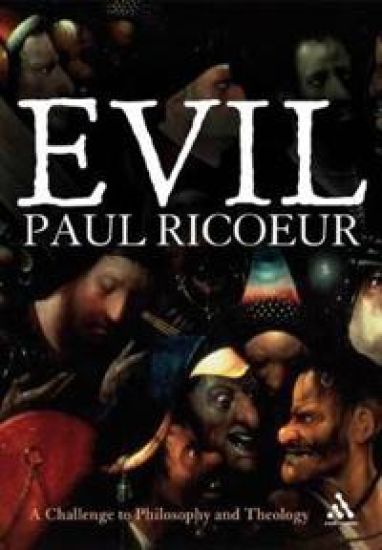
Where does evil come from? How is it that we do evil? This book falls into three parts. The fi rst part deals with the magnitude and complexity of the problem of evil from a phenomenological perspective. The second part investigates the levels of speculation on the origin and nature of evil. The third discusses thinking, acting and feeling in connection with evil. The discussion runs in the classic intellectual tradition from Augustine, through Hegel, Leibnitz, Kant, and Nietzsche. But the voice is always that of Paul Ricoeur himself, though he also refers to modern writers like Harold Kushner (When Bad Things Happen to Good People) and John K. Roth (Encountering Evil). Ricoeur considers here man's vulnerability to evil with depth and matchless sensitivity.
The Conflict Of Interpretations

The Conflict Of Interpretations

Paul Ricoeur; Bernard P. Dauenhauer

Northwestern University Press
2007
nidottu
This collection brings together twenty-two essays by Paul Ricoeur under the topics of structuralism, psychoanalysis, hermeneutics, and religion. In dramatic conciseness, the essays illuminate the work of one of the leading philosophers of the day. Those interested in Ricoeur's development of the philosophy of language will find rich and suggestive reading. But the diversity of essays also speaks beyond the confines of philosophy to linguists, theologians, psychologists, and psychoanalysts.
On Translation

On Translation

Paul Ricoeur

Routledge
2006
sidottu
Paul Ricoeur was one of the most important philosophers of the twentieth century. In this short and accessible book, he turns to a topic at the heart of much of his work: What is translation and why is it so important? Reminding us that The Bible, the Koran, the Torah and the works of the great philosophers are often only ever read in translation, Ricoeur reminds us that translation not only spreads knowledge but can change its very meaning. In spite of these risk, he argues that in a climate of ethnic and religious conflict, the art and ethics of translation are invaluable. Drawing on interesting examples such as the translation of early Greek philosophy during the Renaissance, the poetry of Paul Celan and the work of Hannah Arendt, he reflects not only on the challenges of translating one language into another but how one community speaks to another. Throughout, Ricoeur shows how to move through life is to navigate a world that requires translation itself. Paul Ricoeur died in 2005. He was one of the great contemporary French philosophers and a leading figure in hermeneutics, psychoanalytic thought, literary theory and religion. His many books include Freud and Philosophy and Time and Narrative.
On Translation

On Translation

Paul Ricoeur

Routledge
2006
nidottu
Paul Ricoeur was one of the most important philosophers of the twentieth century. In this short and accessible book, he turns to a topic at the heart of much of his work: What is translation and why is it so important? Reminding us that The Bible, the Koran, the Torah and the works of the great philosophers are often only ever read in translation, Ricoeur reminds us that translation not only spreads knowledge but can change its very meaning. In spite of these risk, he argues that in a climate of ethnic and religious conflict, the art and ethics of translation are invaluable. Drawing on interesting examples such as the translation of early Greek philosophy during the Renaissance, the poetry of Paul Celan and the work of Hannah Arendt, he reflects not only on the challenges of translating one language into another but how one community speaks to another. Throughout, Ricoeur shows how to move through life is to navigate a world that requires translation itself. Paul Ricoeur died in 2005. He was one of the great contemporary French philosophers and a leading figure in hermeneutics, psychoanalytic thought, literary theory and religion. His many books include Freud and Philosophy and Time and Narrative.
Memory, History, Forgetting

Memory, History, Forgetting

Paul Ricoeur; Kathleen Blamey; David Pellauer

University of Chicago Press
2006
nidottu

Halvin toimitettuna 40,60 €

A landmark work, "Memory, History, Forgetting" examines the reciprocal relationship between remembering and forgetting, revealing how this symbiosis influences both the perception of historical experience and the production of historical narrative. A momentous achievement in Ricoeur's career, this book provides the crucial link between his "Time and Narrative" and "Oneself as Another", and his recent reflections on ethics and the problems of responsibility and representation.