Kirjojen hintavertailu – 12 903 725 kirjaa ja 27 kauppaa

Kirjailija

Paul Sanghera

Kirjat ja teokset yhdessä paikassa: 17 kirjaa, julkaisuja vuosilta 2006–2018, suosituimpiin kuuluu PMP in Depth. Vertaile teosten hintoja ja tarkista saatavuus suomalaisista kirjakaupoista.

17 kirjaa

Kirjojen julkaisuvuodet: 2006–2018.

PMP® in Depth

PMP® in Depth

Paul Sanghera

APress
2018
nidottu
Use this study guide to prepare for the Project Management Professional (PMP) exam administered by the Project Management Institute (PMI). The revised third edition of the best-selling PMP in Depth, updated to the sixth edition of PMBOK, has a laser-sharp focus on the exam objectives for project managers and others who want to pass the PMP exam. No prior knowledge of project management is assumed. The chapters and the sections within each chapter are presented in a logical learning sequence. The concepts and topics, both simple and complex, are clearly explained when they appear for the first time. This facilitates step-wise learning, prevents confusion, and makes this book useful for those who want to get up to speed quickly to pass the PMP exam, even if you are new to the discipline of project management. This book tells the story of project management in a cohesive, concise, yet comprehensive fashion. Unlike most PMP exam books, PMP in Depth covers the material in the order in which projects are actually run in the real world. The book is an easy-to-understand guide that is valuable both before and after the exam. What You’ll Learn Understand the body of knowledge required to earn the Project Management Professional (PMP) certification Acquire the knowledge needed to enter the field of project management and successfully manage projects in any fieldWho This Book Is For Project management practitioners preparing for the PMP exam, entry-level project managers and project team members preparing for the PMP exam, beginners who want to join the field of project management and get up to speed quickly, project managers who need a quick and easy reference to the discipline of projectmanagement, and instructors and trainers who want a textbook for the PMP exam or a course on project management
CAPM® in Depth

CAPM® in Depth

Paul Sanghera

APress
2018
nidottu
Use this study guide to prepare for the Certified Associate in Project Management (CAPM) exam, based on PMBOK's sixth edition, administered by the Project Management Institute (PMI). The revised and updated second edition of the best-selling CAPM in Depth has a laser-sharp focus on the exam objectives for project managers and others who want to pass the CAPM exam. No prior knowledge of project management is assumed. The chapters and the sections within each chapter are presented in a logical learning sequence. The concepts and topics, both simple and complex, are clearly explained when they appear for the first time. This facilitates step-wise learning, prevents confusion, and makes this book useful for those who want to get up to speed quickly to pass the CAPM exam, even if you are new to the discipline of project management. This book tells the story of project management in a cohesive, concise, yet comprehensive fashion. Unlike most CAPM exam books, this book is not just an exam-cram book. It is an easy-to-understand guide that is a valuable reference both before and after the exam. What You’ll Learn Understand the body of knowledge required to earn the Certified Associate in Project Management (CAPM) certificationAcquire the knowledge needed to successfully manage projects in any field Who This Book Is For Project management practitioners preparing for the CAPM exam, entry-level project managers and project team members preparing for the CAPM exam, beginners who want to join the field of project management and get up to speed quickly, project managers who need a quick and easy reference to the discipline of project management, instructors and trainers who need a textbook for a course on project management
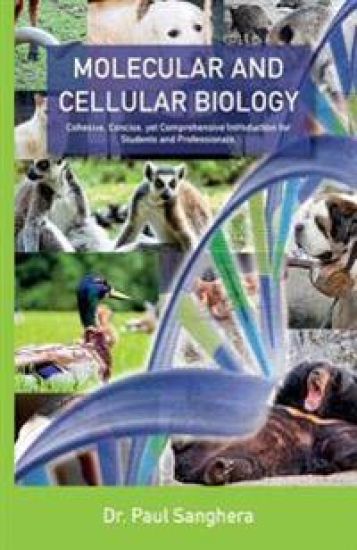
Molecular and Cellular Biology: Cohesive, Concise, yet Comprehensive Introduction for Students and Professionals.
In this book, Dr. Paul Sanghera, the best-selling author of several books in science and technology, provides cohesive, concise, yet comprehensive coverage of the key concepts of molecular and cellular biology in an accessible way. The book presents material in a logical learning sequence: each section builds upon previous sections and each chapter upon previous chapters. All concepts - simple and complex - are well-defined and clearly explained the first time they appear. There is no hopping from topic to topic and no technical jargon without explanation. This book is useful for both students and professionals in biology. Students can use the distilled information in this book to excel in their assignments and exams. Even though this book is self-contained, it works as a great supplement to any textbook in general biology. Professionals in a biology-related field can use it for a quick reference or for a quick review of fundamental concepts, whereas newcomers can use it as their gateway into the field to quickly ramp up to speed. The chapters in the book have the following special features: * Note. A Note is used to present additional helpful material related to the topic being described or to emphasize a concept. * Caution. A Caution is used to highlight a point which either is crucial or may not fit into the commonsense framework of things. * Think About It. This feature presents questions or simple problems with answers and solutions to emphasize critical concepts. * Problems. Problems are presented with solutions to explain mathematical concepts. * Fascinating Fact. This feature singles out biological facts which are simply amazing. * Review Questions. Review questions with answers are presented at the end of each chapter in order to enable you to test your knowledge and detect your strengths and weaknesses. * Glossary. This feature presents quick access to key terms.
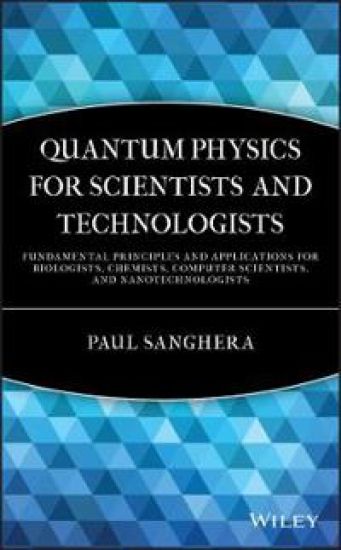
Quantum Physics for Scientists and Technologists

Quantum Physics for Scientists and Technologists

Paul Sanghera

John Wiley Sons Inc
2011
sidottu
Quantum Physics for Scientists and Technologists is a self-contained, comprehensive review of this complex branch of science. The book demystifies difficult concepts and views the subject through non-physics fields such as computer science, biology, chemistry, and nanotechnology. It explains key concepts and phenomena in the language of non-physics majors and with simple math, assuming no prior knowledge of the topic. This cohesive book begins with the wavefunction to develop the basic principles of quantum mechanics such as the uncertainty principle and wave-particle duality. Comprehensive coverage of quantum theory is presented, supported by experimental results and explained through applications and examples without the use of abstract and complex mathematical tools or formalisms. From there, the book: Takes the mystery out of the Schrodinger equation, the fundamental equation of quantum physics, by applying it to atoms Shows how quantum mechanics explains the periodic table of elements Introduces the quantum mechanical concept of spin and spin quantum number, along with Pauli's Exclusion Principle regarding the occupation of quantum states Addresses quantum states of molecules in terms of rotation and vibration of diatomic molecules Explores the interface between classical statistical mechanics and quantum statistical mechanics Discusses quantum mechanics as a common thread through different fields of nanoscience and nanotechnology Each chapter features real-world applications of one or more quantum mechanics principles. "Study Checkpoints" and problems with solutions are presented throughout to make difficult concepts easy to understand. In addition, pictures, tables, and diagrams with full explanations are used to present data and further explain difficult concepts. This book is designed as a complete course in quantum mechanics for senior undergraduates and first-year graduate students in non-physics majors. It also applies to courses such as modern physics, physical chemistry and nanotechnology. The material is also accessible to scientists, engineers, and technologists working in the fields of computer science, biology, chemistry, engineering, and nanotechnology.
PMP in Depth

PMP in Depth

Paul Sanghera

Course Technology Inc
2009
nidottu
The primary purpose of this book is to help you pass the Project Management Professional (PMP) exam administered by the Project Management Institute (PMI). Because the book has a laser-sharp focus on the exam objectives, expert project managers who want to pass the PMP exam can use this book to ensure that they do not miss any objective. Yet this is not simply an exam-cram book. The chapters and the sections within each chapter are presented in a logical learning sequence: A topic and a chapter only depend upon the previously covered topics and chapters, and there is no hopping from topic to topic. The concepts and topics, both simple and complex, are clearly explained when they appear for the first time. No prior knowledge of project management is assumed. This facilitates stepwise learning, prevents confusion, and makes this book useful for anyone who wants to get up to speed quickly to learn the fundamentals of project management, pass the PMP exam, or both, even if they are new to the discipline of project management. A fulllength practice exam with fully explained answers is also included.
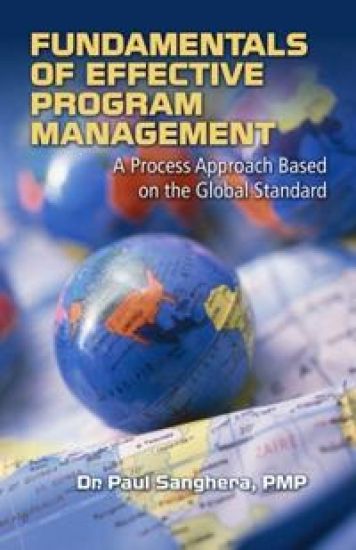
Fundamentals of Effective Program Management

Fundamentals of Effective Program Management

Paul Sanghera

J Ross Publishing
2008
sidottu
Only a small percentage of projects are run in isolation. The majority of projects are conducted in groups under programs to maximize business and organizational objectives. Due to its proven benefits to organizations of all sizes, program management and the demand for resources on how to do it effectively are growing at a rapid pace. In this new book, best-selling author Paul Sanghera presents cohesive, comprehensive coverage of the fundamentals of program management based on the global standard for program management issued by Project Management Institute (PMI), and in accordance with generally recognized best practices. This unique guide clearly places program management in the context of project management and project portfolio management and describes processes that can be applied to programs in any field. Because no prior knowledge of program management is assumed, Fundamentals of Effective Program Management is useful for both those new to program/project management, and to experienced practitioners whose daily tasks and responsibilities extend beyond project management and have a direct impact on accomplishing organizational objectives. Every concept, simple and complex, is defined and explained when it appears the first time. There is no hopping from topic to topic and no technical jargon without explanation. Dr. Sanghera skillfully presents all of the material in a logical learning sequence with each chapter building upon previous chapters and each section on previous sections. Discussion exercises are presented at the end of each chapter to test newly acquired knowledge and to help apply this knowledge to practical situations. This insightful guide to mastering the Fundamentals of Effective Program Management is ideal for self-learning, training or academic instruction.
How to Cheat at Deploying and Securing RFID

How to Cheat at Deploying and Securing RFID

Frank Thornton; Paul Sanghera

Syngress Media,U.S.
2007
nidottu
RFID is a method of remotely storing and receiving data using devices called RFID tags. RFID tags can be small adhesive stickers containing antennas that receive and respond to transmissions from RFID transmitters. RFID tags are used to identify and track everything from Exxon EZ pass to dogs to beer kegs to library books. Major companies and countries around the world are adopting or considering whether to adopt RFID technologies. Visa and Wells Fargo are currently running tests with RFID, airports around the world are using RFID to track cargo and run customs departments, universities such as Slippery Rock are providing RFID-enabled cell phones for students to use for campus charges. According to the July 9 CNET article, RFID Tags: Big Brother in Small Packages?, "You should become familiar with RFID technology because you'll be hearing much more about it soon. Retailers adore the concept, and CNET News.com's own Alorie Gilbert wrote last week about how Wal-Mart and the U. K.-based grocery chain Tesco are starting to install "smart shelves" with networked RFID readers. In what will become the largest test of the technology, consumer goods giant Gillette recently said it would purchase 500 million RFID tags from Alien Technology of Morgan Hill, CA." For security professionals needing to get up and running fast with the topic of RFID, this How to Cheat approach to the topic is the perfect "just what you need to know" book!
RFID+ Study Guide and Practice Exams

RFID+ Study Guide and Practice Exams

Paul Sanghera

Syngress Media,U.S.
2007
nidottu
Radio Frequency Identification (RFID) is an automatic identification method, relying on storing and remotely retrieving data using devices called RFID tags (also called transponders). This book is a guide to CompTIA's new RFID+ Security exam and includes the following study elements: Exam objectives covered in a chapter are clearly explained in the beginning of the chapter, Notes and Alerts highlight the crucial points, Exam’s Eye View emphasizes the important points from the exam’s perspective, Key Terms present definitions, Review Questions contain questions modeled after the real exam questions. Answers to these questions are presented with complete explanations in an appendix. Also included is a full practice exam modeled after the real exam. The answers to the exam questions are presented with full explanations.
SCJP Exam for J2SE 5

SCJP Exam for J2SE 5

Paul Sanghera

APress
2006
nidottu
Best selling author Paul Sanghera offers cohesive, concise, yet comprehensive coverage of all the topics included in the Sun Certified Programmer for Java 5 exam (CX 310-055). With a laser sharp focus on the exam objectives, this study guide goes beyond just being an "exam cram." The material is presented in a logical learning sequence: a section builds upon previous sections and a chapter on previous chapters. All concepts, simple and complex, are defined and explained when they appear the first time. There is no hopping from topic to topic and no technical jargon without explanation. No prior knowledge of Java programming is assumed. The single most difficult aspect of this exam is to read and understand the code in the exam questions in a limited amount of time. To help you get fluent and comfortable with the code, the book offers complete runnable code examples distributed over all the chapters and a codewalk quicklet feature at the end of each chapter. Although the primary purpose of the book is to help you pass the SCJP exam, it will also serve as a good reference after the exam. Special features include: Hundreds of questions modeled after the real exam with fully explained answers. A complete practice exam with questions modeled after the real exam and fully explained answers. Hundreds of complete runnable code examples, explained in the book, that you can download and experiment with. This is a code-intensive exam. The Codewalk Quicklet feature based on the process-based codewalk philosophy to prepare you for efficient response to the code-based questions in the exam. The Exam Quick Prep feature which recaps all the important points for the last hour of preparation before taking the exam. Useful information and analysis for the programmers who are considering updating the J2SE 1.4 certification to J2SE 5.