

Kirjailija
Paul Steinhardt
Kirjat ja teokset yhdessä paikassa: 4 kirjaa, julkaisuja vuosilta 2020–2028, suosituimpiin kuuluu Failed Globalisation: Inequality, Money, And The Renaissance Of The State. Vertaile teosten hintoja ja tarkista saatavuus suomalaisista kirjakaupoista.
4 kirjaa
Kirjojen julkaisuvuodet: 2020–2028.


Failed Globalisation: Inequality, Money, And The Renaissance Of The State
Heiner Flassbeck; Paul Steinhardt
World Scientific Publishing Co Pte Ltd
2020
sidottu
Globalisation is considered a success story. Following the fall of the Berlin Wall and the dissolution of the political divides between East and West Germany, nothing seemed to stand in the way of peaceful cooperation between people everywhere. Under the precepts of economic liberalism, by removing institutional obstacles to international trade and capital flows, a spontaneous global order would emerge, and the dream of a world populated by free and prosperous global citizens would eventually come true. But in the wake of the worldwide financial crisis that began in 2007-2008, in the world of an ongoing Euro-Crisis, Trump and Brexit, it has become apparent that the great liberal project has failed. Neoclassical liberal economic theory has shown itself to be fundamentally incapable of explaining the dynamics of a market economy and in guiding economic policy in developed as well as in developing countries. Given the continuing dominance of that discredited theory today, the world lacks a viable conceptual framework for global cooperation among nations, and appropriate national economic policies. With this book, the authors show how such a framework can be built on the basis of a modern and empirically sound economic theory.
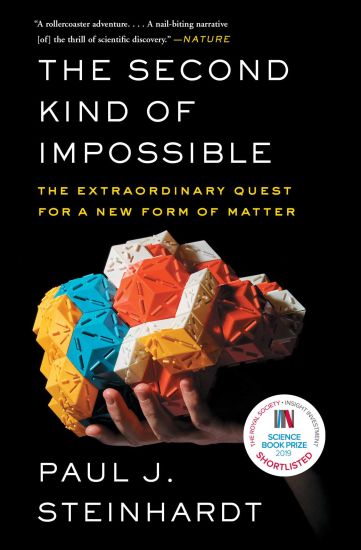
The Second Kind of Impossible: The Extraordinary Quest for a New Form of Matter
Paul Steinhardt
SIMON SCHUSTER
2020
nidottu
*Shortlisted for the 2019 Royal Society Insight Investment Science Book Prize* One of the most fascinating scientific detective stories of the last fifty years, an exciting quest for a new form of matter. "A riveting tale of derring-do" (Nature), this book reads like James Gleick's Chaos combined with an Indiana Jones adventure. When leading Princeton physicist Paul Steinhardt began working in the 1980s, scientists thought they knew all the conceivable forms of matter. The Second Kind of Impossible is the story of Steinhardt's thirty-five-year-long quest to challenge conventional wisdom. It begins with a curious geometric pattern that inspires two theoretical physicists to propose a radically new type of matter--one that raises the possibility of new materials with never before seen properties, but that violates laws set in stone for centuries. Steinhardt dubs this new form of matter "quasicrystal." The rest of the scientific community calls it simply impossible. The Second Kind of Impossible captures Steinhardt's scientific odyssey as it unfolds over decades, first to prove viability, and then to pursue his wildest conjecture--that nature made quasicrystals long before humans discovered them. Along the way, his team encounters clandestine collectors, corrupt scientists, secret diaries, international smugglers, and KGB agents. Their quest culminates in a daring expedition to a distant corner of the Earth, in pursuit of tiny fragments of a meteorite forged at the birth of the solar system. Steinhardt's discoveries chart a new direction in science. They not only change our ideas about patterns and matter, but also reveal new truths about the processes that shaped our solar system. The underlying science is important, simple, and beautiful--and Steinhardt's firsthand account is "packed with discovery, disappointment, exhilaration, and persistence... This book is a front-row seat to history as it is made" (Nature).