Kirjojen hintavertailu – 12 903 724 kirjaa ja 27 kauppaa

Kirjailija

Paul Taubman

Kirjat ja teokset yhdessä paikassa: 4 kirjaa, julkaisuja vuosilta 1995–2012, suosituimpiin kuuluu Causes, Correlates and Consequences of Death Among Older Adults. Vertaile teosten hintoja ja tarkista saatavuus suomalaisista kirjakaupoista.

4 kirjaa

Kirjojen julkaisuvuodet: 1995–2012.

Causes, Correlates and Consequences of Death Among Older Adults

Causes, Correlates and Consequences of Death Among Older Adults

Jere R. Behrman; Robin C. Sickles; Paul Taubman

Springer
2012
nidottu
All humans eventually die, but life expectancies differ over time and among different demographic groups. Teasing out the various causes and correlates of death is a challenge, and it is one we take on in this book. A look at the data on mortality is both interesting and suggestive of some possible relationships. In 1900 life expectancies at birth were 46. 3 and 48. 3 years for men and women respectively, a gender differential of a bit less than 5 percent. Life expectancies for whites then were about 0. 3 years longer than that of the whole population, but life expectancies for blacks were only about 33 years for men and women. At age 65, the remaining life expectancies were about 12 and 11 years for whites and blacks respectively. Fifty years later, life expectancies at birth had grown to 66 and 71 years for males and females respectively. The percentage differential between the sexes was now almost up to 10 percent. The life expectancies of whites were about one year longer than that for the entire population. The big change was for blacks, whose life expectancy had grown to over 60 years with black females living about 5 percent longer than their male counterparts. At age 65 the remaining expected life had increased about two years with much larger percentage gains for blacks.
Causes, Correlates and Consequences of Death Among Older Adults

Causes, Correlates and Consequences of Death Among Older Adults

Jere R. Behrman; Robin C. Sickles; Paul Taubman

Springer
1998
sidottu
All humans eventually die, but life expectancies differ over time and among different demographic groups. Teasing out the various causes and correlates of death is a challenge, and it is one we take on in this book. A look at the data on mortality is both interesting and suggestive of some possible relationships. In 1900 life expectancies at birth were 46. 3 and 48. 3 years for men and women respectively, a gender differential of a bit less than 5 percent. Life expectancies for whites then were about 0. 3 years longer than that of the whole population, but life expectancies for blacks were only about 33 years for men and women. At age 65, the remaining life expectancies were about 12 and 11 years for whites and blacks respectively. Fifty years later, life expectancies at birth had grown to 66 and 71 years for males and females respectively. The percentage differential between the sexes was now almost up to 10 percent. The life expectancies of whites were about one year longer than that for the entire population. The big change was for blacks, whose life expectancy had grown to over 60 years with black females living about 5 percent longer than their male counterparts. At age 65 the remaining expected life had increased about two years with much larger percentage gains for blacks.
From Parent to Child

From Parent to Child

Jere R. Behrman; Robert A. Pollak; Paul Taubman

University of Chicago Press
1995
nidottu
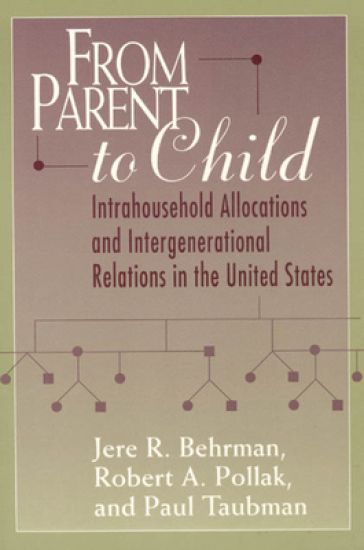
How do parents allocate human capital among their children? To what extent do parental decisions about resource allocation determine children's eventual economic success? The analyses in this text explore these questions by developing and testing a model in which the earnings of children with different genetic endowments respond differently to investments in human capital. Behrman, Pollak and Taubman use this model to investigate issues such as: parental bias in resource allocations based on gender or birth order; the extent of intergenerational mobility in income, earnings and schooling in the United States; the relative importance of environmental and genetic factors in determining variations in schooling; and whether parents' distributions offset the intended effects of government programmes designed to subsidize children. In allocating scarce resources, parents face a trade-off between equity and efficiency, between the competing desires to equalize the wealth of their children and to maximize the sum of their earnings.
From Parent to Child

From Parent to Child

Jere R. Behrman; Robert A. Pollak; Paul Taubman

University of Chicago Press
1995
sidottu
How do parents allocate human capital among their children? To what extent do parental decisions about resource allocation determine children's eventual economic success? The analyses in this text explore these questions by developing and testing a model in which the earnings of children with different genetic endowments respond differently to investments in human capital. Behrman, Pollak, and Taubman use this model to investigate issues such as parental bias in resource allocations based on gender or birth order; the extent of intergenerational mobility in income, earnings, and schooling in the United States; the relative importance of environmental and genetic factors in determining variations in schooling; and whether parents' distributions offset the intended effects of government programmes designed to subsidize children. In allocating scarce resources, parents face a trade-off between equity and efficiency, between the competing desires to equalize the wealth of their children and to maximize the sum of their earnings.