
Kirjojen hintavertailu – 12 903 724 kirjaa ja 27 kauppaa

Kirjailija

Paul Vitanyi

Kirjat ja teokset yhdessä paikassa: 2 kirjaa, julkaisuja vuosilta 2012–2019, suosituimpiin kuuluu An Introduction to Kolmogorov Complexity and Its Applications. Vertaile teosten hintoja ja tarkista saatavuus suomalaisista kirjakaupoista.

Nimi esiintyy myös muodoissa: Paul Vitányi

2 kirjaa

Kirjojen julkaisuvuodet: 2012–2019.

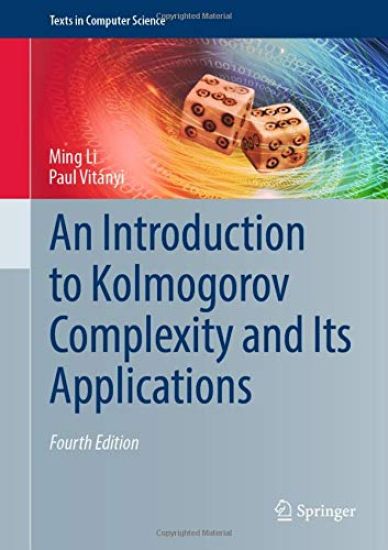
An Introduction to Kolmogorov Complexity and Its Applications

An Introduction to Kolmogorov Complexity and Its Applications

Ming Li; Paul Vitányi

Springer Nature Switzerland AG
2019
sidottu
This must-read textbook presents an essential introduction to Kolmogorov complexity (KC), a central theory and powerful tool in information science that deals with the quantity of information in individual objects. The text covers both the fundamental concepts and the most important practical applications, supported by a wealth of didactic features. This thoroughly revised and enhanced fourth edition includes new and updated material on, amongst other topics, the Miller-Yu theorem, the Gács-Kucera theorem, the Day-Gács theorem, increasing randomness, short lists computable from an input string containing the incomputable Kolmogorov complexity of the input, the Lovász local lemma, sorting, the algorithmic full Slepian-Wolf theorem for individual strings, multiset normalized information distance and normalized web distance, and conditional universal distribution. Topics and features: describes the mathematical theory of KC, including the theories of algorithmic complexity and algorithmic probability; presents a general theory of inductive reasoning and its applications, and reviews the utility of the incompressibility method; covers the practical application of KC in great detail, including the normalized information distance (the similarity metric) and information diameter of multisets in phylogeny, language trees, music, heterogeneous files, and clustering; discusses the many applications of resource-bounded KC, and examines different physical theories from a KC point of view; includes numerous examples that elaborate the theory, and a range of exercises of varying difficulty (with solutions); offers explanatory asides on technical issues, and extensive historical sections; suggests structures for several one-semester courses in the preface. As the definitive textbook on Kolmogorov complexity, this comprehensive and self-contained work is an invaluable resource for advanced undergraduate students, graduate students, and researchers in all fields of science.

Algorithmic Statistics

Algorithmic Statistics

Paul Vitanyi

Springer-Verlag New York Inc.
2012
sidottu
Whereas Kolmogorov complexity is the accepted absolute measure of information content of an individual finite object, a similarly absolute notion is needed for the relation between an individual data sample and an individual model summarizing the information in the data - for example, a finite set (or probability distribution) where the data sample typically came from. The statistical theory based on such relations between individual objects can be called algorithmic statistics, in contrast to classical statistical theory that deals with relations between probabilistic ensembles. "Algorithmic Statistics" develops the algorithmic theory of statistics, sufficient statistics, and minimal sufficient statistics. This theory is based on two-part codes consisting of the code for the statistic (the model summarizing the regularity, the meaningful information, in the data) and the model-to-data code. In contrast to the situation in probabilistic statistical theory, the algorithmic relation of (minimal) sufficiency is an absolute relation between the individual model and the individual data sample. The book distinguishes implicit and explicit descriptions of the models and gives characterizations of algorithmic (Kolmogorov) minimal sufficient statistic for all data samples for both description modes - in the explicit mode under some constraints. It also strengthens and elaborates upon earlier results on the 'Kolmogorov structure function' and 'absolutely non-stochastic objects' - those rare objects for which the simplest models that summarize their relevant information (minimal sufficient statistics) are at least as complex as the objects themselves.