Kirjojen hintavertailu – 12 903 724 kirjaa ja 27 kauppaa

Kirjailija

Paul W. Mielke Jr.

Kirjat ja teokset yhdessä paikassa: 4 kirjaa, julkaisuja vuosilta 2014–2018, suosituimpiin kuuluu A Chronicle of Permutation Statistical Methods. Vertaile teosten hintoja ja tarkista saatavuus suomalaisista kirjakaupoista.

4 kirjaa

Kirjojen julkaisuvuodet: 2014–2018.

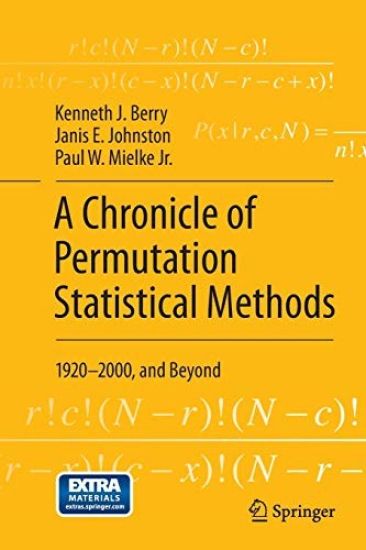
A Chronicle of Permutation Statistical Methods

A Chronicle of Permutation Statistical Methods

Kenneth J. Berry; Janis E. Johnston; Paul W. Mielke Jr.

Springer International Publishing AG
2016
nidottu
The focus of this book is on the birth and historical development of permutation statistical methods from the early 1920s to the near present. Beginning with the seminal contributions of R. A. Fisher, E. J. G. Pitman, and others in the 1920s and 1930s, permutation statistical methods were initially introduced to validate the assumptions of classical statistical methods. Permutation methods have advantages over classical methods in that they are optimal for small data sets and non-random samples, are data-dependent, and are free of distributional assumptions. Permutation probability values may be exact, or estimated via moment- or resampling-approximation procedures. Because permutation methods are inherently computationally-intensive, the evolution of computers and computing technology that made modern permutation methods possible accompanies the historical narrative. Permutation analogs of many well-known statistical tests are presented in a historical context, includingmultiple correlation and regression, analysis of variance, contingency table analysis, and measures of association and agreement. A non-mathematical approach makes the text accessible to readers of all levels.
A Chronicle of Permutation Statistical Methods

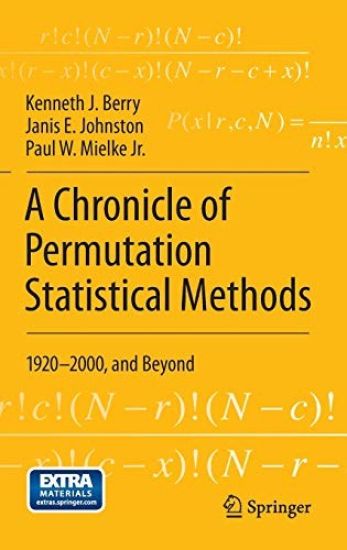
A Chronicle of Permutation Statistical Methods

Kenneth J. Berry; Janis E. Johnston; Paul W. Mielke Jr.

Springer International Publishing AG
2014
sidottu
The focus of this book is on the birth and historical development of permutation statistical methods from the early 1920s to the near present. Beginning with the seminal contributions of R. A. Fisher, E. J. G. Pitman, and others in the 1920s and 1930s, permutation statistical methods were initially introduced to validate the assumptions of classical statistical methods. Permutation methods have advantages over classical methods in that they are optimal for small data sets and non-random samples, are data-dependent, and are free of distributional assumptions. Permutation probability values may be exact, or estimated via moment- or resampling-approximation procedures. Because permutation methods are inherently computationally-intensive, the evolution of computers and computing technology that made modern permutation methods possible accompanies the historical narrative. Permutation analogs of many well-known statistical tests are presented in a historical context, includingmultiple correlation and regression, analysis of variance, contingency table analysis, and measures of association and agreement. A non-mathematical approach makes the text accessible to readers of all levels.
Permutation Statistical Methods

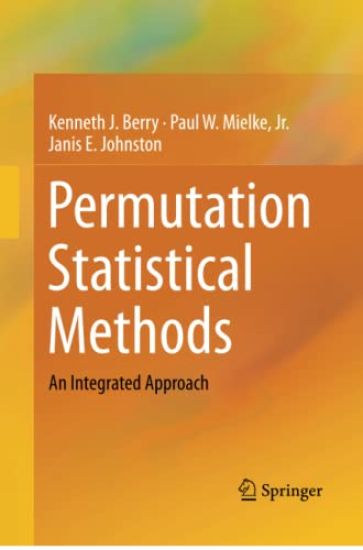
Permutation Statistical Methods

Kenneth J. Berry; Paul W. Mielke Jr.; Janis E. Johnston

Springer International Publishing AG
2018
nidottu
This research monograph provides a synthesis of a number of statistical tests and measures, which, at first consideration, appear disjoint and unrelated. Numerous comparisons of permutation and classical statistical methods are presented, and the two methods are compared via probability values and, where appropriate, measures of effect size. Permutation statistical methods, compared to classical statistical methods, do not rely on theoretical distributions, avoid the usual assumptions of normality and homogeneity of variance, and depend only on the data at hand. This text takes a unique approach to explaining statistics by integrating a large variety of statistical methods, and establishing the rigor of a topic that to many may seem to be a nascent field in statistics. This topic is new in that it took modern computing power to make permutation methods available to people working in the mainstream of research. lly-informed="" audience,="" and="" can="" also="" easily="" serve="" as="" textbook="" in="" graduate="" course="" departments="" such="" statistics,="" psychology,="" or="" biology.="" particular,="" the="" audience="" for="" book="" is="" teachers="" of="" practicing="" statisticians,="" applied="" quantitative="" students="" fields="" medical="" research,="" epidemiology,="" public="" health,="" biology.
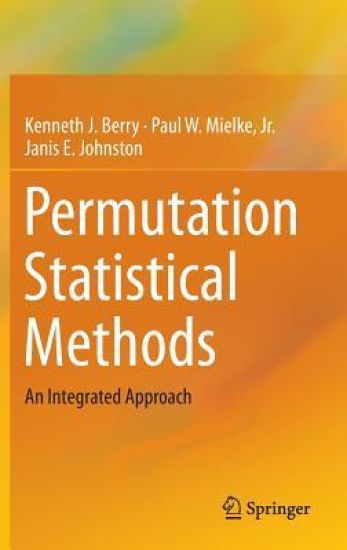
Permutation Statistical Methods

Permutation Statistical Methods

Kenneth J. Berry; Paul W. Mielke Jr.; Janis E. Johnston

Springer International Publishing AG
2016
sidottu
This research monograph provides a synthesis of a number of statistical tests and measures, which, at first consideration, appear disjoint and unrelated. Numerous comparisons of permutation and classical statistical methods are presented, and the two methods are compared via probability values and, where appropriate, measures of effect size. Permutation statistical methods, compared to classical statistical methods, do not rely on theoretical distributions, avoid the usual assumptions of normality and homogeneity of variance, and depend only on the data at hand. This text takes a unique approach to explaining statistics by integrating a large variety of statistical methods, and establishing the rigor of a topic that to many may seem to be a nascent field in statistics. This topic is new in that it took modern computing power to make permutation methods available to people working in the mainstream of research. lly-informed="" audience,="" and="" can="" also="" easily="" serve="" as="" textbook="" in="" graduate="" course="" departments="" such="" statistics,="" psychology,="" or="" biology.="" particular,="" the="" audience="" for="" book="" is="" teachers="" of="" practicing="" statisticians,="" applied="" quantitative="" students="" fields="" medical="" research,="" epidemiology,="" public="" health,="" biology.