Kirjojen hintavertailu – 12 903 725 kirjaa ja 27 kauppaa

Kirjailija

Paul Waldman

Kirjat ja teokset yhdessä paikassa: 6 kirjaa, julkaisuja vuosilta 2004–2025, suosituimpiin kuuluu Das ländliche Amerika und wie es die Demokratie in den USA bedroht. Vertaile teosten hintoja ja tarkista saatavuus suomalaisista kirjakaupoista.

6 kirjaa

Kirjojen julkaisuvuodet: 2004–2025.

White Rural Rage

White Rural Rage

Tom Schaller; Paul Waldman

RANDOM HOUSE USA INC
2025
nidottu
NEW YORK TIMES BESTSELLER - A searing portrait and damning takedown of America's proudest citizens--who are also the least likely to defend its core principles "This is an important book that ought to be read by anyone who wants to understand politics in the perilous Age of Trump."--David Corn, New York Times bestselling author of American Psychosis White rural voters hold the greatest electoral sway of any demographic group in the United States, yet rural communities suffer from poor healthcare access, failing infrastructure, and severe manufacturing and farming job losses. Rural voters believe our nation has betrayed them, and to some degree, they're right. In White Rural Rage, Tom Schaller and Paul Waldman explore why rural Whites have failed to reap the benefits from their outsize political power and why, as a result, they are the most likely group to abandon democratic norms and traditions. Their rage--stoked daily by Republican politicians and the conservative media--now poses an existential threat to the United States. Schaller and Waldman show how vulnerable U. S. democracy has become to rural Whites who, despite legitimate grievances, are increasingly inclined to hold racist and xenophobic beliefs, to believe in conspiracy theories, to accept violence as a legitimate course of political action, and to exhibit antidemocratic tendencies. Rural White Americans' attitude might best be described as "I love my country, but not our country," Schaller and Waldman argue. This phenomenon is the patriot paradox of rural America: The citizens who take such pride in their patriotism are also the least likely to defend core American principles. And by stoking rural Whites' anger rather than addressing the hard problems they face, conservative politicians and talking heads create a feedback loop of resentments that are undermining American democracy. Schaller and Waldman provocatively critique both the structures that permit rural Whites' disproportionate influence over American governance and the prospects for creating a pluralist, inclusive democracy that delivers policy solutions that benefit rural communities. They conclude with a political reimagining that offers a better future for both rural people and the rest of America.

White Rural Rage

White Rural Rage

Tom Schaller; Paul Waldman

RANDOM HOUSE USA INC
2024
sidottu
A searing portrait and damning takedown of America's proudest citizens--who are also the least likely to defend its core principles White rural voters hold the greatest electoral sway of any demographic group in the United States, yet rural communities suffer from poor healthcare access, failing infrastructure, and severe manufacturing and farming job losses. Rural voters believe our nation has betrayed them, and to some degree, they're right. In White Rural Rage, Tom Schaller and Paul Waldman explore why rural Whites have failed to reap the benefits from their outsize political power and why, as a result, they are the most likely group to abandon democratic norms and traditions. Their rage--stoked daily by Republican politicians and the conservative media--now poses an existential threat to the United States. Schaller and Waldman show how vulnerable U. S. democracy has become to rural Whites who, despite legitimate grievances, are increasingly inclined to hold racist and xenophobic beliefs, to believe in conspiracy theories, to accept violence as a legitimate course of political action, and to exhibit antidemocratic tendencies. Rural White Americans' attitude might best be described as "I love my country, but not our country," Schaller and Waldman argue. This phenomenon is the patriot paradox of rural America: The citizens who take such pride in their patriotism are also the least likely to defend core American principles. And by stoking rural Whites' anger rather than addressing the hard problems they face, conservative politicians and talking heads create a feedback loop of resentments that are undermining American democracy. Schaller and Waldman provocatively critique both the structures that permit rural Whites' disproportionate influence over American governance and the prospects for creating a pluralist, inclusive democracy that delivers policy solutions that benefit rural communities. They conclude with a political reimagining that offers a better future for both rural people and the rest of America.

Free Ride: John McCain and the Media

Free Ride: John McCain and the Media

David Brock; Paul Waldman

Knopf Doubleday Publishing Group
2008
nidottu
We live in a gotcha media culture that revels in exposing the foibles and hypocrisies of our politicians. But one politician manages to escape this treatment, getting the benefit of the doubt and a positive spin for nearly everything he does: John McCain. Indeed, even during his temporary decline in popularity in 2007, the media continued to support him by lamenting his fate rather than criticizing the flip flops and politicking that undermined his popular image as a maverick. David Brock and Paul Waldman show how the media has enabled McCain's rise from the Keating Five scandal to the underdog hero of the 2000 primaries to his roller-coaster run for the 2008 nomination. They illuminate how the press falls for McCain's "straight talk" and how the Arizona senator gets away with inconsistencies and misrepresentations for which the media skewers other politicians. This is a fascinating study of how the media shape the political debate, and an essential book for every political junkie.
Being Right Is Not Enough

Being Right Is Not Enough

Paul Waldman

Wiley
2006
sidottu
""Waldman's book is terrific-good sense mustered with evidence, well argued, and sharply written to boot. I agree fervently with almost everything he writes. This is the indispensable book for the 2006 elections.""--Todd Gitlin, author of The Sixties and The Twilight of Common Dreams""A well-sourced, partisan blueprint for undoing Republican control of the nation.""--Publishers Weekly""Here's the ticket for Democrats to get back in power: read this book, understand what it means to be a true American progressive, expose conservatives as the mean elitists they are, get tough, and fight back. Nobody paints the strengths of progressives and the weaknesses of conservatives like Paul Waldman.""--Bill Press, author How the Republicans Stole Christmas""With clarity and passion, Paul Waldman demonstrates persuasively that the forces of the right have not 'taken over the country, ' as the media often lazily put it. They've only taken over politics. That can be reversed, and Waldman shows exactly how.""--Michael Tomasky, Editor, the American Prospect
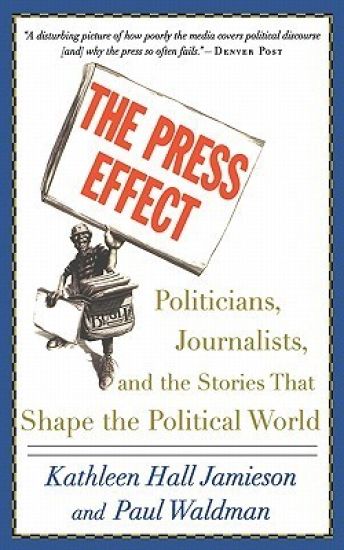
The Press Effect

The Press Effect

Kathleen Hall Jamieson; Paul Waldman

Oxford University Press Inc
2004
nidottu
Was the 2000 presidential campaign merely a contest between Pinocchio and Dumbo? And did Dumbo miraculously turn into Abraham Lincoln after the events of September 11? In fact, Kathleen Hall Jamieson and Paul Waldman argue in The Press Effect, these stereotypes, while containing some elements of the truth, represent the failure of the press and the citizenry to engage the most important part of our political process in a critical fashion. Jamieson and Waldman analyze both press coverage and public opinion, using the Annenberg 2000 survey, which interviewed more than 100,000 people, to examine one of the most interesting periods of modern presidential history, from the summer of 2000 through the aftermath of September 11th. How does the press fail us during presidential elections? Jamieson and Waldman show that when political campaigns side-step or refuse to engage the facts of the opposing side, the press often fails to step into the void with the information citizens require to make sense of the political give-and-take. They look at the stories through which we understand political events--examining a number of fabrications that deceived the public about consequential governmental activities--and explore the ways in which political leaders and reporters select the language through which we talk and think about politics, and the relationship between the rhetoric of campaigns and the reality of governance. They explore the role of the campaigns and the press in casting the 2000 general election as a contest between Pinocchio and Dumbo, and ask whether in 2000 the press applied the same standards of truth-telling to both Bush and Gore. The unprecedented events of election night and the thirty-six days that followed revealed the role that preconceptions play in press interpretation and the importance of press frames in determining the tone of political coverage as well as the impact of network overconfidence in polls. The Press Effect is, ultimately, a wide-ranging critique of the press's role in mediating between politicians and the citizens they are supposed to serve.