Kirjojen hintavertailu – 12 903 725 kirjaa ja 27 kauppaa

Kirjailija

Paul Willman

Kirjat ja teokset yhdessä paikassa: 6 kirjaa, julkaisuja vuosilta 1993–2014, suosituimpiin kuuluu Understanding Management. Vertaile teosten hintoja ja tarkista saatavuus suomalaisista kirjakaupoista.

6 kirjaa

Kirjojen julkaisuvuodet: 1993–2014.

Understanding Management

Understanding Management

Paul Willman

Oxford University Press
2014
sidottu
Management is a fragmented and interdisciplinary area of study, with a lot of academic branches. Willman argues this tree is narrower at its roots, and these roots lie primarily in social science. Key to the purpose of the book is to present management theory as applied social science. Developed out of a core management course at Master's level, this book introduces the field to students who may have little prior knowledge of management. Willman interprets 'management' broadly to embrace the sub-disciplines of strategy, finance, accounting, marketing, organisational behaviour and operations management. The text aims to show how they arose and how they relate, thus engaging the reader in a little history. The book is integrative, in that it seeks to find common concerns in disparate literatures. It is also critical in that it seeks to comparatively evaluate contributions to the management field both in terms of theoretical contribution and practical impact. It is intended to be accessible to a range of readers, presenting technical materials in an informal way. Finally, it is introductory in that it assumes no previous knowledge of the academic management field.

Understanding Management

Understanding Management

Paul Willman

Oxford University Press
2014
nidottu
Management is a fragmented and interdisciplinary area of study, with a lot of academic branches. Willman argues this tree is narrower at its roots, and these roots lie primarily in social science. Key to the purpose of the book is to present management theory as applied social science. Developed out of a core management course at Master's level, this book introduces the field to students who may have little prior knowledge of management. Willman interprets 'management' broadly to embrace the sub-disciplines of strategy, finance, accounting, marketing, organisational behaviour and operations management. The text aims to show how they arose and how they relate, thus engaging the reader in a little history. The book is integrative, in that it seeks to find common concerns in disparate literatures. It is also critical in that it seeks to comparatively evaluate contributions to the management field both in terms of theoretical contribution and practical impact. It is intended to be accessible to a range of readers, presenting technical materials in an informal way. Finally, it is introductory in that it assumes no previous knowledge of the academic management field.
Union Business

Union Business

Paul Willman; Tim Morris; Beverly Aston

Cambridge University Press
2010
pokkari
It is fashionable to speak of trades unions in the UK as organisations in decline. However, it is their organisation and, in particular, their financial status, which ultimately dictates unions' ability to survive, recruit, and influence employers. This book provides the first systematic picture of union financial status for thirty years, and reveals a dramatic picture. Though, overall, unions have become financially less healthy in the post-war period, many unions experienced an improved financial position during the membership contraction of the Thatcher years. It also shows that the long term financial decline of unions has been more affected by competition between unions for membership than by the effects of traumatic industrial disputes.
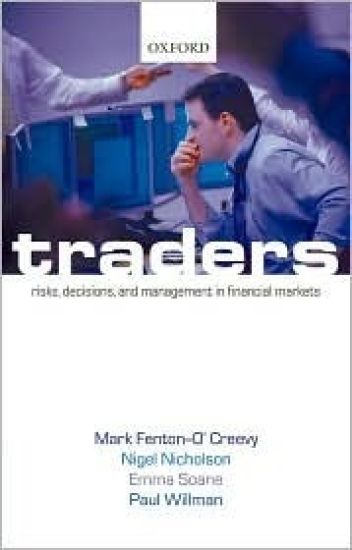
Traders

Traders

Mark Fenton-O'Creevy; Nigel Nicholson; Emma Soane; Paul Willman

Oxford University Press
2007
nidottu
This is a book about traders in financial markets: what they do, the kind of people they are, how they perceive the world they inhabit, how they make decisions and take risks. This is also a book about how traders are managed - the best and the worst examples - and about the institutions they inhabit: firms, markets, cultures, and theories of how the world works. How these institutions function, how traders are managed, and how traders view the world, all have profound effects on the wider financial environment. This book explores these relationships and their implications theoretically and empirically. The data discussed in this book draw on a three-year project researching the psychological and social influences on the behaviour and performance of traders in investment banks. 118 traders and managers in four leading organizations participated. Data were collected through semi-structured interviews supplemented by questionnaires, measures of personality, risk propensity and a novel computer based measure designed to assess illusion of control and other cognitive biases. The authors' approach to writing this book is explicitly interdisciplinary. They draw on sociology, psychology and economics in order to illuminate the work of traders and the world they inhabit. The book is a significant contribution to the growing body of research and literature which suggests that if we are to effectively understand financial markets and the actors who inhabit them, the insights of neo-classical financial economics need supplementing with a broader range of social science approaches. The book will be of value to researchers interested in the functioning of financial institutions and markets, to those with an interest in market regulation and to practitioners wishing to benefit from an analytical perspective on the challenges facing traders and their managers.
Traders

Traders

Mark Fenton-O'Creevy; Nigel Nicholson; Emma Soane; Paul Willman

Oxford University Press
2004
sidottu
This is a book about traders in financial markets: what they do, the kind of people they are, how they perceive the world they inhabit, how they make decisions and take risks. This is also a book about how traders are managed - the best and the worst examples - and about the institutions they inhabit: firms, markets, cultures, and theories of how the world works. How these institutions function, how traders are managed, and how traders view the world, all have profound effects on the wider financial environment. This book explores these relationships and their implications theoretically and empirically. The data discussed in this book draw on a three-year project researching the psychological and social influences on the behaviour and performance of traders in investment banks. 118 traders and managers in four leading organizations participated. Data were collected through semi-structured interviews supplemented by questionnaires, measures of personality, risk propensity and a novel computer based measure designed to assess illusion of control and other cognitive biases. The authors' approach to writing this book is explicitly interdisciplinary. They draw on sociology, psychology and economics in order to illuminate the work of traders and the world they inhabit. The book is a significant contribution to the growing body of research and literature which suggests that if we are to effectively understand financial markets and the actors who inhabit them, the insights of neo-classical financial economics need supplementing with a broader range of social science approaches. The book will be of value to researchers interested in the functioning of financial institutions and markets, to those with an interest in market regulation and to practitioners wishing to benefit from an analytical perspective on the challenges facing traders and their managers.
Union Business

Union Business

Paul Willman; Tim Morris; Beverly Aston

Cambridge University Press
1993
sidottu
It is fashionable to speak of trades unions in the UK as organisations in decline. However, it is their organisation and, in particular, their financial status, which ultimately dictates unions' ability to survive, recruit, and influence employers. This book provides the first systematic picture of union financial status for thirty years, and reveals a dramatic picture. Though, overall, unions have become financially less healthy in the post-war period, many unions experienced an improved financial position during the membership contraction of the Thatcher years. It also shows that the long term financial decline of unions has been more affected by competition between unions for membership than by the effects of traumatic industrial disputes.