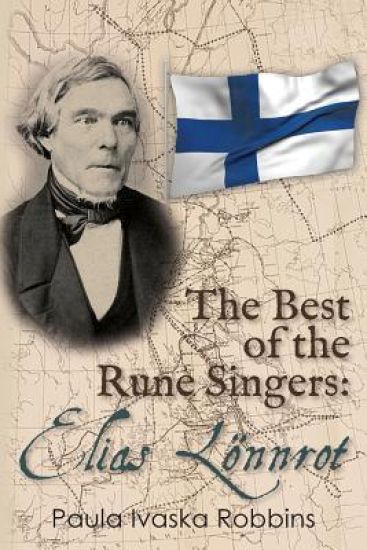
The Best of the Rune Singers: Elias Lönnrot
Paula Ivaska Robbins
Createspace Independent Publishing Platform
2012
nidottu
Halvin toimitettuna 18,90 €
The Best of the Rune-Singers: based on the life of Elias L nnrot, the Compiler of the Finnish National Epic, The Kalevala Paula Ivaska Robbins The book begins with a prologue explaining the significance of The Kalevala to the development of Finnish as a literary language, the eventual independence of Finland from the Russian Empire, and the emergence of Finland in the twenty-first century as one of the most prosperous and successful countries in the world, the homeland of four Nobel prize winners, and an acknowledged leader in technology and education. This work of creative nonfiction follows the life of Elias L nnrot from his childhood as a son of a poor country tailor, his education in bo and Helsinki supported by many scholarships, and his relationship with the wealthy and cosmopolitan T rngren family who encouraged and supported his dream of collecting the ancient Finnish folk poetry. The story focuses on the period from 1828 to 1845, when L nnrot traveled to eastern and northern Finland, Lapland, and Russian Karelia on foot, on skis, by rowboat, on horseback, and by sledge searching out the singers and wise men, possessors of magical powers, who would sing the ancient folk poetry of the Finnish people. One scholar has estimated that his travels over fifteen years took him a distance equivalent to that from Helsinki to the South Pole. L nnrot became the District Medical Officer for a large area based in rural Kaajani, near the border of Russian Karelia, fighting epidemics of cholera and typhoid. The post enabled him to combine his medical work with the goal of collecting the poems of the peasants whom he served. An epidemic of typhoid raged through the region for which L nnrot was responsible, and, overworked, he too contracts the disease. His landlady, a middle-aged widow, nurses him back to health. She becomes his faithful housekeeper, and he grows dependent upon her for many of his physical needs, including sexual. L nnrot was encouraged and financially supported in his travels and writing by a group of intellectuals in Helsinki that became, in 1831, the Finnish Literature Society (Suomen Kansallis Seura). Its aim was "'to propagate more exact notions of the country and its history, to work for the cultivation of the Finnish language and to bring to birth in this language a literature for both the educated classes and the people.'" "Language being the foundation of nationality, a national literature is not possible without a national language." During his travels L nnrot met many fascinating characters and had several frightening adventures. The reader will learn much about the customs and religious beliefs of the rural Karelian peasants. Aarne Anttila, L nnrot's first biographer, tells us that, as a student and during the period of his travels, L nnrot was opposed to religion, drank alcohol often to excess, gambled, and carried on several affairs with women. Yet, at age 47, in 1849, L nnrot married the 26-year-old Maria Piponius, an uneducated housekeeper who was a fervent Pietist. They raised a family and he spent his later years writing hymns. This abrupt change in his life is accounted for by a fictional dramatic episode in which L nnrot breaks the vow that he made when he became a physician. Because of his guilt, he experiences a deep depression during an extended unsuccessful collecting trip to Lapland. After a fictional meeting with the Pietist pastor, Lars Levi Laestadius, during his journey, he returns to beg forgiveness from his friend Carl Saxa, a Lutheran clergyman, and converts to Pietism. Dr. Raija Maijamaa, Senior Research Associate at The Finnish Literature Society and the current biographer of L nnrot, read and critiqued my manuscript and writes, "You have written a fascinating work of creative writing, not only a wonderful piece of documentation, still. Thank you Be proud of the work, which shows American readers such an imaginative story from Finnish history."