Kirjojen hintavertailu – 12 859 818 kirjaa ja 27 kauppaa

Kirjailija

Pauline Maier

Kirjat ja teokset yhdessä paikassa: 9 kirjaa, julkaisuja vuosilta 1990–2020, suosituimpiin kuuluu Om den amerikanska idén. Vertaile teosten hintoja ja tarkista saatavuus suomalaisista kirjakaupoista.

9 kirjaa

Kirjojen julkaisuvuodet: 1990–2020.

Om den amerikanska idén

Om den amerikanska idén

Peter Baldwin; Peter Beinart; Kathleenn Burk; James Carroll; David Ellwood; Godfrey Hodgson; Daniel Walker Howe; Oliver Kamm; Deepak Lal; Anatol Lieven; Edward Luce; Pauline Maier; Douglas Murray; Jong-Yil Ra; David Reynolds; Philippe Roger; Göran Rosenberg; robert J Shapiro; Anders Stephanson; Reinhold Wagnleitner; Alan Wolfe

Bokförlaget Atlantis
2010
sidottu
Hur uppstod idén om Amerika, hur har den omformats genom historien, vart är den på väg? Kring dessa och liknande frågor kretsade Engelsbergsseminariet 2009. Vilka är komponenterna i den amerikanska idén? Hur förvaltas de i dagens USA? Hur reagerar resten av världen på dem? Sker idag en övergång till en post-amerikansk värld? Vem kommer i så fall att ta över USA:s ledande ställning? Indien? Kina? Och vad skulle det innebära? Vilka tankefigurer skulle då komma att prägla världen? Eller har USA chansen att bli kvar som herre på täppan? Bevittnar vi början på slutet för idén om Amerika eller befinner vi oss bara i början av en amerikansk era? Bland bidragsgivarna märks Anatol Lieven, Deepak Lal, Jong-Yil Ra, Edward Luce och Alan Wolfe.
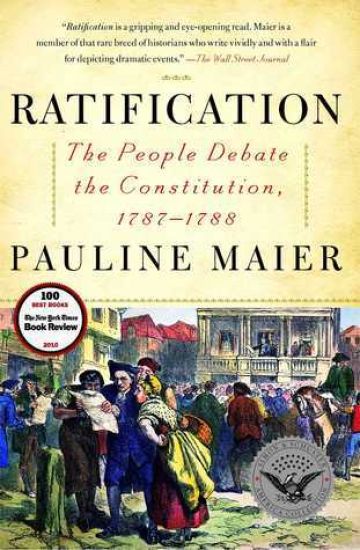
Ratification: The People Debate the Constitution, 1787-1788
The defining book of the American Revolution era and a winner of the George Washington Book Award, Ratification chronicles the pivotal moments and key figures in transforming the US Constitution from an idea into a transformational document and the Constitutional Convention into a working government. When the delegates left the Constitutional Convention in Philadelphia in September 1787, the new Constitution they had written was no more than a proposal. Elected conventions in at least nine of the thirteen states would have to ratify it before it could take effect. There was reason to doubt whether that would happen. The document we revere today as the foundation of our country's laws, the cornerstone of our legal system, was hotly disputed at the time. Some Americans denounced the Constitution for threatening the liberty that Americans had won at great cost in the Revolutionary War. One group of fiercely patriotic opponents even burned the document in a raucous public demonstration on the Fourth of July. In this splendid new history, Pauline Maier tells the dramatic story of the yearlong battle over ratification that brought such famous founders as Washington, Hamilton, Madison, Jay, and Henry together with less well-known Americans who sometimes eloquently and always passionately expressed their hopes and fears for their new country. Men argued in taverns and coffeehouses; women joined the debate in their parlors; broadsides and newspaper stories advocated various points of view and excoriated others. In small towns and counties across the country people read the document carefully and knew it well. Americans seized the opportunity to play a role in shaping the new nation. Then the ratifying conventions chosen by "We the People" scrutinized and debated the Constitution clause by clause. Although many books have been written about the Constitutional Convention, this is the first major history of ratification. It draws on a vast new collection of documents and tells the story with masterful attention to detail in a dynamic narrative. Each state's experience was different, and Maier gives each its due even as she focuses on the four critical states of Pennsylvania, Massachusetts, Virginia, and New York, whose approval of the Constitution was crucial to its success. The New Yorker Gilbert Livingston called his participation in the ratification convention the greatest transaction of his life. The hundreds of delegates to the ratifying conventions took their responsibility seriously, and their careful inspection of the Constitution can tell us much today about a document whose meaning continues to be subject to interpretation. Ratification is the story of the founding drama of our nation, superbly told in a history that transports readers back more than two centuries to reveal the convictions and aspirations on which our country was built.
Inventing America

Inventing America

Pauline Maier; Smith Merritt Roe; Keyssar Alexander; Kevles Daniel J.

WW Norton Co
2006
muu
For the Second Edition, the authors have expanded and strengthened the innovation theme and pared some supporting detail to create a more concise and effective teaching text.
Inventing America

Inventing America

Pauline Maier; Smith Merritt Roe; Keyssar Alexander; Kevles Daniel J.

WW Norton Co
2006
muu
For the Second Edition, the authors have expanded and strengthened the innovation theme and pared some supporting detail to create a more concise and effective teaching text.
American Scripture: Making the Declaration of Independence
Pauline Maier shows us the Declaration as both the defining statement of our national identity and the moral standard by which we live as a nation. It is truly "American Scripture," and Maier tells us how it came to be -- from the Declaration's birth in the hard and tortuous struggle by which Americans arrived at Independence to the ways in which, in the nineteenth century, the document itself became sanctified. Maier describes the transformation of the Second Continental Congress into a national government, unlike anything that preceded or followed it, and with more authority than the colonists would ever have conceded to the British Parliament; the great difficulty in making the decision for Independence; the influence of Paine's Common Sense, which shifted the terms of debate; and the political maneuvers that allowed Congress to make the momentous decision. In Maier's hands, the Declaration of Independence is brought close to us. She lets us hear the voice of the people as revealed in the other "declarations" of 1776: the local resolutions -- most of which have gone unnoticed over the past two centuries -- that explained, advocated, and justified Independence and undergirded Congress's work. Detective-like, she discloses the origins of key ideas and phrases in the Declaration and unravels the complex story of its drafting and of the group-editing job which angered Thomas Jefferson. Maier also reveals what happened to the Declaration after the signing and celebration: how it was largely forgotten and then revived to buttress political arguments of the nineteenth century; and, most important, how Abraham Lincoln ensured its persistence as a living force in American society. Finally, she shows how by the very act of venerating the Declaration as we do -- by holding it as sacrosanct, akin to holy writ -- we may actually be betraying its purpose and its power.
From Resistance to Revolution: Colonial Radicals and the Development of American Opposition.....
In this classic account of the American revolution, Pauline Maier traces the step-by-step process through which the extra-legal institutions of the colonial resistance movement assumed authority from the British. She follows the American Whigs as they moved by stages from the organized resistance of the Stamp Act crisis of 1765 through the non-importation associations of the late 1760s to the collapse of royal government after 1773, the implication of the king in a conspiracy against American liberties, and the consequent Declaration of Independence. Professor Maier's great achievement is to explain how Americans came to contemplate and establish their independence, guided by principle, reason, and experience.
The Old Revolutionaries: Political Lives in the Age of Samuel Adams
The "old revolutionaries" were Samuel Adams, Isaac Sears, Thomas Young, Richard Henry Lee, and Charles Carroll, five men of widely varying backgrounds who played significant roles in the American Revolution. What motivations brought these different men together and made them decide to join the movement for Independence? In telling their stories, Pauline Maier explores the American Revolution not so much as a collective movement as a commitment to an ideal republic--which different people interpreted differently. Pauline Maier has written a new Introduction to the Norton paperback edition, in which she discusses the Old Revolutionaries' pertinence to current debates over liberalism in the American Revolution. Professor Maier teaches history at MIT and is also the author of From Resistance to Revolution: Colonial Radicals and the Development of American Opposition to Britain, 1765-1776.