
Kirjojen hintavertailu – 12 903 724 kirjaa ja 27 kauppaa

Kirjailija

Penny Crook

Kirjat ja teokset yhdessä paikassa: 3 kirjaa, julkaisuja vuosilta 2013–2020, suosituimpiin kuuluu Exploring the Archaeology of the Modern City in Nineteenth-century Australia. Vertaile teosten hintoja ja tarkista saatavuus suomalaisista kirjakaupoista.

3 kirjaa

Kirjojen julkaisuvuodet: 2013–2020.

Exploring the Archaeology of the Modern City in Nineteenth-century Australia

Exploring the Archaeology of the Modern City in Nineteenth-century Australia

Tim Murray; Penny Crook

Springer Nature Switzerland AG
2019
sidottu
This book presents research into the urban archaeology of 19th-century Australia. It focuses on the detailed archaeology of 20 cesspits in The Rocks area of Sydney and the Commonwealth Block site in Melbourne. It also includes discussions of a significant site in Sydney – First Government House. The book is anchored around a detailed comparison of contents of 20 cesspits created during the 19th century, and examines patterns of similarity and dissimilarity, presenting analyses that work towards an integration of historical and archaeological data and perspectives. The book also outlines a transnational framework of comparison that assists in the larger context related to building a truly global archaeology of the modern city. This framework is directly related a multi-scalar approach to urban archaeology. Historical archaeologists have been advocating the need to explore the archaeology of the modern city using several different scales or frames of reference. The most popular (and most basic) of these has been the household. However, it has also been acknowledged that interpreting the archaeology of households beyond the notion that every household and associated archaeological assemblage is unique requires archaeologists and historians to compare and contrast, and to establish patterns. These comparisons frequently occur at the level of the area or district in the same city, where archaeologists seek to derive patterns that might be explained as being the result of status, class, ethnicity, or ideology. Other less frequent comparisons occur at larger scales, for example between cities or countries, acknowledging that the archaeology of the modern western city is also the archaeology of modern global forces of production, consumption, trade, immigration and ideology formation. This book makes a contribution to that general literature
Exploring the Archaeology of the Modern City in Nineteenth-century Australia

Exploring the Archaeology of the Modern City in Nineteenth-century Australia

Tim Murray; Penny Crook

Springer Nature Switzerland AG
2020
nidottu
This book presents research into the urban archaeology of 19th-century Australia. It focuses on the detailed archaeology of 20 cesspits in The Rocks area of Sydney and the Commonwealth Block site in Melbourne. It also includes discussions of a significant site in Sydney – First Government House. The book is anchored around a detailed comparison of contents of 20 cesspits created during the 19th century, and examines patterns of similarity and dissimilarity, presenting analyses that work towards an integration of historical and archaeological data and perspectives. The book also outlines a transnational framework of comparison that assists in the larger context related to building a truly global archaeology of the modern city. This framework is directly related a multi-scalar approach to urban archaeology. Historical archaeologists have been advocating the need to explore the archaeology of the modern city using several different scales or frames of reference. The most popular (and most basic) of these has been the household. However, it has also been acknowledged that interpreting the archaeology of households beyond the notion that every household and associated archaeological assemblage is unique requires archaeologists and historians to compare and contrast, and to establish patterns. These comparisons frequently occur at the level of the area or district in the same city, where archaeologists seek to derive patterns that might be explained as being the result of status, class, ethnicity, or ideology. Other less frequent comparisons occur at larger scales, for example between cities or countries, acknowledging that the archaeology of the modern western city is also the archaeology of modern global forces of production, consumption, trade, immigration and ideology formation. This book makes a contribution to that general literature
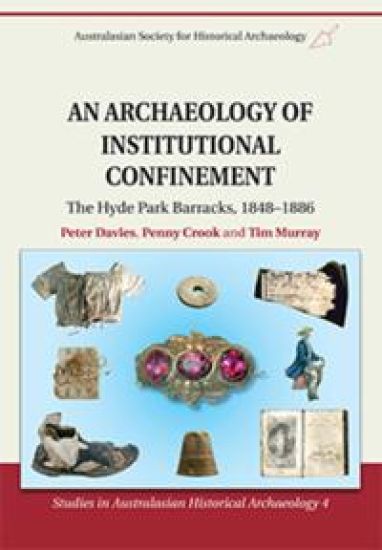
An Archaeology of Institutional Confinement

An Archaeology of Institutional Confinement

Peter Davies; Penny Crook; Tim Murray

Sydney University Press
2013
nidottu
The archaeological assemblage from the Hyde Park Barracks is one of the largest, most comprehensive and best preserved collections of artefacts from any 19th-century institution in the world. Concealed for up to 160 years in the cavities between floorboards and ceilings, the assemblage is a unique archaeological record of institutional confinement, especially of women. The underfloor assemblage dates to the period 1848 to 1886, during which a female Immigration Depot and a Government Asylum for Infirm and Destitute Women occupied the second and third floors of the Barracks. Over the years the women discarded and swept beneath the floor thousands of clothing and textile fragments, tobacco pipes, religious items, sewing equipment, paper scraps and numerous other objects, many of which rarely occur in typical archaeological deposits. These items are presented in detail in this book, and provide unique insight into the private lives of young female migrants and elderly destitute women, most of whom will never be known from historical records.