
Kirjojen hintavertailu – 12 903 725 kirjaa ja 27 kauppaa

Kirjailija

Penny Sebring

Kirjat ja teokset yhdessä paikassa: 2 kirjaa, julkaisuja vuosilta 1999–2023, suosituimpiin kuuluu How a City Learned to Improve Its Schools. Vertaile teosten hintoja ja tarkista saatavuus suomalaisista kirjakaupoista.

2 kirjaa

Kirjojen julkaisuvuodet: 1999–2023.

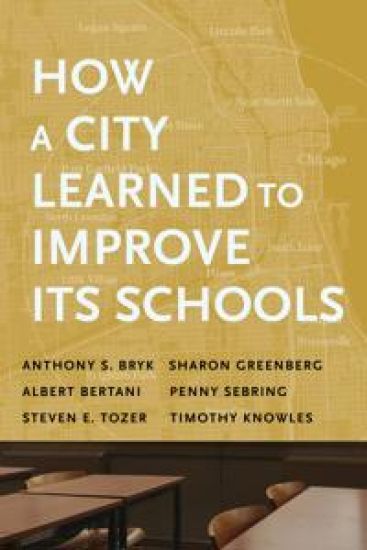
How a City Learned to Improve Its Schools

How a City Learned to Improve Its Schools

Anthony S. Bryk; Sharon Greenberg; Albert Bertani; Penny Sebring; Steven E. Tozer; Timothy Knowles

Harvard Educational Publishing Group
2023
nidottu
A comprehensive analysis of the astonishing changes that elevated the Chicago public school system from one of the worst in the nation to one of the most improved. How a City Learned to Improve Its Schools tells the story of the extraordinary thirty-year school reform effort that changed the landscape of public education in Chicago. Acclaimed educational researcher Anthony S. Bryk joins five coauthors involved in Chicago-based education reform, Sharon Greenberg, Albert Bertani, Penny Sebring, Steven E. Tozer, and Timothy Knowles, to illuminate the many factors that led to the ultimate success of Chicago Public Schools. Beginning in 1987, Bryk and team lay out the civic context for reform, outlining the systemic challenges such as segregation, institutional racism, and income and resource disparities that reformers grappled with as well as the social conflicts they faced. Next, they analyze continuous improvement to teaching and learning, including the recruitment and retention of high-quality educators and leadership, a transformation validated by unprecedented increases in benchmarks such as graduation rates and college matriculation. This riveting account introduces key actors within the schools, city government, and business community, and the partnerships they forged. It also reveals the surprising yet essential role of Chicago's innovative information infrastructure in aligning disparate initiatives. In making clear how elements such as advocacy, expanded civic capacity, improvement research, and strong democracy contributed to large-scale progress in the system's 600-plus schools, the book highlights the greater lessons that the Chicago story offers for system improvement overall.
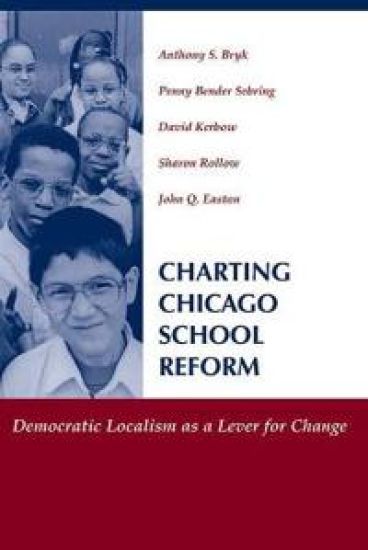
Charting Chicago School Reform

Charting Chicago School Reform

Anthony Bryk; David Kerbow; John Easton; Penny Sebring; Sharon Rollow

Westview Press Inc
1999
pokkari
In 1989, Chicago began an experiment with radical decentralization of power and authority. This book tells the story of what happened to Chicago's elementary schools in the first four years of this reform. Implicit in this reform is the theory that expanded local democratic participation would stimulate organizational change within schools, which in turn would foster improved teaching and learning. Using this theory as a framework, the authors marshal massive quantitative and qualitative data to examine how the reform actually unfolded at the school level. With longitudinal case study data on 22 schools, survey responses from principals and teachers in 269 schools, and supplementary system-wide administrative data, the authors identify four types of school politics: strong democracy, consolidated principal power, maintenance, and adversarial. In addition, they classify school change efforts as either systemic or unfocused. Bringing these strands together, the authors determine that, in about a third of the schools, expanded local democratic participation served as a strong lever for introducing systemic change focused on improved instruction. Finally, case studies of six actively restructuring schools illustrate how under decentralization the principal's role is recast, social support for change can grow, and ideas and information from external sources are brought to bear on school change initiatives. Few studies intertwine so completely extensive narratives and rigorous quantitative analyses. The result is a complex picture of the Chicago reform that joins the politics of local control to school change. This volume is intended for scholars in the fields of urban education, public policy, sociology of education, anthropology of education, and politics of education. Comprehensive and descriptive, it is an engaging text for graduate students and upper-level undergraduates. Local, state, and federal policymakers who are concerned with urban education will find new and insightful material. The book should be on reading lists and in professional development seminars for school principals who want to garner community support for change and for school community leaders who want more responsive local institutions. Finally, educators, administrators, and activists in Chicago will appreciate this detailed analysis of the early years of reform.