Kirjojen hintavertailu – 12 903 724 kirjaa ja 27 kauppaa

Kirjailija

Peter Appelbaum

Kirjat ja teokset yhdessä paikassa: 9 kirjaa, julkaisuja vuosilta 2002–2025, suosituimpiin kuuluu Prayer After the Slaughter. Vertaile teosten hintoja ja tarkista saatavuus suomalaisista kirjakaupoista.

9 kirjaa

Kirjojen julkaisuvuodet: 2002–2025.

Prayer After the Slaughter

Prayer After the Slaughter

Kurt Tucholsky; Peter Appelbaum; James Scott

Berlinica
2025
pokkari
No one before or after Kurt Tucholsky has captured the horrors of the "Great War," as World War I was known, quite like he did. The famed Weimar writer, who would become one of Germany's best-known satirist and journalists, describes surviving in the trenches and fighting a losing battle, the arrogance of the officers and the desperation of the loved ones back home. His writing is similar to that of Heinrich Heine, his role model, in that it appears superficially simple but is replete with hidden meanings. His works are touching, stirring, and precisely to the point. He brings alive the war that still looms even into our own 21st century. This is the first bilingual anthology in German and in English of his works on World War I. Kurt Tucholsky's Prayer After the Slaughter is a book by Berlinica Publishing LLC, a multi-media publishing house based in New York City. Berlinica offers English-language books from Berlin, German; fiction, non-fiction, travel guides, history about the Wall and the Third Reich, Jewish life, art, architecture and photography, as well as books about nightlife, cookbooks, and maps. It also offers documentaries and feature films on DVD, as well as music CDs. Berlinica caters to history buffs, Americans of German heritage, travelers, and artists and young people who love the cutting-edge city in the heart of Europe. Berlinica cooperates with Berlin-based publishing houses and tourist organizers. Berlinica's current and upcoming titles include "Our West Berlin," by various authors, also five translated books by famed Weimar author Kurt Tucholsky as well as Harold Poor's landmark biography of Tucholsky, two translated plays by Ernst Toller, and two American travel stories by Alfred Kerr and Roda Roda, soon to be followed by Egon Erwin Kisch's "Paradise America". In the non-fiction department, we have "Rocking the Wall," the Bruce-Springsteen-book and "Burning Beethoven," about German Americans in World War I, both by Erik Kirschbaum, also "Mark Twain in Berlin," by Andreas Austilat, "Berlin 1945: World War II: Photos of the Aftermath," by Michael Brettin, "The Berlin Wall Today," a full-color guide to the remnants of the Wall, by Michael Cramer, "Berlin in the Cold War," about post-World War II history, the comprehensive guide "Jews in Berlin," by Andreas Nachama, Julius Schoeps, Hermann Simon, and "A Place they Called Home," edited by Donna Swarthout about Jews returning to Germany. Berlinica's current and upcoming titles include "Our West Berlin," by various authors, also five translated books by famed Weimar author Kurt Tucholsky as well as Harold Poor's landmark biography of Tucholsky, two translated plays by Ernst Toller, and two American travel stories by Alfred Kerr and Roda Roda, soon to be followed by Egon Erwin Kisch's "Paradise America". We also offer "The Berlin Cookbook," a full-color collection of traditional German recipes by Rose Marie Donhauser, the picture book "Wings of Desire," by Lothar Heinke, "Martin Luther's Travel Guide," by Cornelia D mer, "Leipzig The City of Books und Music," by Sebastian Ringel, and "Berlin For Free," a guide for the frugal traveler by Monica Maertens.
Post-Anthropocene Civic and Global Education Studies

Post-Anthropocene Civic and Global Education Studies

Peter Appelbaum

Springer International Publishing AG
2024
sidottu
This book explores community action within our more-than-human lifeworld, tackling post-Anthropocene challenges. It presents bold experiments, shifting from crisis study to asking, "How are we here?". It addresses key issues by moving beyond posthuman perspectives, integrating indigenous ways of being, resisting ‘Doomer Culture’, and rejecting blind ‘Hopeism’. Part 1 focuses on Post-Anthropocene Pedagogies from an Education Studies perspective. Part 2 illustrates the power of these pedagogies, while Part 3 delves into literature on Post-Anthropocene Education. Part 4 illustrates the approach via case studies of teaching, the development of an NGO, and community art projects. The narrative emphasizes maintaining a two-way flow between human culture and nature, highlighting porous boundaries. It argues that mere knowledge won't cure or save the world. Instead, it advocates for leadership and civic engagement that enrich reconnection with place and stewardship. The primary audience is within environmental education, sustainability studies, curriculum studies, post-human studies, sociology of education, and resource management as educational enterprise.
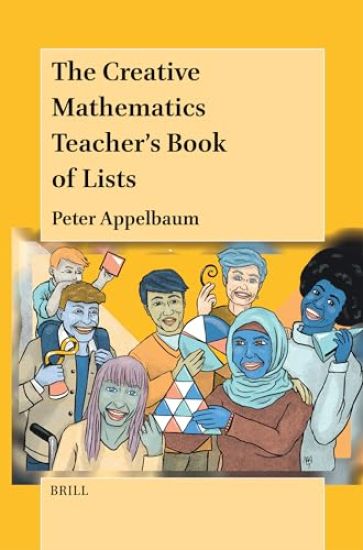
The Creative Mathematics Teacher's Book of Lists
Unexpected lists that propel your teaching into refreshingly new directions From lesson planning and assessment strategies to ideas for changing the world, there is something for everybody at every level and age of mathematics - entertaining humor, deeply serious provocations to push you out of the box, and good, clean wholesome tips for creative experiments in classroom organization.
The Creative Mathematics Teacher's Book of Lists
Unexpected lists that propel your teaching into refreshingly new directions From lesson planning and assessment strategies to ideas for changing the world, there is something for everybody at every level and age of mathematics - entertaining humor, deeply serious provocations to push you out of the box, and good, clean wholesome tips for creative experiments in classroom organization.
Embracing Mathematics

Embracing Mathematics

Peter Appelbaum; with David Scott Allen

Routledge
2008
sidottu
This alternative textbook for courses on teaching mathematics asks teachers and prospective teachers to reflect on their relationships with mathematics and how these relationships influence their teaching and the experiences of their students. Applicable to all levels of schooling, the book covers basic topics such as planning and assessment, classroom management, and organization of classroom experiences; it also introduces some novel approaches to teaching mathematics, such as psychoanalytic perspectives and post-modern conceptions of curriculum. Traditional methods-of-teaching issues are recast in a new discourse, provoking new ideas for making mathematics education meaningful to teachers as well as their students. Co-authored by a professor and coordinator of mathematics education programs, with illustrative contributions from practicing elementary, middle, and high school mathematics teachers, this book is a unique collaboration across all pre-college grades, making it ideal for teacher discussion groups at any level. Embracing Mathematics: integrates pedagogy and content exploration in ways that are unique in mathematics education features textboxes with reflection questions and suggested explorations that can be easily utilized as homework for a course or as discussion opportunities for teacher reading groups offers examples of teachers’ action research projects that grew out of their interactions with the main chapters in the book is not narrowly limited to mathematics education but incorporates curriculum studies – an invaluable asset that allows instructors to find more ways to engage students in self-reflexive acts of teachingEmbracing Mathematics is intended as a method text for undergraduate and master’s-level mathematics education courses and more specialized graduate courses on mathematics education, and as a resource for teacher discussion groups.
Embracing Mathematics

Embracing Mathematics

Peter Appelbaum; with David Scott Allen

Routledge
2008
nidottu
This alternative textbook for courses on teaching mathematics asks teachers and prospective teachers to reflect on their relationships with mathematics and how these relationships influence their teaching and the experiences of their students. Applicable to all levels of schooling, the book covers basic topics such as planning and assessment, classroom management, and organization of classroom experiences; it also introduces some novel approaches to teaching mathematics, such as psychoanalytic perspectives and post-modern conceptions of curriculum. Traditional methods-of-teaching issues are recast in a new discourse, provoking new ideas for making mathematics education meaningful to teachers as well as their students. Co-authored by a professor and coordinator of mathematics education programs, with illustrative contributions from practicing elementary, middle, and high school mathematics teachers, this book is a unique collaboration across all pre-college grades, making it ideal for teacher discussion groups at any level. Embracing Mathematics: integrates pedagogy and content exploration in ways that are unique in mathematics education features textboxes with reflection questions and suggested explorations that can be easily utilized as homework for a course or as discussion opportunities for teacher reading groups offers examples of teachers’ action research projects that grew out of their interactions with the main chapters in the book is not narrowly limited to mathematics education but incorporates curriculum studies – an invaluable asset that allows instructors to find more ways to engage students in self-reflexive acts of teachingEmbracing Mathematics is intended as a method text for undergraduate and master’s-level mathematics education courses and more specialized graduate courses on mathematics education, and as a resource for teacher discussion groups.
Children's Books for Grown-Up Teachers
Teachers and prospective teachers read children's books, but that reading is often done as a "teacher" – that is, as planning for instruction – rather than as a "reader" engaged with the text. Children’s Books for Grown-Up Teachers models the kind of thinking about teaching and learning – the sort of curriculum theorizing – accomplished through teachers’ interactions with the everyday materials of teaching. It starts with children’s books, branches out into other youth culture texts, and subsequently to thinking about everyday life itself. Texts of curriculum theory describe infrastructures that support the crafts of inquiry and learning, and introduce a new vocabulary of poaching, weirding, dark matter, and jazz. At the heart of this book is a method of reading; Each reader pulls idiosyncratic concepts from children’s books and from everyday life. Weaving these concepts into a discourse of curriculum theory is what makes the difference between "going through the motions of teaching" and "designing educational experiences. This book was awarded the 2009 AERA Division B (Curriculum Studies) Outstanding Book Award.
Children's Books for Grown-Up Teachers

Children's Books for Grown-Up Teachers

Peter Appelbaum

Routledge Member of the Taylor and Francis Group
2007
sidottu
Teachers and prospective teachers read children's books, but that reading is often done as a "teacher" – that is, as planning for instruction – rather than as a "reader" engaged with the text. Children’s Books for Grown-Up Teachers models the kind of thinking about teaching and learning – the sort of curriculum theorizing – accomplished through teachers’ interactions with the everyday materials of teaching. It starts with children’s books, branches out into other youth culture texts, and subsequently to thinking about everyday life itself. Texts of curriculum theory describe infrastructures that support the crafts of inquiry and learning, and introduce a new vocabulary of poaching, weirding, dark matter, and jazz. At the heart of this book is a method of reading; Each reader pulls idiosyncratic concepts from children’s books and from everyday life. Weaving these concepts into a discourse of curriculum theory is what makes the difference between "going through the motions of teaching" and "designing educational experiences. This book was awarded the 2009 AERA Division B (Curriculum Studies) Outstanding Book Award.
Multicultural and Diversity Education
A state-of-the-art resource concentrating on the practical applications, philosophical and social policy motivations, and historical development of various approaches to multicultural education in the United States. In this comprehensive introduction to multicultural education, author Peter Appelbaum reveals that Native American-run schools in the early 19th century produced nearly 100 percent literacy rates—higher among western Oklahoma Cherokees than among whites in nearby Texas or Arkansas. Today, as the country rapidly becomes more racially and ethnically diverse, he discusses how success in diversity education requires that administrators, teachers, and students change the way they look at each other, the curriculum, and the structures and policies that govern schools. Diversity and Multicultural Education: A Reference Handbook examines the political and educational arguments for and against multicultural education, provides a range of curriculum approaches, describes the dilemmas of assessment, and explores political and legal issues. Also included are a chronology, directories, and bibliographies. Bibliography contains print resources covering community building and curriculum such as Venture into Cultures: A Resource Book of Multicultural Materials and Programs, along with nonprint resources such as websites for state standards on culturally responsive schools and online magazines devoted to multicultural educationProvides a chronology of the evolution of the concept of multicultural and diversity education in the United States from the introduction of the term multiculturalism in the 1970s to the reexamination of the concept as a culturally valued term in the 1990s