

Kirjailija
Peter Bishop
Kirjat ja teokset yhdessä paikassa: 11 kirjaa, julkaisuja vuosilta 1998–2023, suosituimpiin kuuluu Repurposing the Green Belt in the 21st Century. Vertaile teosten hintoja ja tarkista saatavuus suomalaisista kirjakaupoista.
11 kirjaa
Kirjojen julkaisuvuodet: 1998–2023.

Repurposing the Green Belt in the 21st Century
Peter Bishop; Alona Martinez Perez; Rob Roggema; Williams
UCL Press
2020
nidottu
Repurposing the Green Belt in the 21st Century
Peter Bishop; Alona Martinez Perez; Rob Roggema; Williams
UCL Press
2020
sidottu
The invention of the Groff changed everything. It propelled people out-of-body and into the shallows of subtle-space, to skim, or ghost, intimately alongside the physical world. As the twenty-first century staggered towards its conclusion everyone was travelling out-of-body, for work or pleasure, legal and illegal. But with new freedoms and opportunities came new forms of power, crime, vulnerability and madness. Now, an immensely powerful SuperGroff could punch minds far deeper. The Argentinian Collective's leading scientist, Vicente, has disappeared during a mission into deepest subtle-space. Vicente's partner Tasha, a renowned psychotherapist, believes it is madness to enter such regions and that out-of-body galactic travel is impossible, merely a dangerous illusion. As the search for Vicente erupts into full-scale conflicts both in subtle-space and South America, casualties mount, deepest beliefs are challenged and relationships transformed.
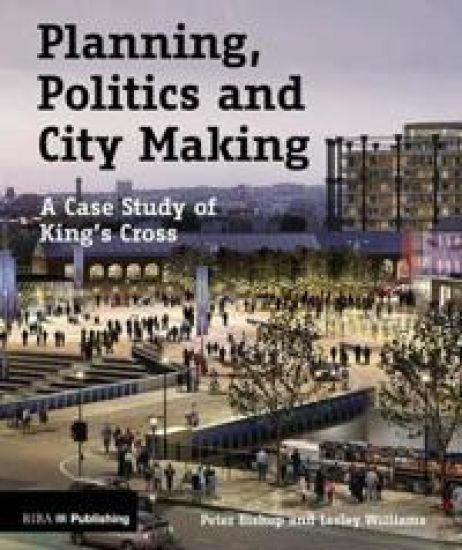
The King’s Cross scheme is one of the largest and most complex developments taking place in Britain today. Through documenting this seminal case-study, this book sheds light on the complex process through which public realm development proposals are planned and approved: through complex negotiation and deal making, involving many different stakeholders. Unique, insider’s account: draws on first-hand interviews and full access to previously confidential material from primary sources. Comprehensive look at urban planning relevant to both students and practitioners. Currently very little available on the process through which public realm schemes are planned and approved. Kings Cross is now a standing event in the teaching calendars of many planning schools. Huge international market: KX visitor centre receives delegations on study tours from Japan, Taiwan, China, USA, India, Korea, Australia, Malaysia, UAE, Russia, South Africa, Mexico and most the EU.
Most of the professional training, thinking and strategies of architects, urban designers and planners, are strictly three-dimensional. In reality of course the city is four dimensional, and one needs to acknowledge the influence of time in planning and design strategies. Similarly, there has been relatively little analysis of the importance of interim, short-term or ‘meanwhile’ activities in urban areas. In an era of increasing pressure on scarce resources, we cannot wait for long-term solutions to vacancy or dereliction. Instead, we need to view temporary uses as increasingly legitimate and important in their own right. They can be a powerful tool through which we can drip-feed initiatives for incremental change – as and when we have the resources – while being guided by a loose-fit vision. Peter Bishop and Lesley Williams explore the growing interest among practitioners at the cutting edge of architecture, urban design and regeneration, in temporary, interim, ‘pop-up’ or ‘meanwhile’ uses for land and buildings in our urban areas. They explore the origins and the social, economic and technological drivers behind this phenomenon, and its place within modern planning theory and practice. The Temporary City challenges our preoccupation with long-term strategies and masterplans and questions our ability to achieve these in the face of increasing resource constraints and political and economic uncertainty. The book includes sixty-eight diverse case studies from Europe and North America which illustrate the range of temporary use opportunities and the benefits that these can bring. This is essential reading for all those struggling to address the current problems of urban renewal in an era of great change. It offers a prism through which to view the city as a rich mosaic of time-limited, but inspiring urban interventions.
Most of the professional training, thinking and strategies of architects, urban designers and planners, are strictly three-dimensional. In reality of course the city is four dimensional, and one needs to acknowledge the influence of time in planning and design strategies. Similarly, there has been relatively little analysis of the importance of interim, short-term or ‘meanwhile’ activities in urban areas. In an era of increasing pressure on scarce resources, we cannot wait for long-term solutions to vacancy or dereliction. Instead, we need to view temporary uses as increasingly legitimate and important in their own right. They can be a powerful tool through which we can drip-feed initiatives for incremental change – as and when we have the resources – while being guided by a loose-fit vision. Peter Bishop and Lesley Williams explore the growing interest among practitioners at the cutting edge of architecture, urban design and regeneration, in temporary, interim, ‘pop-up’ or ‘meanwhile’ uses for land and buildings in our urban areas. They explore the origins and the social, economic and technological drivers behind this phenomenon, and its place within modern planning theory and practice. The Temporary City challenges our preoccupation with long-term strategies and masterplans and questions our ability to achieve these in the face of increasing resource constraints and political and economic uncertainty. The book includes sixty-eight diverse case studies from Europe and North America which illustrate the range of temporary use opportunities and the benefits that these can bring. This is essential reading for all those struggling to address the current problems of urban renewal in an era of great change. It offers a prism through which to view the city as a rich mosaic of time-limited, but inspiring urban interventions.


A history of Tranmere Rovers Football Club