Kirjojen hintavertailu – 12 903 725 kirjaa ja 27 kauppaa

Kirjailija

Peter Bofinger

Kirjat ja teokset yhdessä paikassa: 7 kirjaa, julkaisuja vuosilta 1990–2019, suosituimpiin kuuluu Kazakstan 1993 – 2000. Vertaile teosten hintoja ja tarkista saatavuus suomalaisista kirjakaupoista.

7 kirjaa

Kirjojen julkaisuvuodet: 1990–2019.

Monetary Policy

Monetary Policy

Peter Bofinger

Oxford University Press
2001
sidottu
This book provides an in-depth description and analysis of monetary policy in Europe and the United States. Unusually for a volume in the field, it focuses on actual monetary policy - targets, institutions, strategies, and instruments - but traditional and contemporary theoretical approaches to monetary policy form the basis for each chapter. Concentrating specifically on the European Central Bank, "Monetary Policy" offers one of the first comprehensive guides to understanding the targets, strategy, and instruments of the ECB. In the past, many books have presented mere descriptions of the institutional framework without providing a theoretical framework, while others have dealt mainly with theoretical aspects, thus neglecting the policy implications of their analysis. By combining a theoretical with a policy-oriented approach, Peter Bofinger succeeds in closing this gap in the monetary policy literature. As a result, his book will appeal to a broad readership, including investment bankers and other professional investors, central bankers, and scholars working in the field.

Monetary Policy

Monetary Policy

Peter Bofinger

Oxford University Press
2001
nidottu
This volume provides an in-depth description and analysis of monetary policy in Europe and the United States. Focusing specifically on the European Central Bank, it offers one of the first comprehensive guides to understanding the targets, strategy, and instruments of the ECB.
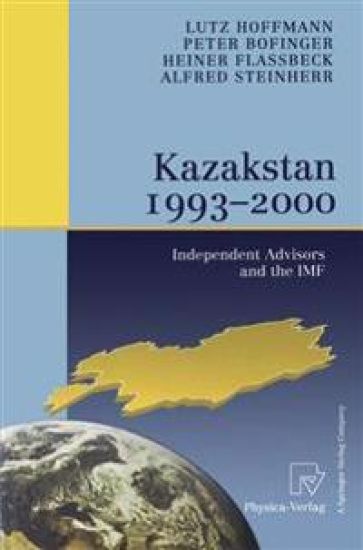
Kazakstan 1993 – 2000

Kazakstan 1993 – 2000

Lutz Hoffmann; Peter Bofinger; Heiner Flassbeck; Alfred Steinherr

Physica-Verlag GmbH Co
2000
nidottu
By introducing a new national currency in November 1993, the Republic of Kazakstan took a decisive step towards establishing its political and economic independence. In the following years, Kazakstan made great efforts to lay the institutional foundation for econonmic policy in line with a free market system. The cooperation between Kazak experts and independent international advisors such as the group of German econonmists under the leadership of Lutz Hoffmann played an important role for the Kazak government in choosing the most effective concepts and instruments for economic policy. Thus, the main topic of this book is the discussion of the macroeconomic problems during the first years of transition and the role of international financial institutions, in particular the International Monetary Fund. The topics are dealt with in a new form of presentation, collecting the papers of the advisory group in chronological order.
Der Weg zur Wirtschafts- und Währungsunion in Europa
Das Ziel, den Gemeinsamen Markt in Europa durch eine Wirtschafts- und Wahrungsunion erst wirklich zu einem Binnenmarkt zu machen, ist nicht neu. Es hat von Beginn der EG an Initiativen bei Gemeinschaftsorganen und Mit- gliedsregierungen ausgelOst. Ihnen war aber bisher kein Erfolg beschieden. In ihrem Aktionsprogramm flir die zweite Stufe der Zollunion entwickelte die Kommission der EWG bereits 1962 konkrete Vorstellungen flir eine Wah- rungsunion. Obwohl mit bemerkenswerter innerer Geldwertstabilitat und starker auSenwirtschaftlicher Position bei den damaligen "Sechs" die 6kono- mischen Voraussetzungen flir diesen Weg giinstig und die wirtschaftlichen Strukturen weitaus weniger heterogen waren als heute unter den "Zw61f', wurde die Initiative der Kommission nicht aufgegriffen. GewiS lag das Ziel der Wahrungsunion von Beginn an in der Logik des Integrationsprozesses, je- doch war die Bereitschaft, die politischen Implikationen dieses Weges hin zur Wahrungsunion zu akzeptieren, nicht gegeben. Auch schien die flir den Fort- gang des Integrationsprozesses notwendige Stabilitat der Wechselkurse zwi- schen den EWG-Wahrungen durch die Einbindung aller Mitgliedsstaaten in das damals noch funktionierende Festkurssystem von Bretton-Woods hinrei- chend gesichert zu sein. Als das Festkurssystem von Bretton-Woods Ende der sechziger Jahre ins Wanken geriet, bevor es Anfang 1973 endgiiltig zusammenbrach, war es nur folgerichtig, die Stabilitat der Wechselkurse in der EG durch gemein- schaftseigene Vorkehrungen sichern zu wollen. In diesen Zusammenhang ge- hOren die in dieser Zeit wieder auflebenden Plane flir eine Wahrungsunion. Einige Mitgliedsregierungen, darunter auch die Bundesregierung, prasen- tierten Stufenplane flir die Verwirklichung dieses ehrgeizigen Ziels.