Kirjojen hintavertailu – 12 903 725 kirjaa ja 27 kauppaa

Kirjailija

Peter Borwein

Kirjat ja teokset yhdessä paikassa: 5 kirjaa, julkaisuja vuosilta 1995–2012, suosituimpiin kuuluu Polynomials and Polynomial Inequalities. Vertaile teosten hintoja ja tarkista saatavuus suomalaisista kirjakaupoista.

5 kirjaa

Kirjojen julkaisuvuodet: 1995–2012.

Polynomials and Polynomial Inequalities

Polynomials and Polynomial Inequalities

Peter Borwein; Tamas Erdelyi

Springer-Verlag New York Inc.
2012
nidottu
Polynomials pervade mathematics, virtually every branch of mathematics from algebraic number theory and algebraic geometry to applied analysis and computer science, has a corpus of theory arising from polynomials. The material explored in this book primarily concerns polynomials as they arise in analysis; it focuses on polynomials and rational functions of a single variable. The book is self-contained and assumes at most a senior-undergraduate familiarity with real and complex analysis. After an introduction to the geometry of polynomials and a discussion of refinements of the Fundamental Theorem of Algebra, the book turns to a consideration of various special polynomials. Chebyshev and Descartes systems are then introduced, and Müntz systems and rational systems are examined in detail. Subsequent chapters discuss denseness questions and the inequalities satisfied by polynomials and rational functions. Appendices on algorithms and computational concerns, on the interpolation theorem, and on orthogonality and irrationality conclude the book.
Computational Excursions in Analysis and Number Theory

Computational Excursions in Analysis and Number Theory

Peter Borwein

Springer-Verlag New York Inc.
2010
nidottu
This book is designed for a topics course in computational number theory. It is based around a number of difficult old problems that live at the interface of analysis and number theory. Some of these problems are the following: The Integer Chebyshev Problem. Find a nonzero polynomial of degree n with integer eoeffieients that has smallest possible supremum norm on the unit interval. Littlewood's Problem. Find a polynomial of degree n with eoeffieients in the set { + 1, -I} that has smallest possible supremum norm on the unit disko The Prouhet-Tarry-Escott Problem. Find a polynomial with integer co­ effieients that is divisible by (z - l)n and has smallest possible 1 norm. (That 1 is, the sum of the absolute values of the eoeffieients is minimal.) Lehmer's Problem. Show that any monie polynomial p, p(O) i- 0, with in­ teger coefficients that is irreducible and that is not a cyclotomic polynomial has Mahler measure at least 1.1762 .... All of the above problems are at least forty years old; all are presumably very hard, certainly none are completely solved; and alllend themselves to extensive computational explorations. The techniques for tackling these problems are various and include proba­ bilistic methods, combinatorial methods, "the circle method," and Diophantine and analytic techniques. Computationally, the main tool is the LLL algorithm for finding small vectors in a lattice. The book is intended as an introduction to a diverse collection of techniques.
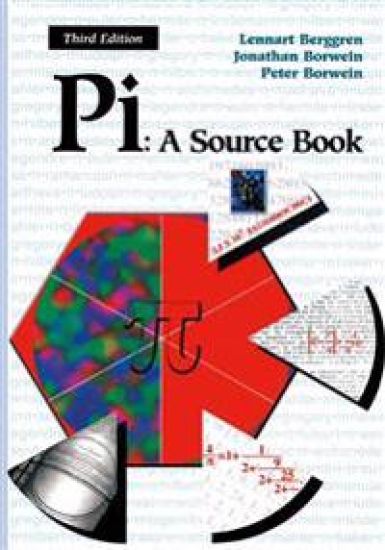
Pi: A Source Book

Pi: A Source Book

J.L. Berggren; Jonathan Borwein; Peter Borwein

Springer-Verlag New York Inc.
2004
sidottu
This book documents the history of pi from the dawn of mathematical time to the present. One of the beauties of the literature on pi is that it allows for the inclusion of very modern, yet accessible, mathematics. The articles on pi collected herein include selections from the mathematical and computational literature over four millennia, a variety of historical studies on the cultural significance of the number, and an assortment of anecdotal, fanciful, and simply amusing pieces. For this new edition, the authors have updated the original material while adding new material of historical and cultural interest. There is a substantial exposition of the recent history of the computation of digits of pi, a discussion of the normality of the distribution of the digits, new translations of works by Viete and Huygen, as well as Kaplansky's never-before-published "Song of Pi." From the reviews of earlier editions: "Few mathematics books serve a wider potential readership than does a source book and this particular one is admirably designed to cater for a broad spectrum of tastes: professional mathematicians with research interest in related subjects, historians of mathematics, teachers at all levels searching out material for individual talks and student projects, and amateurs who will find much to amuse and inform them in this leafy tome. The authors are to be congratulated on their good taste in preparing such a rich and varied banquet with which to celebrate pi."- Roger Webster for the Bulletin of the LMS "The judicious representative selection makes this a useful addition to one's library as a reference book, an enjoyable survey of developments and a source of elegant and deep mathematics of different eras."- Ed Barbeau for MathSciNet "Full of useful formulas and ideas, it is a vast source of inspiration to any mathematician, A level and upwards-a necessity in any maths library."- New Scientist
Computational Excursions in Analysis and Number Theory

Computational Excursions in Analysis and Number Theory

Peter Borwein

Springer-Verlag New York Inc.
2002
sidottu
This book is designed for a topics course in computational number theory. It is based around a number of difficult old problems that live at the interface of analysis and number theory. Some of these problems are the following: The Integer Chebyshev Problem. Find a nonzero polynomial of degree n with integer eoeffieients that has smallest possible supremum norm on the unit interval. Littlewood's Problem. Find a polynomial of degree n with eoeffieients in the set { + 1, -I} that has smallest possible supremum norm on the unit disko The Prouhet-Tarry-Escott Problem. Find a polynomial with integer co­ effieients that is divisible by (z - l)n and has smallest possible 1 norm. (That 1 is, the sum of the absolute values of the eoeffieients is minimal.) Lehmer's Problem. Show that any monie polynomial p, p(O) i- 0, with in­ teger coefficients that is irreducible and that is not a cyclotomic polynomial has Mahler measure at least 1.1762 .... All of the above problems are at least forty years old; all are presumably very hard, certainly none are completely solved; and alllend themselves to extensive computational explorations. The techniques for tackling these problems are various and include proba­ bilistic methods, combinatorial methods, "the circle method," and Diophantine and analytic techniques. Computationally, the main tool is the LLL algorithm for finding small vectors in a lattice. The book is intended as an introduction to a diverse collection of techniques.
Polynomials and Polynomial Inequalities

Polynomials and Polynomial Inequalities

Peter Borwein; Tamas Erdelyi

Springer-Verlag New York Inc.
1995
sidottu
Polynomials pervade mathematics, virtually every branch of mathematics from algebraic number theory and algebraic geometry to applied analysis and computer science, has a corpus of theory arising from polynomials. The material explored in this book primarily concerns polynomials as they arise in analysis; it focuses on polynomials and rational functions of a single variable. The book is self-contained and assumes at most a senior-undergraduate familiarity with real and complex analysis. After an introduction to the geometry of polynomials and a discussion of refinements of the Fundamental Theorem of Algebra, the book turns to a consideration of various special polynomials. Chebyshev and Descartes systems are then introduced, and Müntz systems and rational systems are examined in detail. Subsequent chapters discuss denseness questions and the inequalities satisfied by polynomials and rational functions. Appendices on algorithms and computational concerns, on the interpolation theorem, and on orthogonality and irrationality conclude the book.